


A new paper has been published in Dalton Transactions:
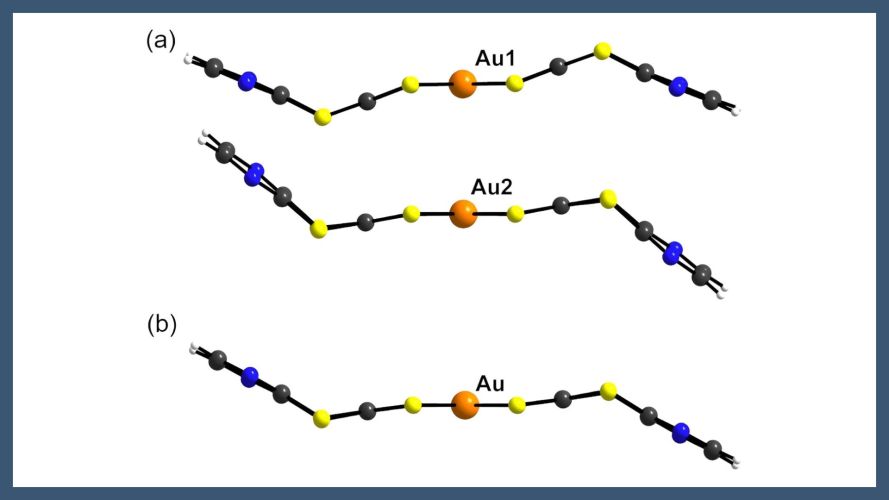
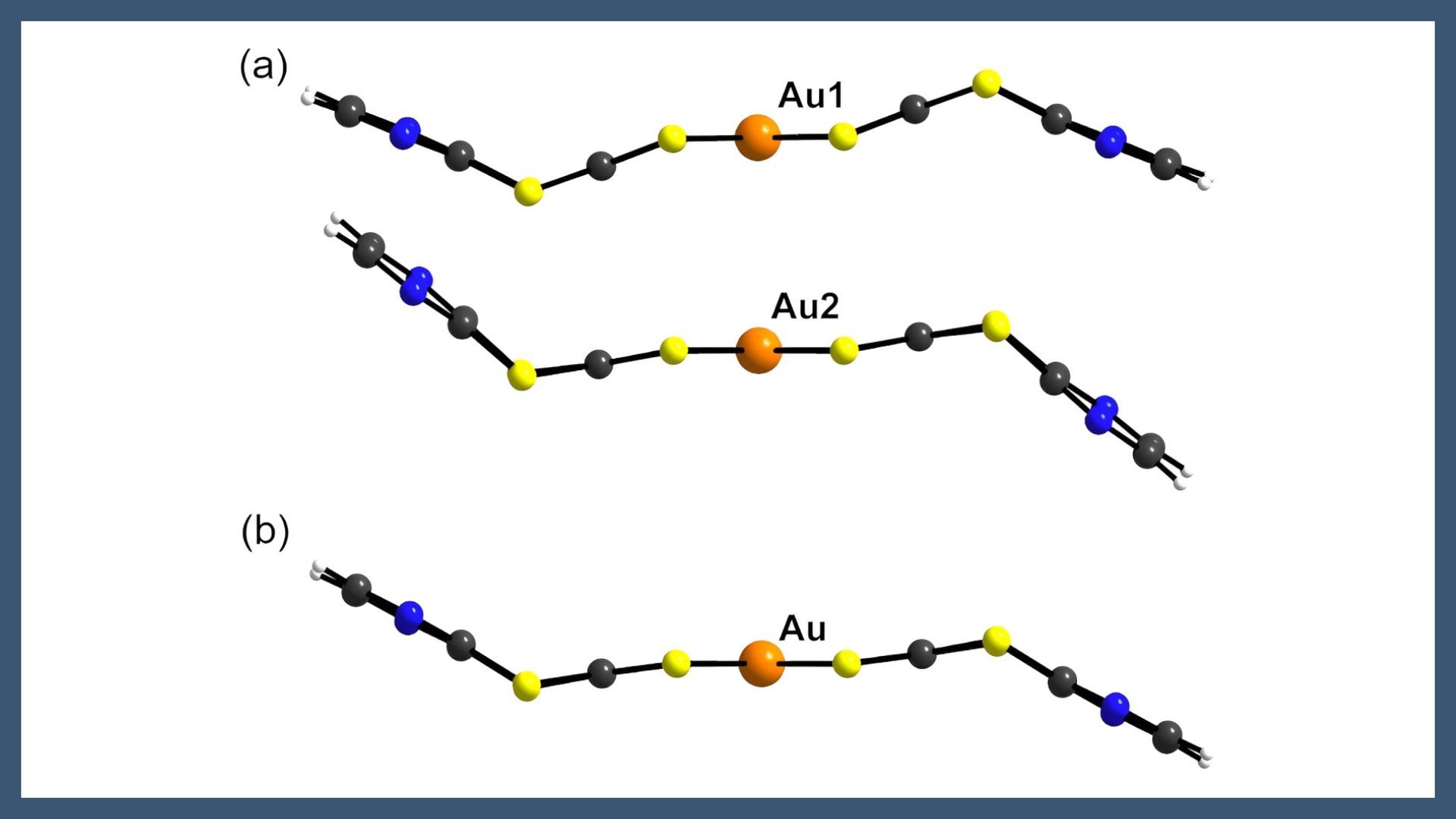
Conducting molecular materials built on dithiolene complexes, as mixed-valence salts or single component materials, are most often based on planar structures which efficiently stack on top of each other. Herein, we report an original dithiolene ligand, namely, [1,4]dithiino[2,3-b]pyrazine-2,3-bis(thiolate) (hereafter noted as pzdtdt), which combines an electron-withdrawing pyrazine ring and a folded (by 40–50°) dithiine ring. Until now, such strong distortions from planarity have been hindering the isolation of highly conducting materials from dithiine-containing dithiolene complexes. However, in this study, we showed that the gold complex radical [Au(pzdtdt)2]˙ obtained via electrocrystallization from the 1e− oxidation of [Ph4P][Au(pzdtdt)2] organized into regular, non-dimerized chains in the solid state. Interestingly, [Au(pzdtdt)2]˙ exhibited a semi-conducting behaviour at ambient pressure and turned metallic upon application of pressures above 4 GPa. The electronic structure of [Au(pzdtdt)2]˙ was investigated in terms of electron localization effects through spin-polarized band-structure calculations.
M4ELC Sustainable Electronics
Gold bis(dithiolene) radical with fused pyrazine and dithiine rings on dithiolene ligand turns metallic under pressure
Haia Kharraz, Pere Alemany, Enric Canadell, Thierry Roisnel, Hengbo Cui, Kee Hoon Kim, Marc Fourmigué & Dominique Lorcy
DOI: 10.1039/D5DT00380F

