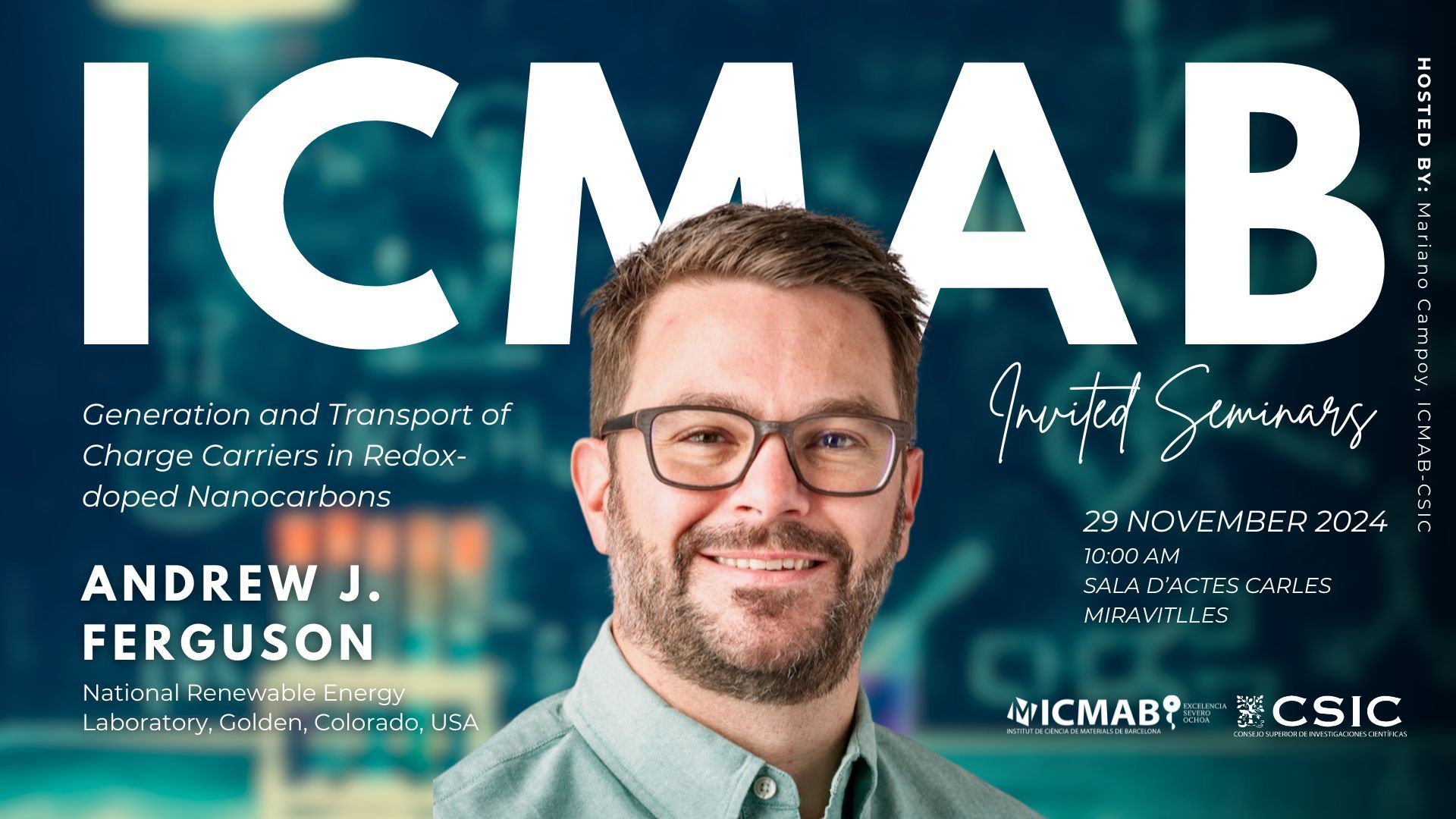
Generation and Transport of Charge Carriers in Redox-doped Nanocarbons
by Andrew J. Ferguson, National Renewable Energy Laboratory, Golden, Colorado, USA
Friday 29 November 2024, 10.00 AM
ICMAB - Sala d'Actes Carles Miravitlles
Hosted by Mariano Campoy-Quiles
Abstract
The performance of many emerging electronic and optoelectronic devices based on organic semiconductors can be fine-tuned by control of the charge carrier density injected by redox dopants. I will present several studies aimed at understanding the factors that affect the transport and thermoelectric properties of thin-film networks of enriched semiconducting single-walled carbon nanotubes (SWCNT).
We recently showed that the chemical structure (size, shape, and redox properties) of the dopant counterion has a significant influence on the electrostatic interactions with the charge carrier injected into the organic semiconductor, which affects charge (de)localization and transport, and can be exploited to enhance the thermoelectric properties of SWCNT networks. I will conclude by outlining several spectroscopic studies aimed at gaining a more detailed understanding of the counterion-charge interactions in an array of organic and nanocarbon semiconductors, and will compare and contrast charge carrier transport in thin films of conjugated polymers (CPs), graphene nanoribbons (GNRs), and SWCNTs.
Short bio
Andrew Ferguson received his Ph.D. in Physical Chemistry from Imperial College, United Kingdom before joining the National Renewable Energy Laboratory (NREL) for a postdoctoral appointment. He is currently a Distinguished Member of the NREL Research Staff and a Group Leader for Spectroscopy & Photoscience in the Chemistry & Nanoscience Center.
His primary research interests focus on light-matter interactions and developing an understanding of exciton, carrier, and heat transport in organic, inorganic, and nanoscale material systems. He is also working on the integration of these materials into novel energy harvesting and conversion technologies.