


A new paper has been published in Nanoscale Advances:
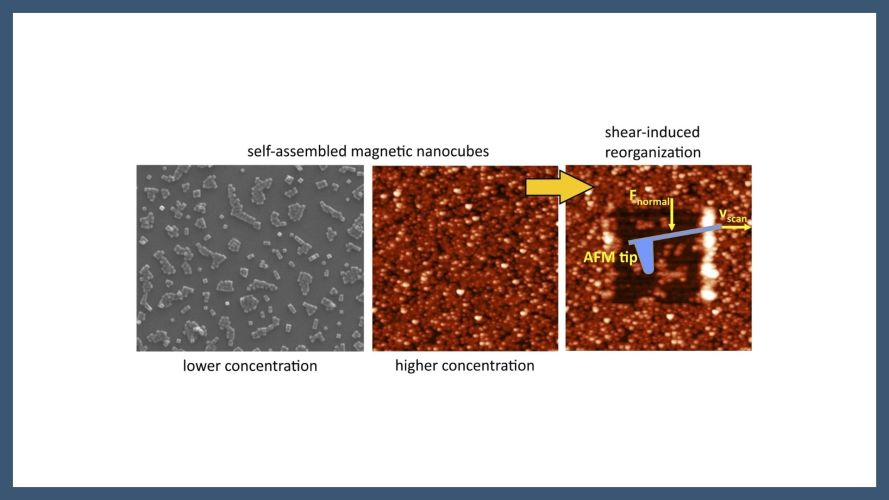
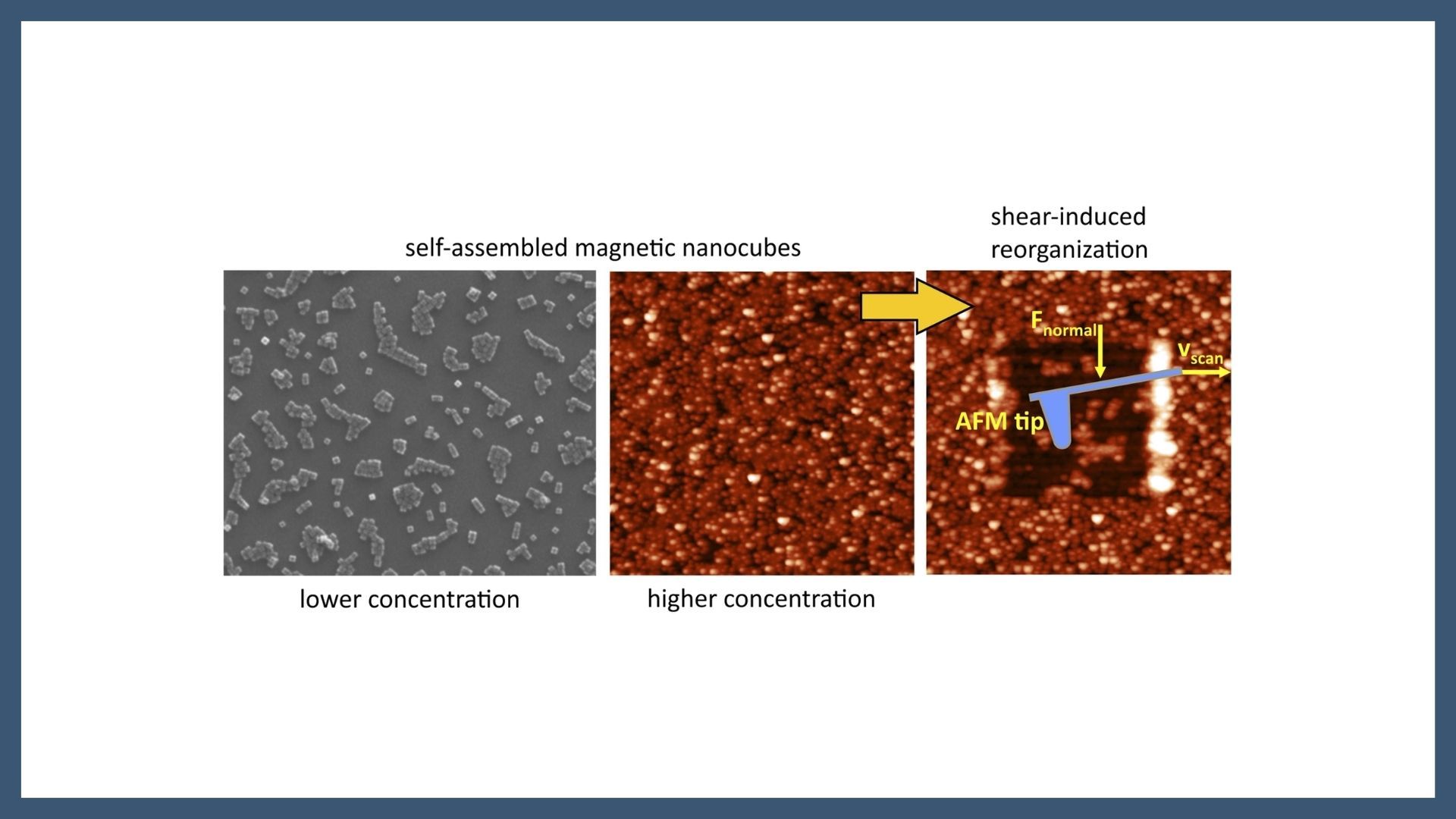
We report an experimental study on the self-assembly and atomic force microscopy (AFM) manipulation of ligand-free Fe/Fe3O4 nanocubes synthesized via a gas aggregation cluster source, a method that eliminates steric and capillary effects typical of wet-chemistry routes. This approach isolates magnetic dipolar and surface forces as the primary drivers of cluster formation. Sub-20 nm nanocubes spontaneously organize into close-packed two-dimensional arrays with dominant {100}–{100} contacts, exhibiting a preferential [001] magnetic easy axis consistent with Fe-core-driven anisotropy. AFM manipulation reveals elastic-like responses in monolayers, strong shape persistence of compact clusters, and shear-induced reorganization into short chains with defined orientations. Mobility is strongly layer-dependent, with multilayers requiring significantly higher loads to initiate motion. By mapping local lateral-force peaks during manipulation and estimating the relevant force scales, it is shown that magnetic dipolar interactions act together with van der Waals attraction and frictional dissipation to restrict particle motion. These findings contribute to a better understanding of self-assembly and shear-assisting assembly of magnetic nanoparticles and suggest that magnetic nanocubes may serve as versatile building blocks for two- and three-dimensional magnetic architectures.
M4ELC Sustainable Electronics
Evidence of dipolar magnetic interactions in the self-assembly of two-dimensional magnetic nanocubes
Vasic, Borislav; Balcells, Lluis; Mestres, Narcis; Martinez, Benjamin; Pomar, Alberto; Konstantinovic, Zorica
DOI: 10.1039/d6na00067c

