


A new paper has been published in the journal Physical Review B:
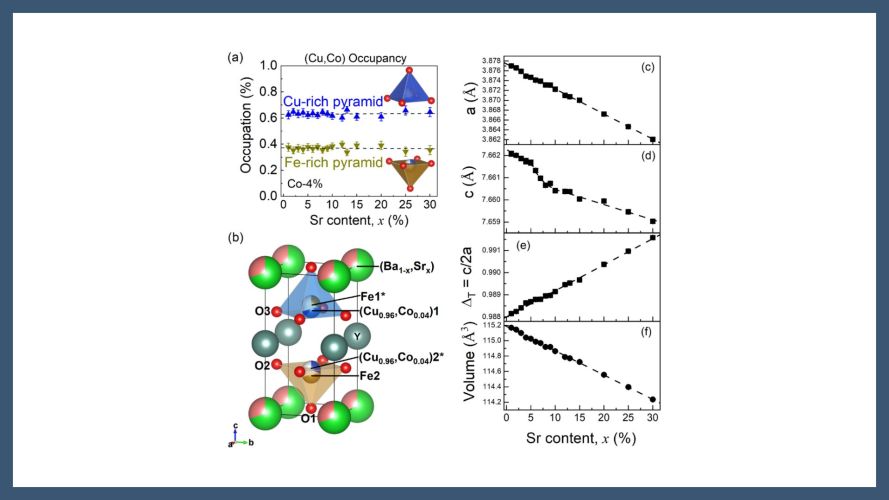
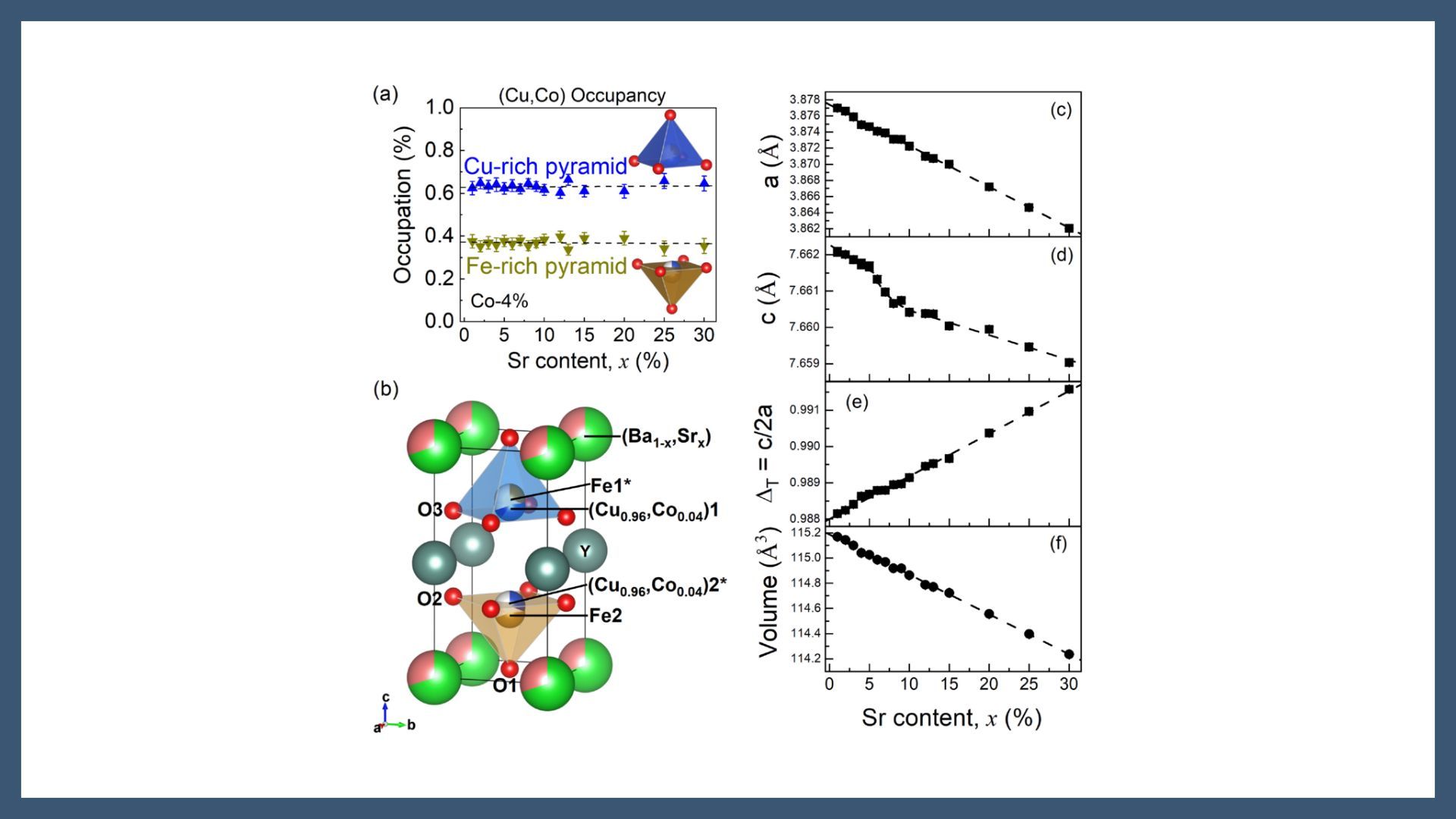
YBaCuFeO5 and related compounds can sustain chiral magnetic order up to unexpectedly high temperatures. The underlying mechanism, governed by cation disorder, offers a promising route for the development of magnetoelectric spirals operable at ambient temperature. In addition, some chemical substitutions at the A or B sites allow upgrading the spiral stability and reducing significantly the required level of cation disorder in these layered perovskites. In this work, we have addressed the effects of simultaneous divalent substitution at the A and B sites, in Y(Ba,Sr)(Cu,Co)FeO5 samples synthesized with the same level of Fe/Cu disorder. This strategy combines the chemical pressure induced by the smaller A-site Sr ions with the reduced uniaxial elongation in the Cu pyramids induced by Co substitution. By enhancing frustration through chemical pressure, we investigated the evolution of the spiral order and its stability relative to other competing magnetic phases. Three distinct regions were identified as a function of Sr content, demonstrating a pronounced interplay between A- and B-site substitutions that substantially alters the phase diagrams obtained for single-site doping. In low-disorder Y(Ba1-xSrx)(Cu0,96Co0,04)FeO5, TS1 approximately 300K for x lower or equal than 5%. At higher Sr concentrations, TS1 decreases and the spiral order eventually disappears abruptly for x higher than 10%.
M4ELC Sustainable Electronics
Effects of 𝐴- and 𝐵-site codoping in layered YBaCuFeO5 type perovskites with high-𝑇𝑆 magnetic spirals
Li, Ruyong; Keller, Lukas; Fauth, Francois; Orench, Ines Puente; Garcia-Munoz, Jose Luis
DOI: 10.1103/2b8m-1sgp

