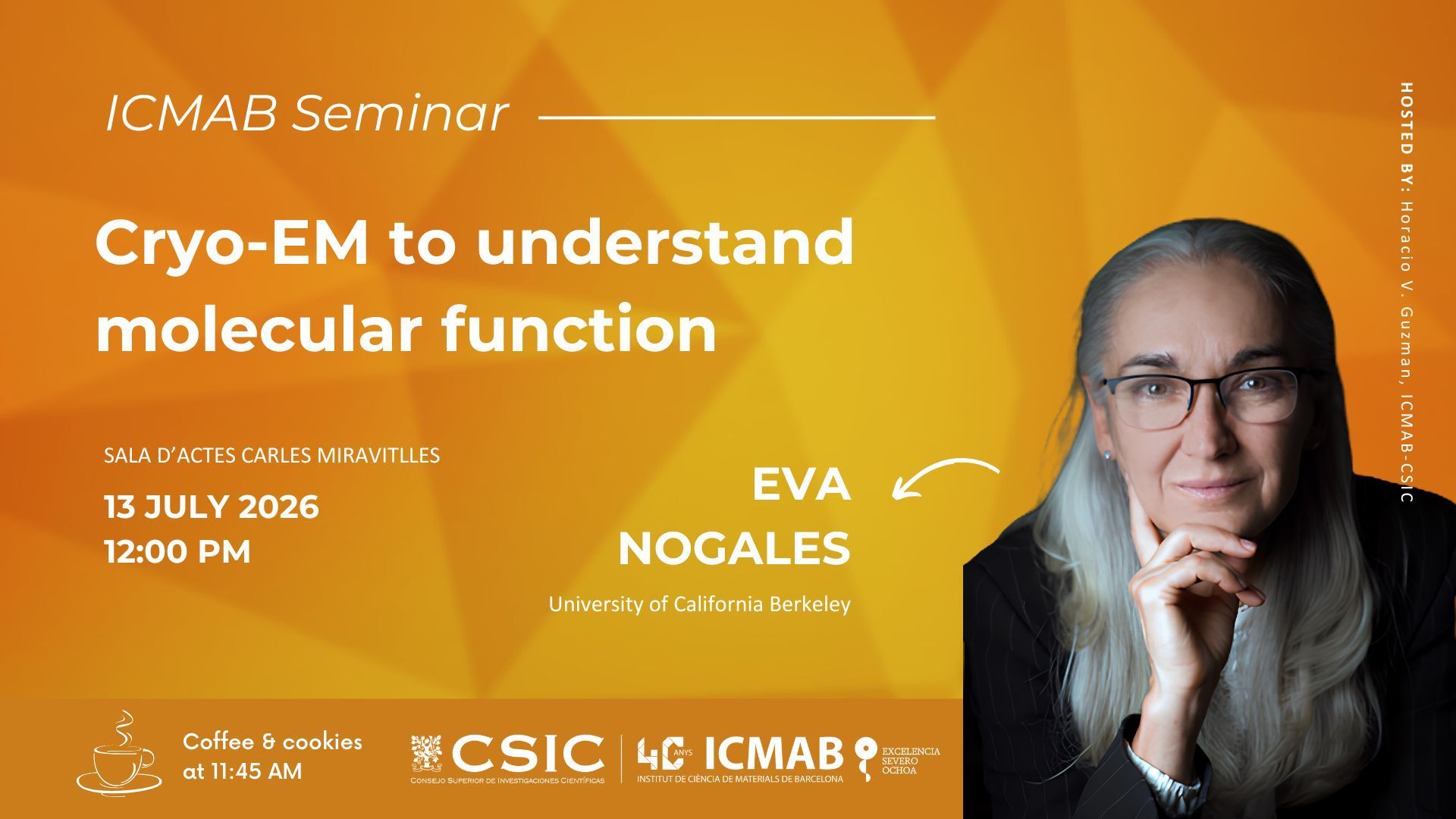
Cryo-EM to understand molecular function
Eva Nogales, University of California, US
Monday, 13 July 2026, 12.00 PM
ICMAB - Sala d'Actes Carles Miravitlles and ONLINE (Register here)
Abstract
Cryo-electron microscopy (cryo-EM) is a powerful technique for the structural analysis of samples that challenge other methods, such as large protein complexes involved in the regulation of gene expression, or cytoskeletal polymers engaged with associated factors. My lab has used cryo-EM to study both.
Microtubules are essential cytoskeletal polymers that are regulated by a myriad of microtubule associated proteins (MAPs) and serve as freeways for motor proteins. Interestingly, there is a complex interplay between MAPs and motors on the microtubule surface. We are characterizing the competition, coexistence, or regulatory interactions between these factors, with important repercussions for our understanding of microtubule-base cellular transport.
Polycomb repressive complex 2 (PRC2) is an epigenetic regulator responsible for the trimethylation of histone H3 at lysine 27 that leads to the silencing of key genes, an essential process for both embryonic development and the maintenance of cell identity. PRC2 function is regulated by its association with various accessory proteins and its recognition of different histone posttranslational modifications. We have used cryo-EM to shed light into the different molecular mechanisms that regulate the activity of PRC2.
Short bio
Nogales earned her degree in physics from the Autonomous University of Madrid and obtained her doctorate in biophysics from Keele University in the United Kingdom. She is presently a Distinguished Professor in Biochemistry, Biophysics and Structural Biology at the University of California, Berkeley, a Howard Hughes Medical Institute investigator, and senior scientist at the Lawrence Berkeley National Laboratory.
Nogales is interested in defining the molecular bases of cellular activity by describing, using cryo-EM, the structure, dynamics and interactions of cellular components essential for eukaryotic life. During her postdoctoral studies with Ken Downing, Nogales obtained the first structure of tubulin using electron crystallography. Her laboratory at UC Berkeley has since visualized microtubules to define the structural bases of microtubule dynamic instability and how it is affected by Taxol and other drugs with anti-proliferative properties. It has also described the interaction of microtubules with associated proteins that regulate their function in the cell, including kinetochore complexes that connect microtubules in the mitotic spindle to chromosomes during cell division.
In a parallel line of work, her laboratory has visualized the structures of the molecular machinery responsible for regulating gene expression, describing for the first time, how the transcription start site is identified by TFIID, and how it is followed by the assembly of the pre-initiation complex that recruits RNA polymerase II and opens the transcription bubble. Her lab has also described the structure of co-transcriptional activators that act on chromatin and visualized the epigenetic silencer polycomb repressive complex 2 (PRC2), describing how it binds to nucleosomes and is activated or repressed to regulate its function.
Eva Nogales has received awards from scientific societies in the United States, including Microscopy (MSA), Biophysics (BPS), Cell Biology (ASCB), Biochemistry and Molecular Biology (ASBMB) and the Protein Societies. Eva Nogales is an elected member of the American Association for the Advancement of Science (AAAS), the National Academy of Sciences (NAS), the American Academy of Arts and Sciences (AAAS), and a foreign member of the European Molecular Biology Organization (EMBO) and the Royal Academy of Exact Sciences of Spain. In 2019 she received the Grimwade Medal from the University of Melbourne, in 2020 she was president of the American Society for Cell Biology, in 2023 she received the Shaw Prize in Life Sciences and Medicine, in 2024 she received the CSIC Medal for Extraordinary Scientific Merit, the highest honor awarded by the National Science Council of Spain, and in 2025 she became a Foreign Member of the Royal Society.
Hosted by Horacio V. Guzmán, from the MST group (Materials for Health Research Line)
>>If you want to meet the speaker, please contact the host at This email address is being protected from spambots. You need JavaScript enabled to view it..