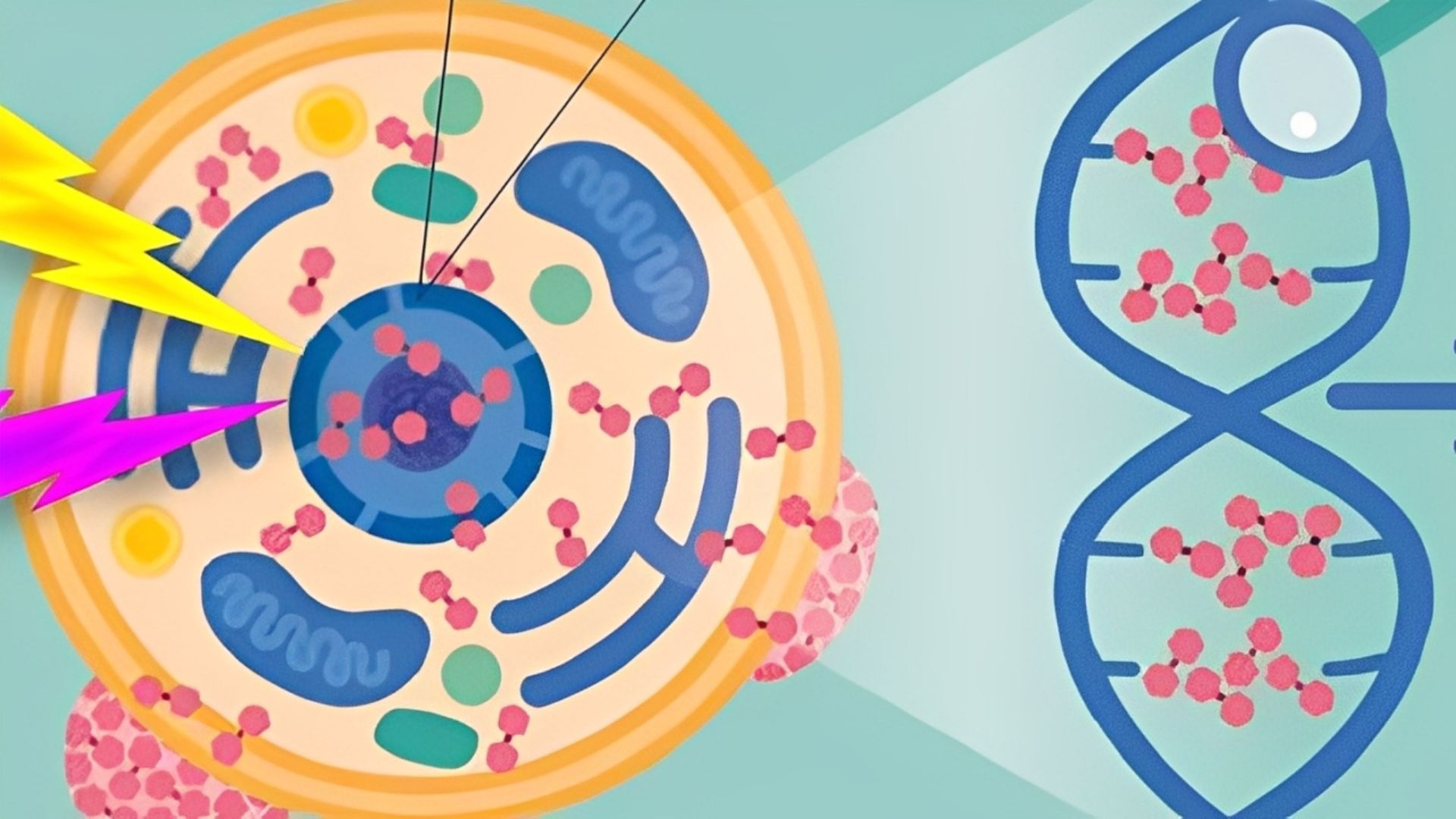
Two new studies led by researchers at the Institute of Materials Science of Barcelona (ICMAB‑CSIC) reveal why a particular boron‑rich molecule, called o‑FESAN, behaves in an unusually helpful way, remaining intercalated into DNA even though it was thought it should be repelled by it.
Boron is an element with a key role in the future of radiotherapy, mainly through two techniques: Boron Neutron Capture Therapy (BNCT) and Proton Boron Fusion Therapy (PBFT). In a nutshell, they both work by sending boron-enriched compounds into the tumour and “bombarding” them with particles (neutrons or protons), causing tiny nuclear-reaction explosions that selectively destroy cancer cells. However, the big challenge is sending these particles only where we want them, and nowhere else. And that is what these teams, both led by ICMAB researcher Clara Viñas, have been working on.
“We have mainly studied two molecules: o-COSAN and o-FESAN”, says Viñas, “the former contains cobalt, whereas the latter incorporates iron instead”. Both are closely related 8-shaped structures, consisting of two boron–carbon clusters surrounded by a hydrogen shell and linked at the centre by either iron or cobalt. These structures have a negative charge, so they should repel each other… but instead, they associate.
The team investigated one of these structures, specifically o-FESAN, to understand why two of them tend to associate. They found that the outer hydrogen layers form many weak bonds (called dihydrogen bonds), but the large number of them compensates for the charge repulsion. It is a similar effect to that of Velcro, which keeps two parts together from being pulled apart by opposing forces.
This discovery led them to another question that could have a big impact on cancer therapies: given that DNA also has a negative charge, can o-FESAN stick to it, too? “In every anticancer drug, intercalation with DNA is a key mechanism”, says Viñas. Indeed, they found that o-FESAN intercalates with DNA: “That means, the damage it can generate to the cell is very big.”
How does o-FESAN help fight cancer?
o-FESAN intercalates into DNA molecules like a zipper, and it does so without provoking immediate toxicity or damage to the nucleic acid and the cells. That means it could be transported to the tumours without damaging anything else before activating those clusters with radiotherapy.
When Viñas’ team began this line of research several years ago, their goal was to apply it to BNCT. However, “BNCT relies on boron-10, an isotope that accounts for only about 20% of naturally occurring boron, while the remaining 80% consists of boron-11.” In contrast, PBFT targets the latter isotope. For that reason, the team is now working to combine both approaches, aiming to exploit the full boron content delivered to tumours.
“But it is not all”, points Clara Viñas: when iron is incorporated into o‑FESAN, the iron‑57 isotope can be activated by highly specific gamma radiation, opening the door to an additional therapeutic mechanism based on the Mössbauer effect. This excites the atom and ejects electrons, producing a very short-range damaging effect.
As Viñas puts it: “This breakthrough achieves the same therapeutic effect with far smaller doses of compound and radiation, drastically reducing side effects and giving patients a safer, healthier, and more hopeful future.”
o-FESAN, a promising, multimodal molecule for cancer therapy
Clara Viñas, regarding the potential use of o-FESAN in future radiotherapies, declared:
“o-FESAN stands out as a promising candidate for multimodal cancer therapy. o-FESAN rapidly crosses cell membranes without the need for a carrier and accumulates in the nucleus, where it intercalates with ds-DNA by means of hydrogen (C-H···O, C-H···N) and dihydrogen (H···H) bonds into its pair bases.
Its chemical composition, including iron and significant amounts of 11B and 10B, renders it active under irradiation with three different modalities: BNCT, PBFT, and Mössbauer irradiation. While we have investigated the effects of each irradiation separately, if all equipment were available in the same facility, cells could be exposed successively to each source in a single workflow.”
>> Download here the press release in CAT, ESP, and ENG.
Reference Articles
Compelling DNA intercalation through ‘anion–anion’ anti-coulombic interactions: boron cluster self-vehicles as promising anticancer agents
Gutiérrez-Gálvez, L., García-Mendiola, T., Lorenzo, E., Nuez-Martinez, M., Ocal, C., Yan, S., Teixidor, F., Pinheiro, T., Marques, F., & Viñas, C.
Journal Of Materials Chemistry B, 2024
DOI: 10.1039/d4tb01177e
Stabilizing Anion–Anion Aggregates via Dihydrogen Bonds in Non‐Classical Inorganic Molecules
Zaulet, A., Nuez‐Martinez, M., Hirva, P., Sillanpää, R., Teixidor, F., & Viñas, C.
Aggregate, 2026
DOI: 10.1002/agt2.70228
More news