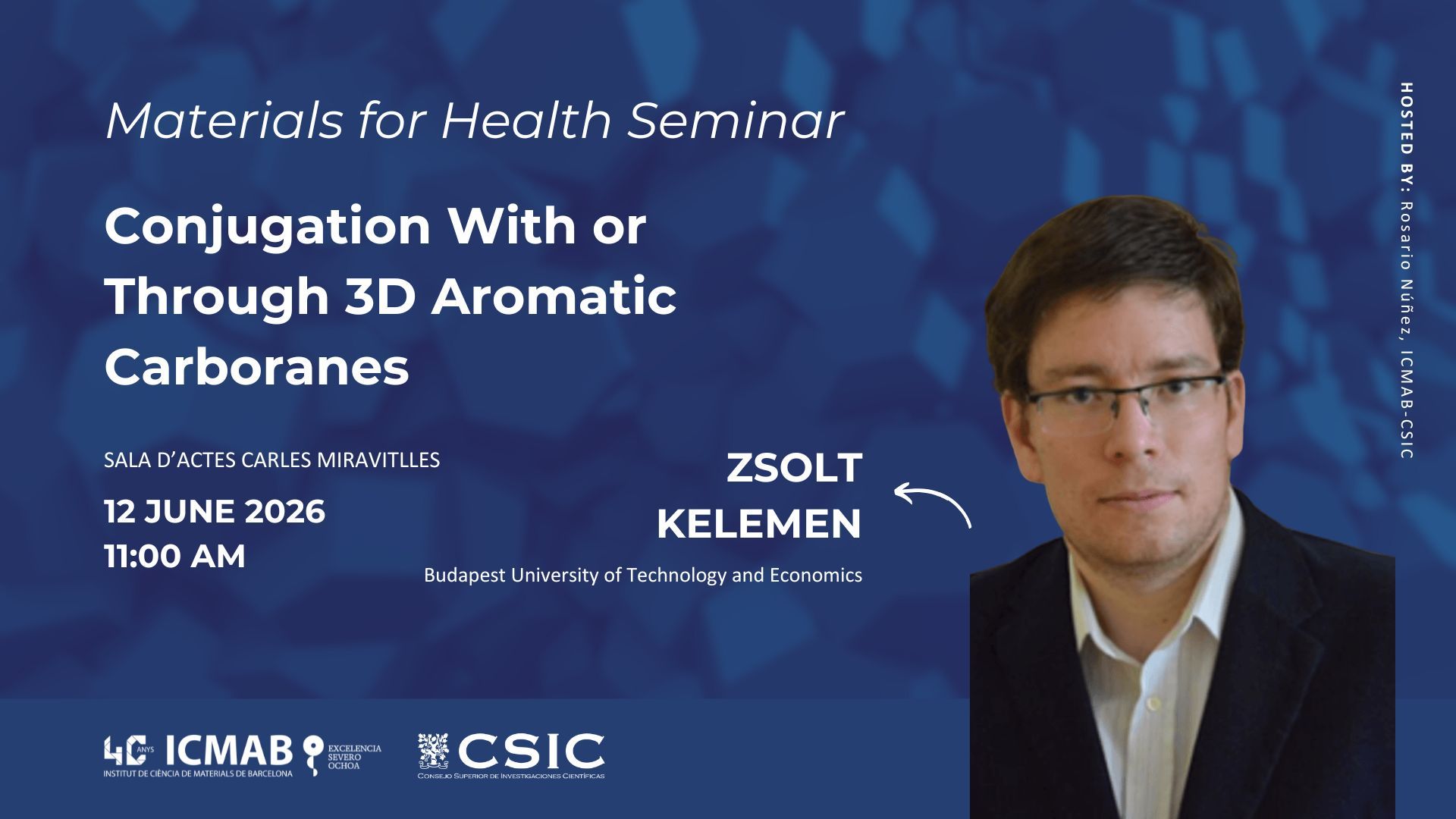
Conjugation With or Through 3D Aromatic Carboranes
Zsolt Kelemen, Budapest University of Technology and Economics
Friday, 12 June 2026, 11.00 AM
ICMAB - Sala d'Actes Carles Miravitlles
Abstract
The potential aromatic conjugation between 3D and 2D aromatic units has been a topic of interest since the synthesis of benzocarborane. It has been demonstrated that in 3D aromatic icosahedral 1,2-dicarba-closo-dodecaborane systems fused with 2D aromatic rings, a global 3D/2D aromaticity does not exist. Nevertheless, in recent years, several studies have suggested interactions between 2D and 3D aromatic moieties. Therefore, we have computationally studied various systems, focusing on different aromatic descriptors. However, there are several pitfalls that may lead to an overestimation of the 2D aromatic character of these compounds. The magnetic field of the carborane has a significant impact over a large radius around the cluster and it can be solely responsible for distinguishing between the nuclear independent chemicals shift values, which were widely used for estimation of aromatic character. Moreover, ring strain depends on the type of the cluster, strongly influencing the overall stability of these systems, which may attributed to their global aromatic characters. Certain conjugative properties can be attributed to the well-known effect of negative hyperconjugation, which is rather a local effect.
Extending these insights, we explore boron-substituted carboranes, which remain significantly less studied than carbon-substituted analogues due to synthetic challenges associated with boron functionalization. While previous studies have highlighted the fundamental differences between boron and carbon-substituted carboranes, our work demonstrates that boron-substituted carboranes can exhibit advantages comparable to those of their carbon analogues. We show that negative hyperconjugation enables the elongation of B–B bonds, allowing precise modulation of bond lengths. Furthermore, when functionalized with fluorophores at the boron vertices, these compounds display aggregation-induced emission (AIE), a property previously considered exclusive to carbon-substituted carboranes.
Short bio
Zsolt Kelemen is an associate professor at the Department of Analytical and Inorganic Chemistry, Faculty of Chemical Technology and Biotechnology, Budapest University of Technology and Economics (Hungary). Since 2025, he also served as Vice Dean for Scientific Affairs and International Relations at the same faculty. He graduated in chemistry at the same department in 2015. After receiving his PhD, he spent his postdoctoral period first in Germany and then in Barcelona (Spain) as a Marie Skłodowska-Curie individual fellow (with Clara Vinas 2017–2019). His research interests include inorganic chemistry, organometallic chemistry and applied quantum chemistry. His research group’s main activities focus on synthesizing new carborane- and ferrocene-based compounds and exploring their potential applications across different fields. He published more than 80 research articles in peer-reviewed international journals and received more than 800 independent citations. He received several prestigious grants and fellowships such as the Youth Award of the Hungarian Academy of Sciences (2023). He has been involved in several national and international research projects during the last years: Momentum Grant (2025-2030), Central Europe Leuven Strategic Alliance (2022–2024), Hungarian-Germen research exchange programme (2021–2022). He is married with two children, Levente (2020) and Csenge (2022)."
Hosted by Rosario Núñez, from the LMI group (Materials for Health Research Line)
>>If you want to meet the speaker, please contact the host at This email address is being protected from spambots. You need JavaScript enabled to view it.