


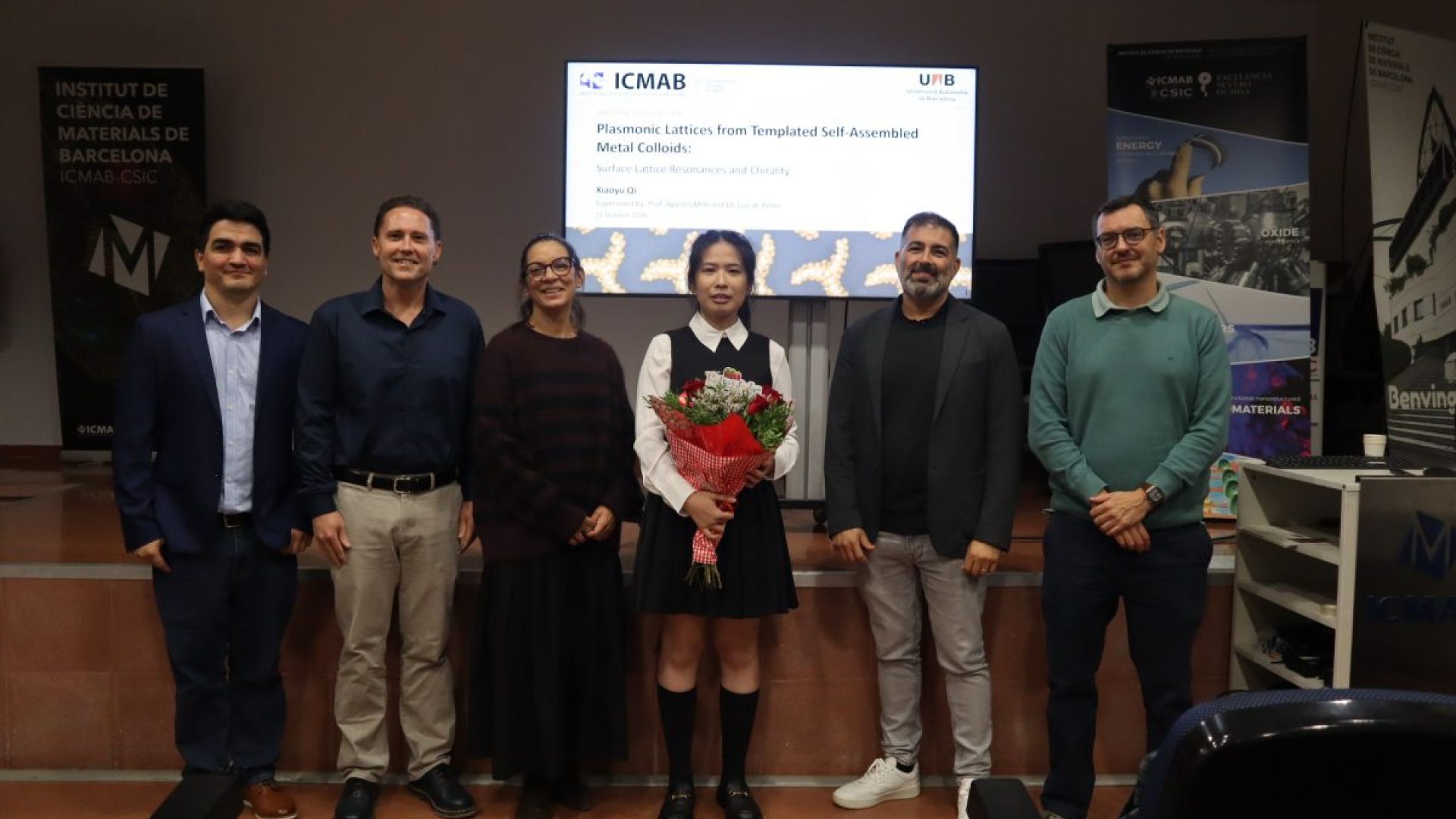
What was the focus of your PhD research? Can you explain it to a non-scientific audience?
My PhD research focused on plasmonic nanostructures and how we can control their interaction with light. I developed a template-assisted self-assembly method to organize nanoparticles into ordered arrays and studied their optical and chiral properties.
Can you briefly summarize the main findings or contributions of your research? You can give us some examples.
I developed a simple approach to assemble nanoparticles into highly ordered plasmonic arrays. This allowed us to obtain sharp surface lattice resonances with high Q factors, and we also explored their potential for refractive-index sensing and chiroptical applications.
Why do you think your research is important, and how could it impact your field or society?
By controlling how nanoparticles are organized, we can better control their optical properties. This could be useful for developing more sensitive optical sensors and new photonic materials.
What was one of the most challenging aspects of your PhD journey, and how did you overcome it?
One of the biggest challenges was dealing with experiments that did not always work as expected. I learned to be more patient and systematic, and to see failed experiments as opportunities to understand the system better.
Why did you end up at ICMAB? And what do you think you will miss the most from this institute?
I came to ICMAB because I wanted to work in an international research environment and develop my experience in nanomaterials and nanophotonics. I will miss the people the most, discussions, coffee breaks, and the everyday life in the lab.
What’s next for you after completing your PhD? Do you have any upcoming projects or goals?
After completing my PhD, I would like to continue my research in nanophotonics and explore new ideas beyond my current work. I hope to gain experience in a different research environment, learn new techniques, and keep developing as a researcher.
How has completing this PhD changed you, either professionally or personally?
The PhD has made me more independent, patient and confident. I learned not only how to do research, but also how to deal with uncertainty, solve problems, and keep going when things become difficult.
What advice would you give to someone just starting their PhD journey?
Take the time to build a strong foundation in the basic knowledge from the very beginning, because it will make everything easier later.
Why did you become a scientist? Which have been your role models that inspired you to pursue a PhD?
I became a scientist because I have always been curious about how things work and enjoy finding answers to questions. My supervisors and the researchers I have worked with have been important role models throughout my academic journey.
Who or what helped you the most during your PhD journey, and is there anyone you'd like to thank?
My supervisors, colleagues, friends, and family all played an important role in my PhD journey. I am especially grateful to my supervisors and colleagues at ICMAB for their support, guidance, and help throughout these years.
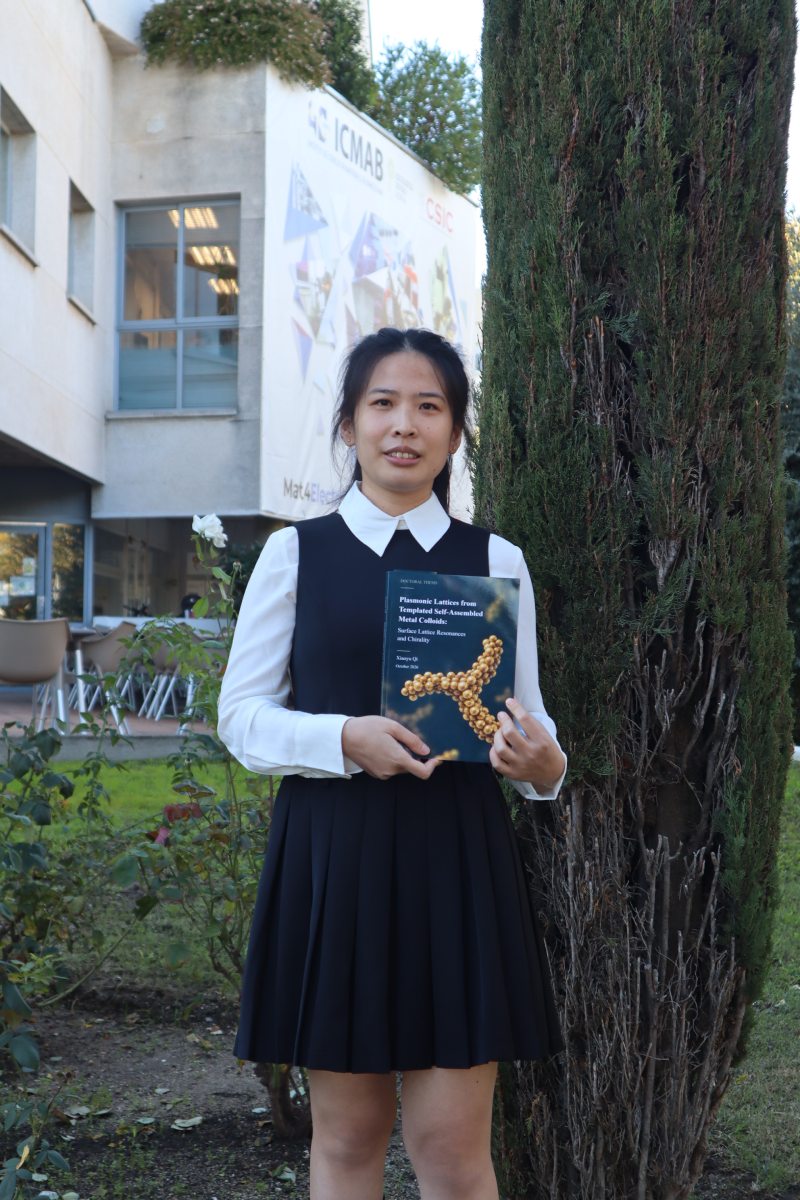
Xiaoyu Qi at the ICMAB garden on the day of her thesis | ICMAB-CSIC
Abstract
This thesis develops a template-assisted self-assembly strategy for fabricating large-area plasmonic nanoparticle lattices from chemically synthesized metal colloids. The resulting periodic structures support high-Q surface lattice resonances through the coherent coupling between localized surface plasmon resonances and diffractive lattice modes. By incorporating chiral triskelion motifs, symmetry engineering is further used to achieve tunable chiroptical responses with enhanced absorption dissymmetry factors. The plasmonic platforms are also functionalized for reversible refractive-index sensing, resonance-enhanced circularly polarized photoluminescence, and structural stabilization by atomic layer deposition. Overall, this work establishes self-assembled plasmonic nanoparticle lattices as a scalable platform for multifunctional nanophotonic applications.
Supervisors
- Agustín Mihi, ICMAB-CSIC
- Luis A. Pérez, ICMAB-CSIC
- Maria Isabel Alonso, ICMAB-CSIC
PhD committee
- President: Neus Gómez, ICN2, Spain
- Secretary: Pablo Guardia, ICMAB-CSIC, Spain
- Vocal: Justin Zoppe, UPC, Spain
Read more
ICMAB - Xiaoyu Qi will defend her PhD thesis on 21 October 2026
