


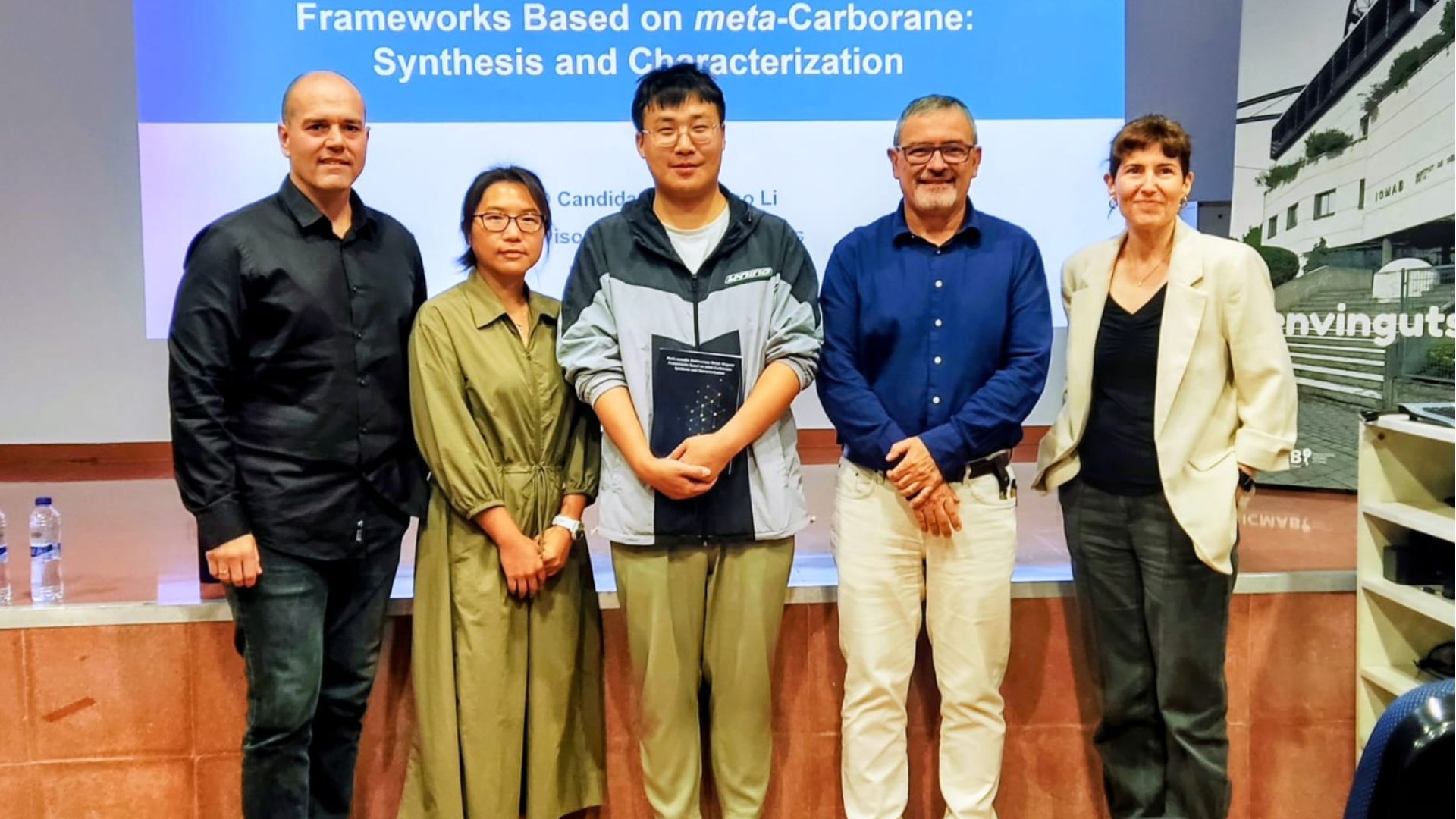
What was the focus of your PhD research? Can you explain it to a non-scientific audience?
During my PhD studies, my research focuses on the synthesis of multivariate metal-organic frameworks (MTV-MOFs) and how to change the multivariable sequences. Generally speaking, MOFs are stated as a class of crystalline materials assembled from metal ions or clusters and organic linkers in a “building block” approach. Every year, a large number of MOF structures are developed. Many reports indicate the necessity to create new MOFs due to specific demands, which makes the things complex and time-consuming. However, a promising approach is to create MTV-MOFs by introducing multivariables (different metals or ligands) within a single structure. So, you can imagine this MOF as a Rubik's Cube, where blocks with different colors represent distinct multivariable units. Clearly, the same-colored block can be arranged in different ways within the cube. That is, these multivariables induce “sequence” variations within the MOF structure, creating heterogeneous environments that in turn lead to performance changes.
Can you briefly summarize the main findings or contributions of your research? You can give us some examples.
First, we introduced up to eight rare-earth (RE) elements into a RE MTV-MOF. thanks to the presence of Carborane-based ligand, they can be distributed evenly throughout the structure. Compared to previous reports on rare-earth MOFs, which typically incorporate two or three metals, our work is remarkable.
Second, we also explored how to introduce different metal orders within the same structure by utilizing the same two multivalents. This approach has not been reported elsewhere, and we are the first to propose it.
Why do you think your research is important, and how could it impact your field or society?
I think that, overall, MTV-MOFs represent an inevitable progression in the vertical development of simple MOFs. Building upon existing MOF structures to generate MTV-MOFs for new properties is both cost-effective and time-efficient. Recently, the Nobel Prize in Chemistry was awarded to the field of MOFs, affirming their significant status in scientific history. This also signals that MOFs are highly likely to enter industrial and domestic applications in the future, and the synthesis and sequence alteration of MTV-MOFs will become key focuses in this development.
What was one of the most challenging aspects of your PhD journey, and how did you overcome it?
In our study of metallic sequence, we discovered that two MOFs with identical topological structures exhibit distinct metallic sequences. However, what are their sequences in both MOF? This was a big challenge in our research. Luckily, we ultimately found a way to determine the relevant sequence through magnetic properties and computational simulations.
Why did you end up at ICMAB? And what do you think you will miss the most from this institute?
ICMAB possesses a strong scientific research capability and is an international research institute that brings together passionate researchers from around the world. They are enthusiastic, patient, and flexible in their thinking, constantly influencing and inspiring me in advertently.
What’s next for you after completing your PhD? Do you have any upcoming projects or goals?
I am going to take some time off to rest first, and then look for a job in the field.
How has completing this PhD changed you, either professionally or personally?
After completing my doctoral degree, I believe my way of thinking about things has changed a lot, and this change makes me more confident about the future.
What advice would you give to someone just starting their PhD journey?
I think, firstly, it's essential to read a lot of professional literature, as this can help spark your creativity. Additionally, you should often discuss with your supervisor, as they possess extensive experience and can help you avoid unnecessary obstacles.
Why did you become a scientist? Which have been your role models that inspired you to pursue a PhD?
In the process of scientific research, I relish the sense of accomplishment that reveals rules through experimental or theoretical verification. Particularly in the field of materials science, scientific research not only expands the boundaries of human knowledge but also provides practical solutions for sustainable development—this makes me feel that my work has long-term significance.
Who or what helped you the most during your PhD journey, and is there anyone you'd like to thank?
During my PhD studies, I think my supervisor, Dr José Giner Planas, provided me with great support. Since my prior research was not in metal-organic frameworks, I had limited knowledge of this field. It was he who guided me into this area, and his expertise and patience gave me huge confidence. Of course, I am also deeply grateful to the other professors and colleagues in my research group as well as friends in other groups, who offered me a lot of care and assistance whenever needed.
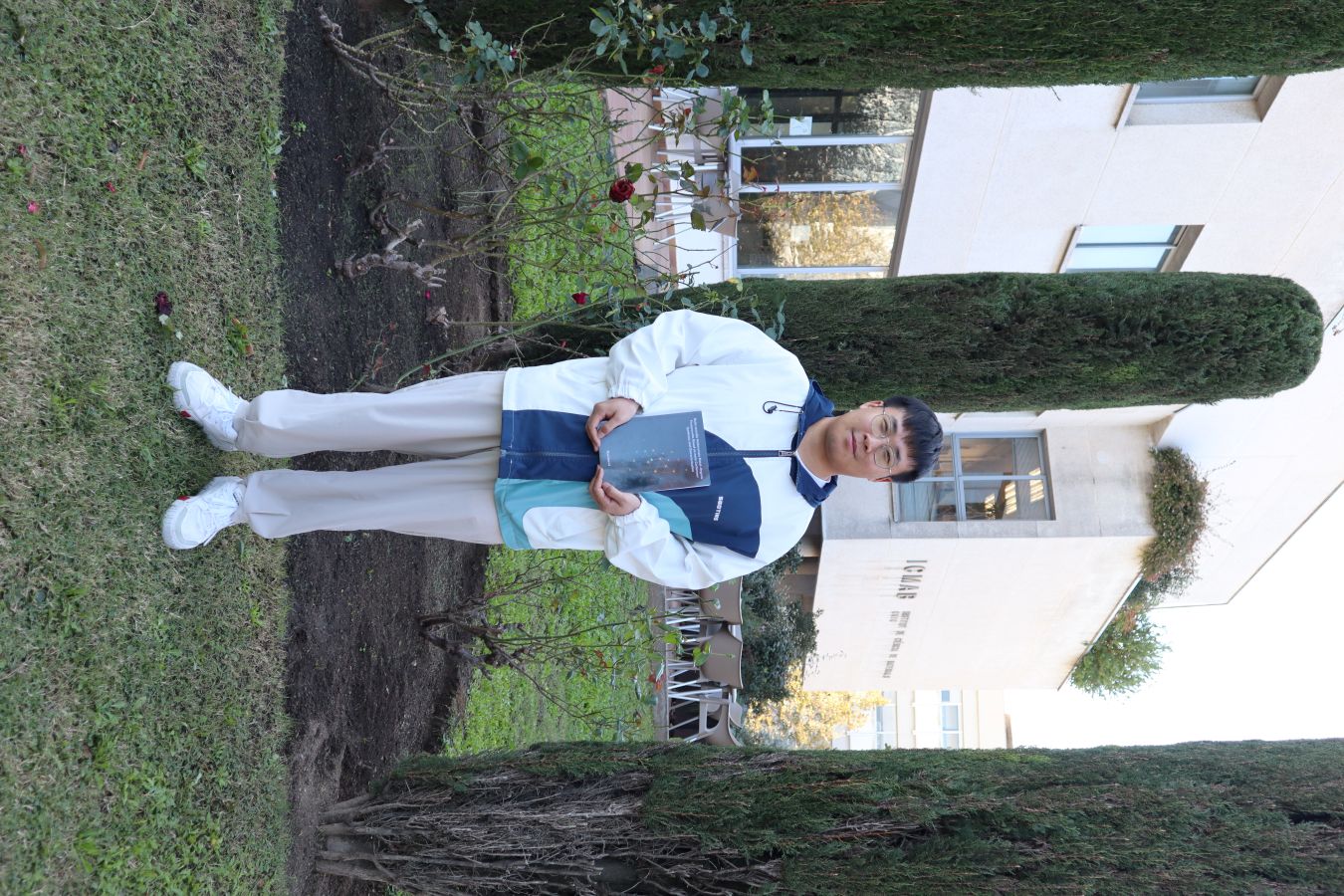
Xiao-bao Li at ICMAB garden on the day of his thesis | ICMAB-CSIC
Abstract
In this thesis, we have focused on the synthesis of a series of novel multi-metallic and multivariant metalloorganic frameworks (MTV-MOFs) based on meta-carborane. In the rare earth (RE) MTV-MOFs system, we successfully incorporated up to eight different RE metals into a single structure, an exceptionally rare achievement given the wide variation of ionic radii among these metals. In the transition metal (TM) MTV-MOFs system, we have prepared the first family of carborane-based MTV-MOFs, including Co and/or Ni. Inspired by the DNA sequences of living beings, we propose for the first time a “two-pot method” for metal incorporation. Using both the traditional “one-pot” method and our recently developed “two-pot” method, we introduced TMs into MTV-MOFs to produce structures with identical compositions and structures, but with different metal sequences. In addition, we synthesized new families of Co and/or Ni m-carborane-based MOFs, incorporating various N, N’ ligands of different sizes. In addition to their excellent stability and structural diversity, all these TM-based MOFs have been systematically investigated to explore the correlation between structure and electronic properties. Preliminary photocatalytic hydrogenation experiments have also revealed a relationship between the band gaps and the catalytic performance of some of the new materials.
Supervisors
- José Giner Planas, ICMAB-CSIC, Spain
PhD Committee
- President: Nuria Aliaga-Alcalde, ICMAB, Spain
- Secretary: Josep Puigmarti-Luis, UB, Spain
- Vocal: Min Ying Tsang, Łukasiewicz Research Network - PORT Polish Center for Technology Development, Poland
Read more
ICMAB - Xiao-bao Li will defend his PhD thesis on 17 October 2025 at ICMAB
