


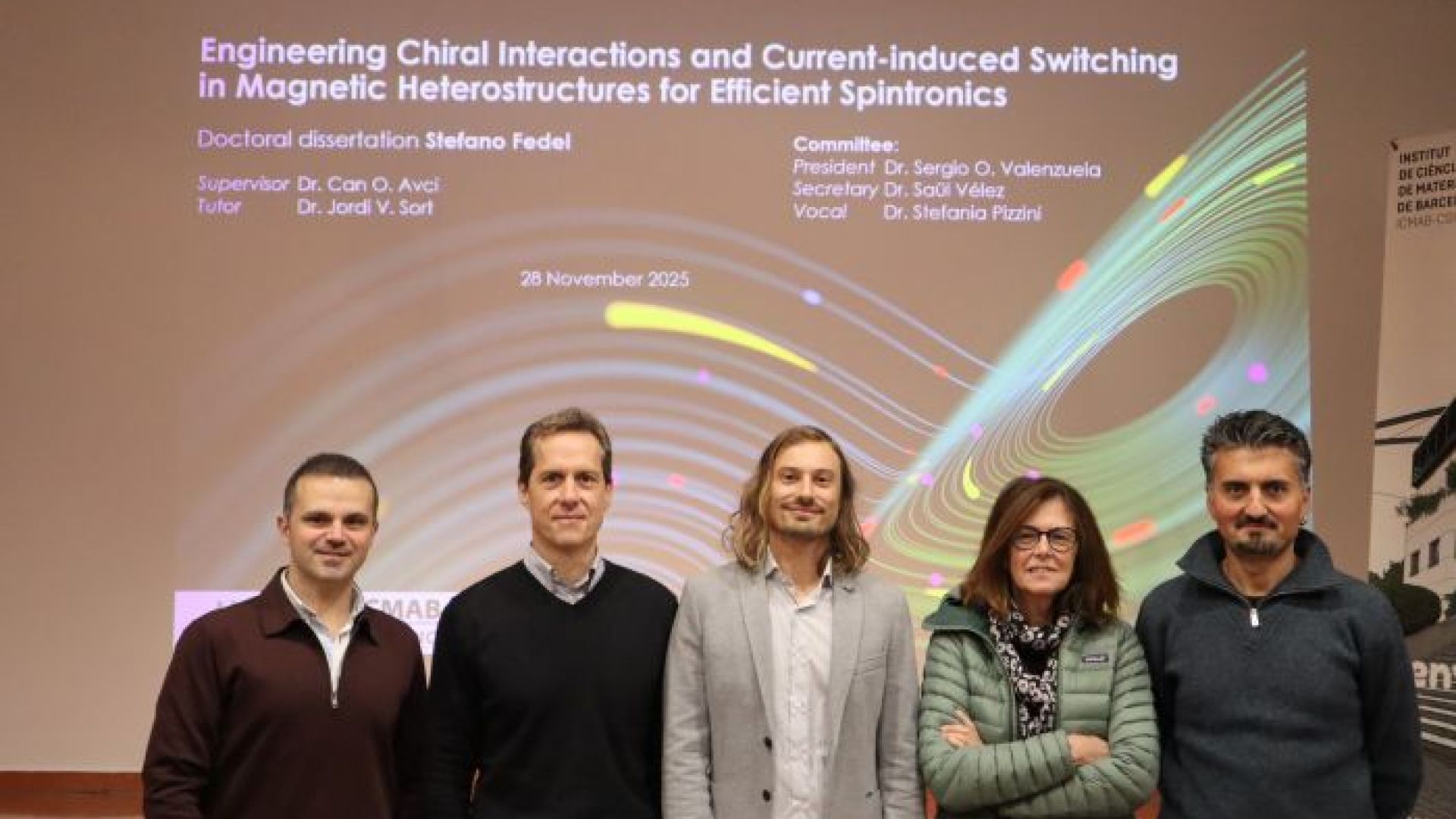
What was the focus of your PhD research? Can you explain it to a non-scientific audience?
My research focused on finding new ways to control magnetism using electric currents in extremely thin materials. This is important because magnetism can store information without power, and if we can control it efficiently, we can create faster and more energy-saving memory for computers and smartphones.
Can you briefly summarize the main findings or contributions of your research? You can give us some examples.
I developed a custom microscope to visualize magnetic patterns and domain walls, which are tiny boundaries inside magnetic materials. Using this tool, I discovered how certain interfaces between materials create chiral magnetic interactions, which give magnetism a “twist.” I showed that by adding very thin layers of metals, we can tune these interactions and even make them stronger or weaker. Finally, I demonstrated that ultrathin metals and even orbital effects—something often overlooked—can make magnetization switching much more efficient, reducing power consumption significantly.
Why do you think your research is important, and how could it impact your field or society?
Today’s electronics consume enormous amounts of energy. My research provides strategies to design memory and logic devices that are faster, more reliable, and use far less power. This could help reduce the energy footprint of data centers and everyday devices, making technology more sustainable while enabling new applications like neuromorphic computing and advanced sensors.
What was one of the most challenging aspects of your PhD journey, and how did you overcome it?
One of the biggest challenges was building a magneto-optical microscope from scratch. At first, I had no experience with optics, and the system required precise alignment and programming. I overcame this by learning step by step, asking for advice from colleagues, and staying persistent even when things didn’t work.
Why did you end up at ICMAB? And what do you think you will miss the most from this institute?
I chose ICMAB because of its strong reputation in materials science and the opportunity to work on cutting-edge spintronics projects with excellent supervision. What I will miss the most is the collaborative and friendly atmosphere. The institute feels like a community where people share ideas, help each other, and celebrate successes together.
What’s next for you after completing your PhD? Do you have any upcoming projects or goals?
I am still exploring my options, but I will probably look for opportunities in industry. I am interested in roles where I can apply my knowledge of advanced materials and spintronics to develop technologies that have a real-world impact.
How has completing this PhD changed you, either professionally or personally?
This PhD has made me more resilient and independent. I learned how to tackle complex problems, manage long-term projects, and adapt when things don’t go as planned.
What advice would you give to someone just starting their PhD journey?
Don’t be afraid to ask questions to anyone, even if they are a well-known scientist or if your question seems simple or “stupid.” Curiosity is essential, and asking questions is how you learn and grow. Everyone started somewhere, and most people are happy to help.
Why did you become a scientist? Which have been your role models that inspired you to pursue a PhD?
I’ve always been curious about how things work. During my master’s thesis, I spent a lot of time around PhD students and built good relationships with them. Seeing their passion and dedication inspired me to follow the same path and pursue a PhD myself.
Who or what helped you the most during your PhD journey, and is there anyone you'd like to thank?
My supervisor and colleagues were essential, providing guidance and support both scientifically and personally. Friends and family also played a big role in keeping me motivated. I’m deeply grateful to all of them for making this journey possible.
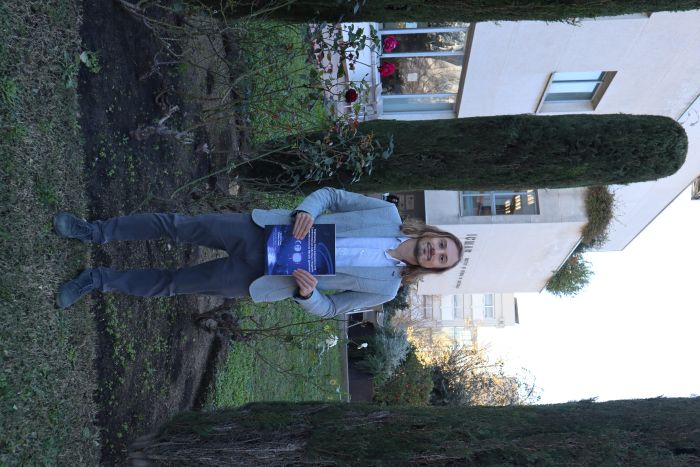
Stefano Fedel at ICMAB garden on the day of his thesis | ICMAB-CSIC
Abstract
This thesis investigates chiral magnetic interactions and current-induced control of magnetization in complex magnetic heterostructures to advance the development of spintronic technologies. The work explores how interfacial effects, material composition, and structural properties influence chiral interactions and spin–orbit torques (SOTs), which are key for efficient magnetic switching. It demonstrates that interface engineering and ultrathin metallic layers can strongly enhance performance while reducing energy consumption. The study also reports the observation and control of complex chiral magnetic textures, such as spiral domains, in metallic multilayers. Overall, the research provides new insights into the mechanisms governing chiral magnetism and spin–orbit phenomena, offering design principles for future low-power, high-speed spintronic devices and magnetic memory technologies.
Supervisor
- Can Onur Avci, ICMAB-CSIC
PhD Committee
- President: Sergio O. Valenzuela, ICN2, Spain
- Secretary: Saul Velez, UAM, Spain
- Vocal: Stefania Pizzini, Institut Néel, CNRS, France
Read more
Stefano Fedel will defend his PhD thesis on 28 November 2025
