


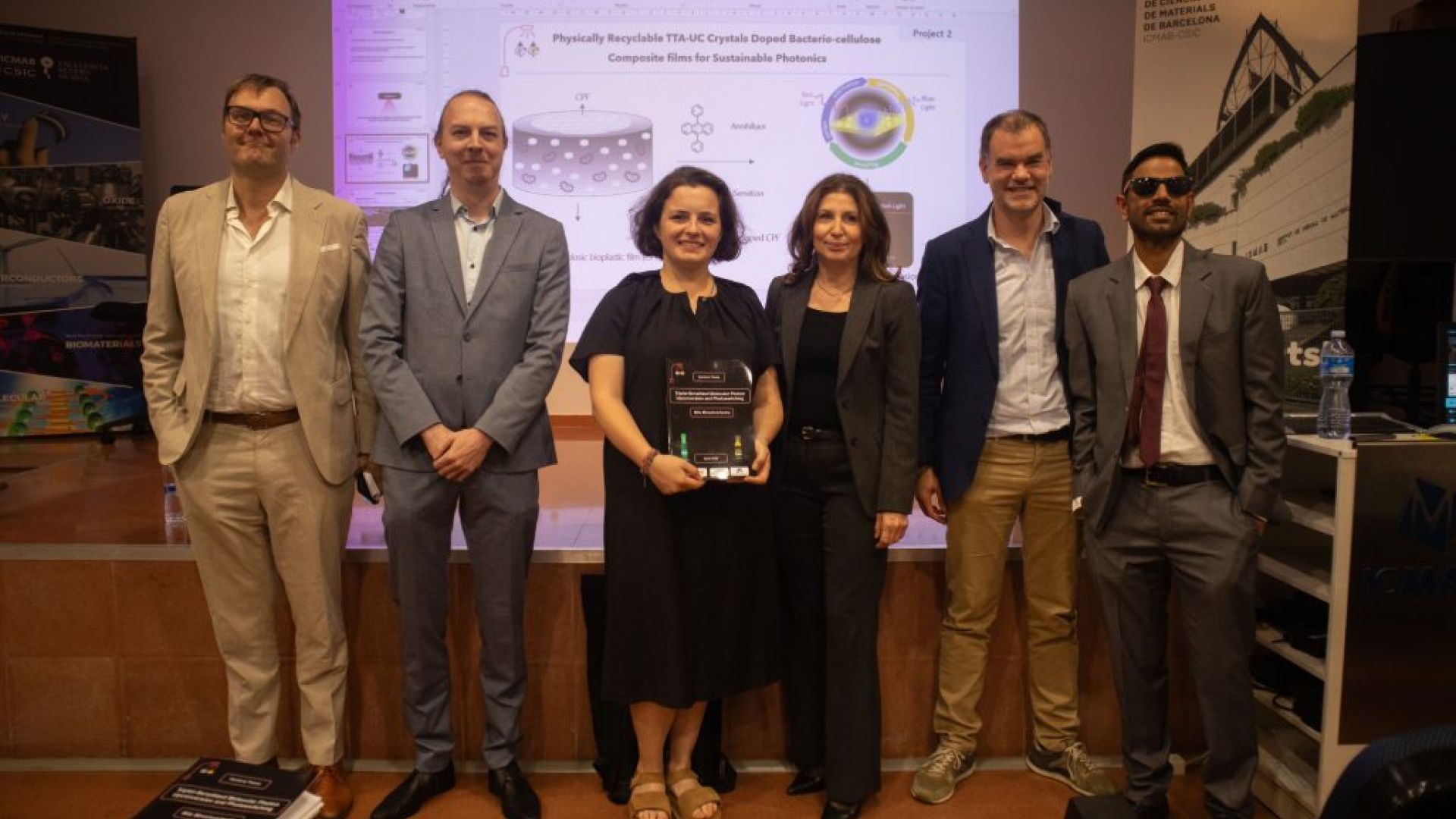
What was the focus of your PhD research? Can you explain it to a non-scientific audience?
My PhD research focused on organic chemistry—specifically, designing and creating new molecules with useful properties. In simple terms, I was building tiny structures (molecules) and figuring out how their design affects what they can do.
For example, just like the shape and materials of a bridge determine how strong it is, the structure of a molecule determines how it behaves—whether it can act as a medicine, a material, or react in a certain way.
More recently, I’ve been expanding into photophysical chemistry, which looks at how molecules interact with light. That means studying things like how a molecule absorbs light and then emits it again—similar to how glow-in-the-dark materials or fluorescent dyes work.
So overall, my work connects making new molecules with understanding their behavior, especially how they respond to light, which is important for technologies like sensors, imaging, and advanced materials.
Can you briefly summarize the main findings or contributions of your research? You can give us some examples.
My main contributions were in designing and synthesizing new organic molecules and understanding how they interact with light to produce useful effects.
One key area I worked on was triplet–triplet annihilation—a process where two low-energy excited molecules combine to produce one higher-energy state. In simple terms, it allows us to convert low-energy light into higher-energy light, which can be useful for improving solar energy systems or creating more efficient light-emitting materials.
I also studied photoisomerization, where molecules change their shape when exposed to light. This is important because it can be used to create light-controlled switches at the molecular level, with applications in smart materials or drug delivery.
In addition, I synthesized several new compounds specifically designed to optimize these light-driven behaviors. By modifying their structure, I was able to tune how efficiently they absorb light, transfer energy, or change form.
Overall, my work connects molecular design with light-driven functionality, contributing to the development of advanced materials for energy, sensing, and responsive systems.
Why do you think your research is important, and how could it impact your field or society?
I think my research is important because it contributes to developing smarter and more efficient materials, which are essential across many industries.
By designing new organic molecules and understanding how they behave—especially under light—we can improve how materials perform in real-world applications. For example, this kind of work can support better energy technologies, more sensitive detection systems, or materials that respond to external stimuli in a controlled way.
More broadly, my research helps move the field toward a more predictive approach. Instead of relying only on trial and error, we can design molecules with specific properties from the start, which saves time, reduces costs, and accelerates innovation.
From a societal perspective, these advances can contribute to more sustainable technologies, improved healthcare solutions, and new high-performance materials. Even if the applications are not always immediate, this type of research builds the foundation for future technologies that can have a real impact on everyday life.”
What was one of the most challenging aspects of your PhD journey, and how did you overcome it?
One of the most challenging aspects of my PhD was moving beyond pure organic synthesis into the physics side of the work—especially understanding photophysical processes like excited states and energy transfer.
As an organic chemist, I was very comfortable designing and making molecules, but concepts like triplet states, energy levels, and light–matter interactions were initially quite abstract for me.
I overcame this by taking a very structured approach: I went back to the fundamentals, studied key concepts step by step, and actively connected theory to my own experiments. I also learned a lot through discussions with colleagues from physics-oriented backgrounds and by interpreting my own spectroscopic data.
Over time, this became a strength rather than a limitation. It allowed me not only to synthesize new compounds but also to understand why they behave the way they do under light. That combination of chemistry and photophysics made my research much more impactful.
Why did you end up at ICMAB? And what do you think you will miss the most from this institute?
I will miss my office, Giulia, Giovanni, Xiaoming, Nicola, Laura, Gerard, Shou, Joseline, Joset, Miquel, Julia, Andres, Chenlong also people from ICMAB Yrene, Coco, Ester, Matteo, Stefano, Emanuele, Weronica.
What’s next for you after completing your PhD? Do you have any upcoming projects or goals?
Yes I will be postdoc at UPC in Barcelona.
How has completing this PhD changed you, either professionally or personally?
Completing my PhD has changed me both professionally and personally.
Professionally, it made me much more independent and solution-oriented. I learned how to take ownership of complex problems, design experiments from scratch, and adapt quickly when things don’t work as expected. It also pushed me to go beyond my core expertise in organic chemistry and develop a more interdisciplinary mindset, especially by integrating photophysical concepts into my work.
Personally, it taught me resilience and persistence. Research often involves setbacks, and I became much more comfortable dealing with uncertainty and staying focused over long-term goals. I also improved my ability to communicate complex ideas clearly to different audiences, which is something I really value.
What advice would you give to someone just starting their PhD journey?
Just do it , its will be interesting and funny journey
Why did you become a scientist? Which have been your role models that inspired you to pursue a PhD?
I became a scientist because I’ve always been curious about how things work at a fundamental level, especially in chemistry. I liked the idea that you can design and create something completely new—like a molecule—and then understand and control its behavior. That combination of creativity and problem-solving is what really drew me to science and eventually to a PhD.
As for role models, I’ve been inspired both by well-known scientists and by people I’ve worked with directly. For example, scientists like Marie Curie, who combined fundamental discovery with real-world impact, have always been motivating.
But honestly, some of the strongest influences were my academic mentors and colleagues during my studies. Seeing how they approached problems, stayed persistent through challenges, and built expertise over time made pursuing a PhD feel like a natural step for me.
Overall, it was a mix of curiosity, creativity, and the influence of people around me that led me to become a scientist.
Who or what helped you the most during your PhD journey, and is there anyone you'd like to thank?
My office friend
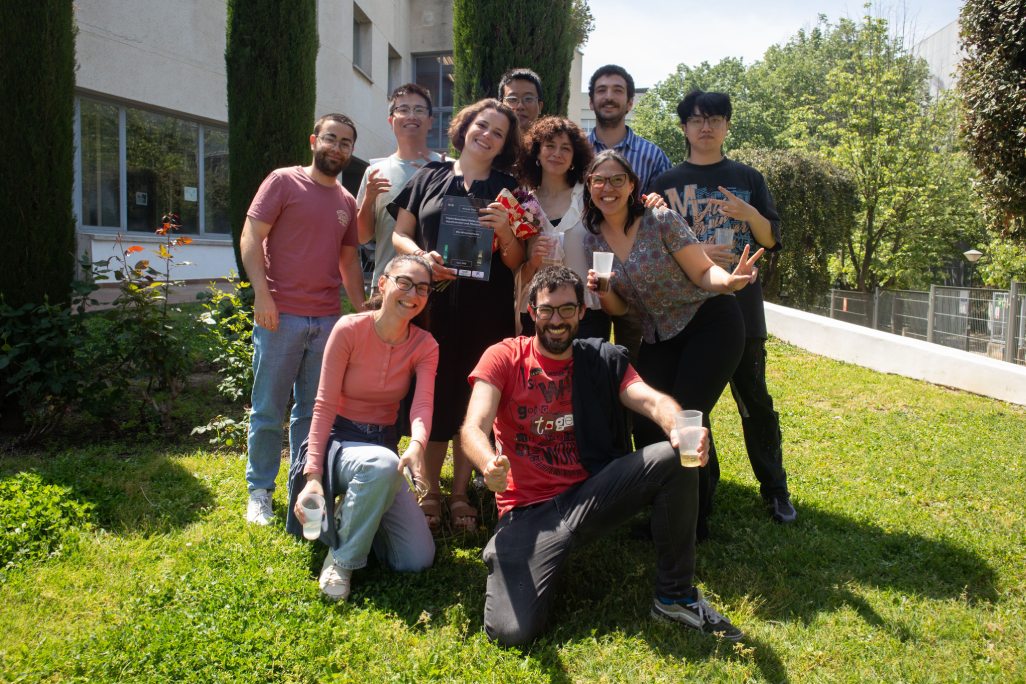
Mila Miroshnichenko at ICMAB garden on the day of his thesis with some friends| ICMAB-CSIC
Abstract
This thesis investigates triplet-sensitized processes for energy upconversion and photoswitching across organic, aqueous, and biopolymer matrices. Novel triplet acceptor chromophores were synthesized and demonstrated efficient triplet–triplet annihilation upconversion (TTA-UC) and triplet-sensitized photoswitching (TSP). A new perylene-based annihilator enabled broadband red-to-green upconversion with high efficiency. Bio-sustainable TTA-UC films were developed using bacterial cellulose, allowing recyclability of chromophores. Additionally, a lipophilic azobenzene derivative showed reversible red/far-red light-driven isomerization within the phototherapeutic window. Finally, the work demonstrates in vivo photopharmacological control of heart rate using a triplet-sensitized azobenzene drug, highlighting the potential of these systems for biomedical applications.
Supervisor
- Kasper Moth-Poulsen, UPC & ICMAB-CSIC
- Pankaj Bharmoria, UPC & ICMAB-CSIC
PhD committee
- President: Chiara Bertarelli, Politecnico di Milano, Italy
- Secretary: Claudio Roscini, ICN2, Spain
- Vocal: Bart Limburg, UB, Spain
Read more
ICMAB - Mila Miroshnichenko will defend her PhD thesis on 21 April 2026
