


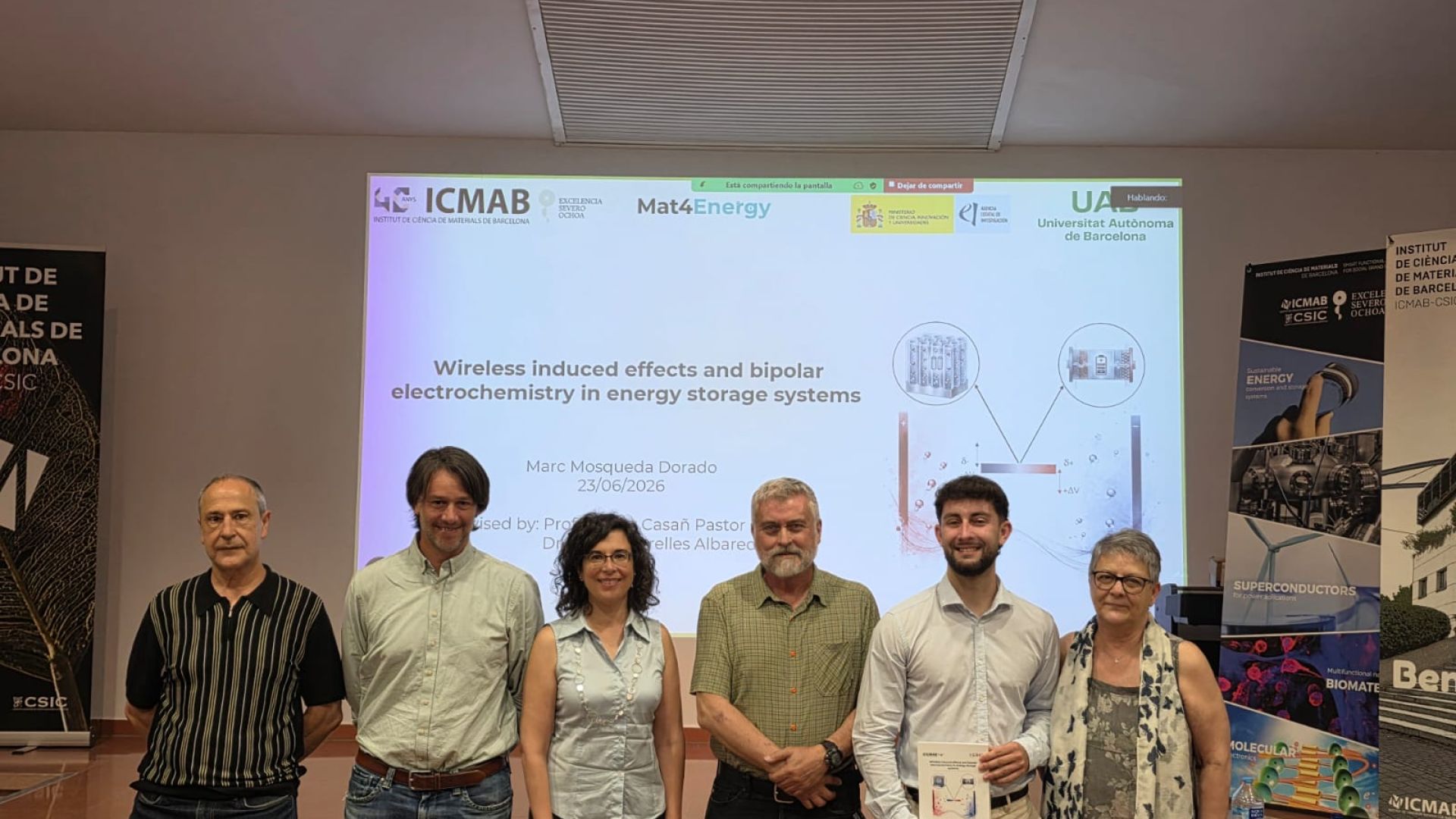
What was the focus of your PhD research? Can you explain it to a non-scientific audience?
My thesis focused primarily on bipolar electrochemistry. This involves the generation of a dipole in a conductive material without the need for a connection, using an external electric field. The research group had previously worked on bipolar electrochemistry, and the aim of this thesis was to evaluate its application in energy storage systems.
Can you briefly summarize the main findings or contributions of your research? You can give us some examples.
- TiO₂ nanotubes for photocatalytic applications were successfully synthesized using bipolar electrochemistry.
- The performance of different types of batteries was successfully improved using bipolar electrochemistry.
- The function of bipolar electrodes in batteries was evaluated and understood.
Why do you think your research is important, and how could it impact your field or society?
Energy storage systems are one of the key areas of study in the development of sustainable strategies aimed at reducing the carbon footprint. In this regard, the findings presented in this thesis open up new avenues of research for improving certain electrochemical storage systems, with the potential to develop systems featuring higher power, lower overpotential, and substantial increases in apparent concentration.
What was one of the most challenging aspects of your PhD journey, and how did you overcome it?
One of the most important aspects of this thesis was that bipolar electrochemistry had never before been applied to energy storage systems. As a result, we were often unable to rely on previous work reported in the literature when designing certain experiments.
Why did you end up at ICMAB? And what do you think you will miss the most from this institute?
I had already been working on my senior thesis with the group when I saw the job posting online, and I didn't hesitate to apply. Above all, I'll miss my classmates—who became friends—with whom I shared so many great moments at the center.
What’s next for you after completing your PhD? Do you have any upcoming projects or goals?
My plan is to stay at ICMAB for a while to finish up some experiments and projects that are still pending.
How has completing this PhD changed you, either professionally or personally?
On a personal level, it has allowed me to meet a large number of people with whom I have shared many stories and had some wonderful times. On a scientific level, I have learned a wide range of techniques and developed skills that I am sure will be of great help to me in the future.
What advice would you give to someone just starting their PhD journey?
Above all, enjoy the experience and the process. Although there may sometimes be stressful situations that are hard to cope with, a doctoral program is an enriching experience that brings you many positive things.
Why did you become a scientist? Which have been your role models that inspired you to pursue a PhD?
I've never really had a scientific role model who steered me in that direction. However, I've always been very curious and have asked myself why things are the way they are, and that led me to want to pursue a career in science.
Who or what helped you the most during your PhD journey, and is there anyone you'd like to thank?
The truth is that everyone around me has helped and encouraged me throughout this entire process. Starting with my family, my friends, and the people at ICMAB.
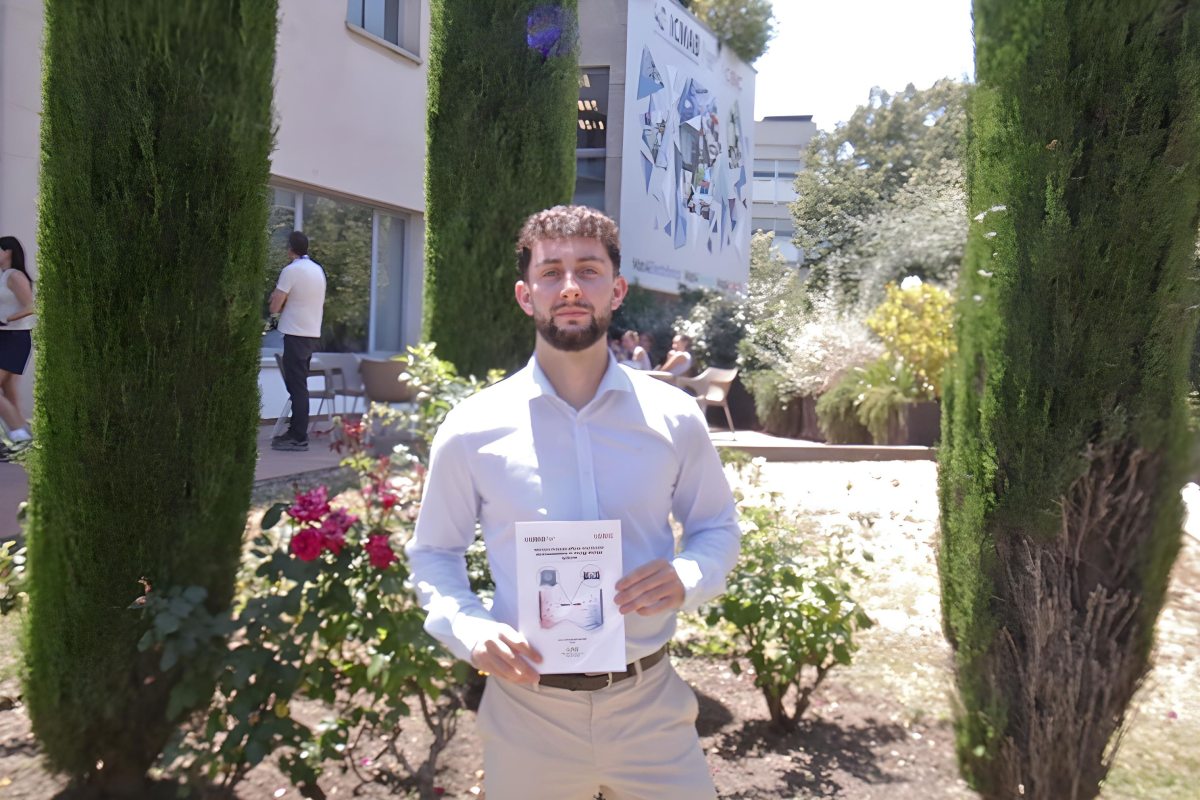
Marc Mosqueda at ICMAB garden on the day of his thesis | ICMAB-CSIC
Abstract
The main objective of this thesis is to elucidate the role of induced wireless bipolar electrochemistry in the field of energy storage, never tackled before in the field.
New applications for wireless electrochemistry have been found recently from wireless electrodeposition to oscillating reactions related to local changes in resistance of the bipolar electrode. If the material allows mixed conductivity and redox intercalation/deintercalation, asymmetric reactions achieved through the material create redox gradients with significant structures and effects on wireless neural electrostimulation or magnetoionics.
In particular, our observation of a great decrease in ohmic and charge transfer resistance for electrochemical cells, when immersing a conducting material in the electrolyte, suggests a significant possible improvement in battery design, with larger efficiencies, and enhanced power. Furthermore, wireless electrochemical synthesis of catalysts could be possible using simplified cells without direct wirings. In this thesis, the study of bipolar electrochemistry effects have focused on both chemical or electrochemical energy storage, following two fundamental lines in parallel, 1) The synthesis of specific nanostructures that facilitate energy harvesting/storage (photocatalysis using TiO2 to harvest solar energy for H2 production), and 2) The use of induced unwired bipolar electrodes within the electrolyte to engineer battery performance: the unwired induced anodes and cathodes formed in presence of external electric fields would modify cell resistance and offer additional charge transfer mechanisms within the battery, thus offering a new paradigm in battery performance, lifetime, and capacity improvement.
Therefore, we have specifically tested:
1) The synthesis of aligned nanostructures of TiO₂-nanotubes, through wireless anodization of titanium metal. TiO₂, with a band gap in the UV range may still raise its photocatalytic performance through doping that could improve its conductivity and photoactivity. Here, a secondary vacuum annealing after wireless synthesis, attempts to induce doping/structure defects to enhance the
photoactivity. Different arrangements of the Ti metal within the electric field may create different gradients in NT diameter/thickness, modifying activity. Once annealed under vacuum, intertwined anatase-rutile phases are observed, while several spectroscopic techniques demonstrate that sub-states appear facilitating transitions and increasing the separation of electron-hole charges generated photoelectrochemically. This is correlated with H₂ production and photoelectrochemical water splitting.
2) The effect of bipolar unwired electrodes in a battery is studied to determine the influence of induced polarization. Different configurations of bipolar electrodes are tested within three distinct batteries. Each type of battery includes specific factors like: having the redox active material in solid or soluble form, using systems with or without membrane, as well as different materials as unwired bipolar electrodes, with different electrochemical activity.
As this is the first study that applies bipolar electrochemistry to electrochemical energy storage systems, we have chosen widely studied systems to focus exclusively on the changes observed in batteries when bipolar electrodes are included: a Cu/Zn battery; a symmetrical Fe(CN)63-/Fe(CN)64- cell containing soluble redox components and a Zn-air alkaline reversible battery. Having active redox sites in solid state and in solution is evaluated, as well as the influence of the configuration of bipolar electrodes and the materials used in them. Electrochemical characterization experiments for each battery type are performed to reach full interpretation of bipolar electrodes influence and to verify the chemical changes observed. Simultaneous impedance measurements are carried out that show the evolution of the main physical effects of bipolar electrochemistry along charge and discharge. COMSOL simulations evaluate the given hypotheses.
In all cases, unwired bipolar electrodes lower battery-overpotentials and cell resistance, increase power, enhancing charge capacities fourfold in certain configurations. This strongly suggests the possible application of bipolar effects in batteries with longer autonomy distances, smaller weight or larger usage times in mobile or stationary applications.
Supervisor
- Nieves Casañ, ICMAB-CSIC
- Xavier Torrelles, ICMAB-CSIC
PhD Committee
- President: Pedro Gómez Romero, ICN2, Spain
- Secretary: Eva Maria Pellicer Vilà, UAB, Spain
- Vocal: Juan Sebastián Reparaz, ICMAB-CSIC, Spain
Read more
ICMAB - Marc Mosqueda will defend his PhD thesis on 23 June 2026
