What was the focus of your PhD research? Can you explain it to a non-scientific audience?
My PhD focused on developing antibacterial nanofiber materials for potential use in wound dressings. I worked with chitosan, a naturally derived polymer with antibacterial properties, and poly(vinyl alcohol) (PVA), which can be made into extremely thin fibers. By combining them, we aimed to design materials that could help control bacteria while supporting the wound-healing process.
Can you briefly summarize the main findings or contributions of your research? You can give us some examples.
First, we prepared low-molecular-weight chitosan with different chain lengths and investigated how its molecular properties influenced antibacterial activity. One sample, called CS7, showed particularly promising results. We then incorporated chitosan into electrospun PVA nanofibers. In laboratory tests, selected nanofibers reduced bacterial growth upon direct contact and promoted skin-cell migration in a scratch assay. Finally, we showed that adding glycerol or changing the fiber architecture could improve water stability and adjust the speed of chitosan release.
Why do you think your research is important, and how could it impact your field or society?
Infections can make wound care more difficult, so there is a need for materials that combine antibacterial properties with suitable performance in a wound environment. Our research shows that both the molecular properties of chitosan and the structure of the nanofibers are important. These findings may guide the design of future antibacterial wound-contact materials, although further testing will be needed before any practical or clinical application.
What was one of the most challenging aspects of your PhD journey, and how did you overcome it?
One challenge was connecting several different parts of the project, from preparing and characterizing chitosan to making nanofibers and evaluating their antibacterial and biological performance. Sometimes improving one property, such as water stability, also changed another, such as release behavior. I addressed this by working systematically, comparing different formulations, discussing unexpected results with my supervisors, and collaborating with researchers who had complementary expertise.
Why did you end up at ICMAB? And what do you think you will miss the most from this institute?
I came to ICMAB for the opportunity to conduct materials research in an international and collaborative environment. What I will miss most is the people: my supervisors, colleagues, and friends who were always willing to share ideas and offer support. I especially valued the freedom to explore research questions, the open scientific discussions, and the friendships I made along the way.
What’s next for you after completing your PhD? Do you have any upcoming projects or goals?
After completing my PhD, I plan to return to China and pursue a career in industry. I hope to join a company where I can continue working on research and development related to biomaterials, applying the knowledge and experience gained during my PhD to develop materials with practical applications.
How has completing this PhD changed you, either professionally or personally?
Completing this PhD has made me a more independent and confident researcher. I have learned not only new experimental techniques but also how to think critically, deal with unexpected results, and communicate scientific ideas. Personally, working with people from different backgrounds has made me more open-minded, patient, and resilient.
What advice would you give to someone just starting their PhD journey?
Stay curious, be patient with setbacks, and do not be afraid to ask questions or seek help. Research does not always go according to plan, and unexpected results can be valuable. Keep good records, communicate openly with your supervisors and colleagues, and remember to enjoy the learning process and the people you meet along the way.
Why did you become a scientist? Which have been your role models that inspired you to pursue a PhD?
I was attracted to science by curiosity about how materials work and by the possibility of using that knowledge to solve practical problems. Throughout my studies, dedicated teachers and researchers inspired me through their enthusiasm and persistence. My PhD supervisors have also been important examples of how to approach scientific questions with rigor, creativity, and an open mind.
Who or what helped you the most during your PhD journey, and is there anyone you'd like to thank?
I am especially grateful to my supervisors, Dr. Pablo Guardia and Dr. Rafael Contreras-Cáceres, for their guidance, patience, and trust, and to Prof. Anna Roig and Prof. Ignacio Fernández for their support. I would also like to thank my colleagues at ICMAB and the University of Almería, and the collaborators who helped with material characterization, release studies, antibacterial experiments, and cell assays. Finally, I am deeply thankful to my family and friends for their encouragement throughout this journey.
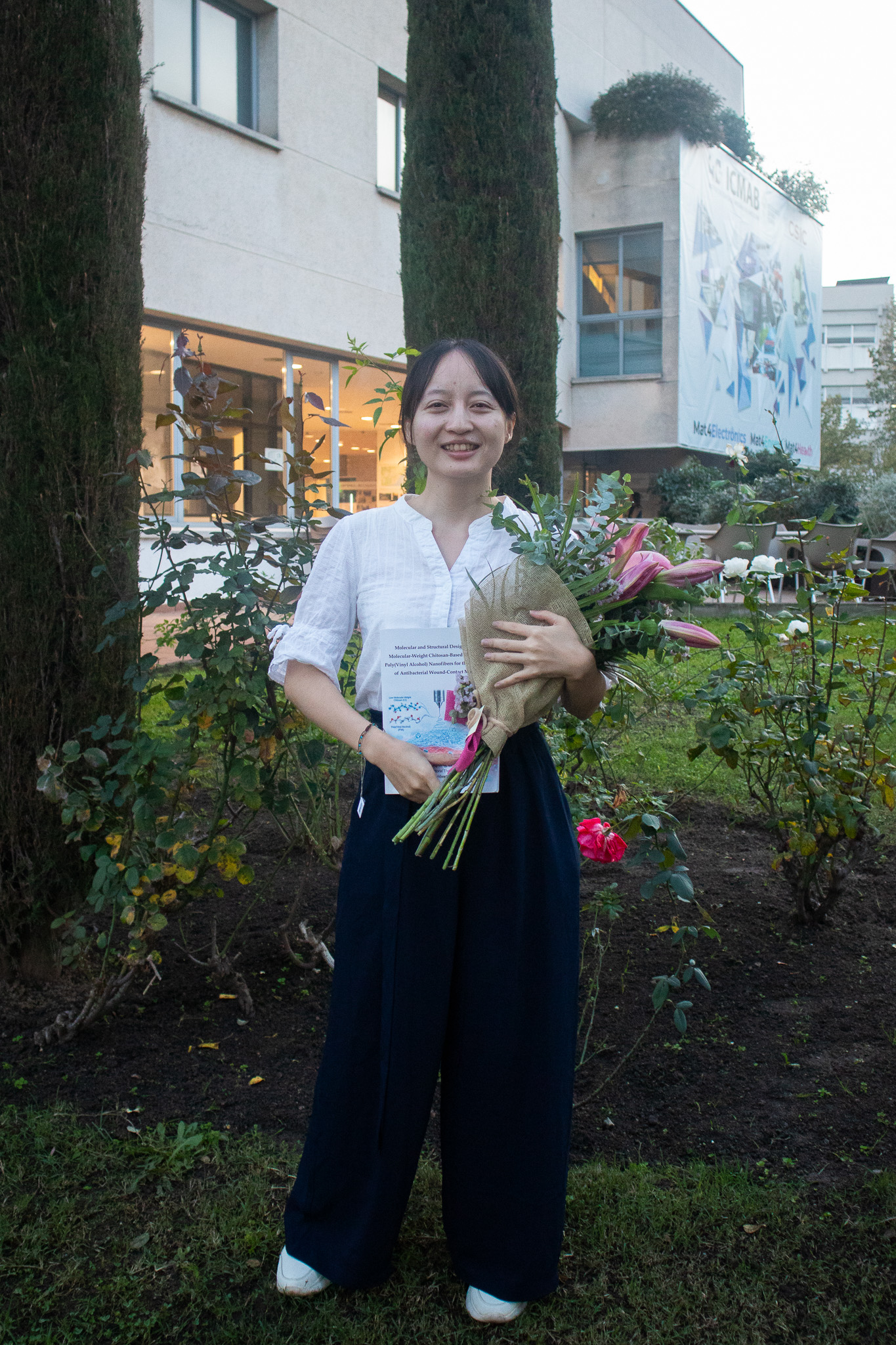 Liqiong Li at the ICMAB garden on the day of her thesis | ICMAB-CSIC
Abstract
This thesis investigates the molecular selection and structural design of low-molecular-weight chitosan (LMWCS)-containing electrospun poly(vinyl alcohol) (PVA) nanofibers for antibacterial wound-contact applications.
First, chitosan samples with different molecular characteristics were evaluated to understand their antimicrobial performance and identify suitable candidates. CS7 was selected as the lead candidate, with CS1 as a lower-molecular-weight reference.
Next, PVA/LMWCS nanofibers were fabricated to examine how chitosan molecular weight and loading influence fiber morphology, apparent release, antibacterial activity, and wound-healing-related cellular responses.
Finally, glycerol was investigated as a formulation strategy to improve aqueous stability and moderate apparent CS7 release while retaining direct-contact antibacterial activity.
Overall, the work highlights the combined importance of chitosan molecular properties, matrix interactions, and formulation design for nanofiber performance.
Supervisors
- Pablo Guardia, Nanoparticles & Nanocomposites Group, ICMAB-CSIC, Spain
- Rafael Contreras-Cáceres, CIAMIBITAL Group, Universidad de Almería (UAL), Spain
PhD committee
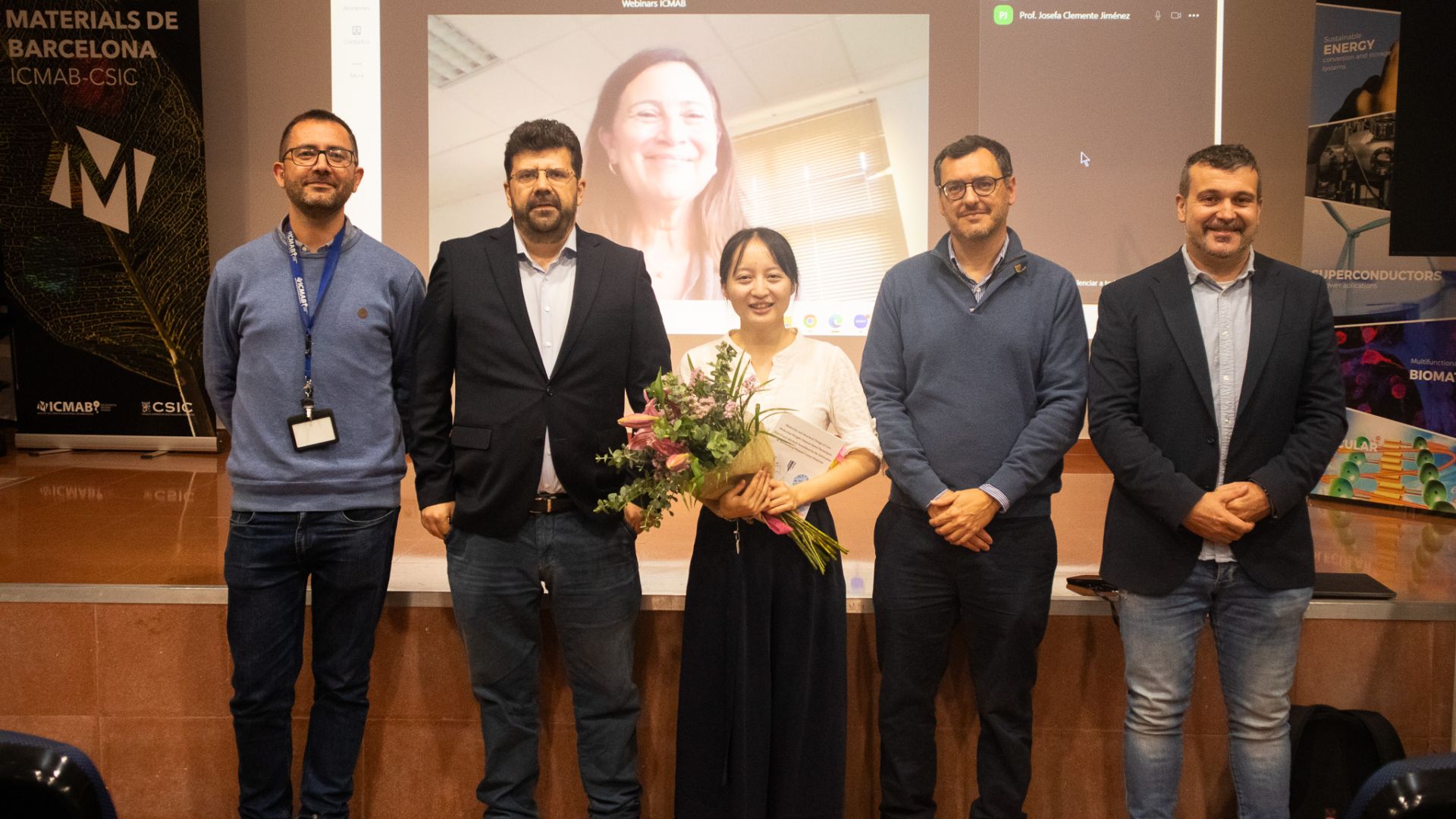
- President: Josefa Clemente Jiménez, Universidad de Almería, Spain
- Secretary: Fernando Novio Vázquez, Universitat Autònoma de Barcelona, Spain
- Vocal: Juan Pellico Sáez, Institut de Ciència de Materials de Barcelona (ICMAB), Spain
Read more
ICMAB - Liqiong Li will defend her PhD thesis on 6 November 2026