


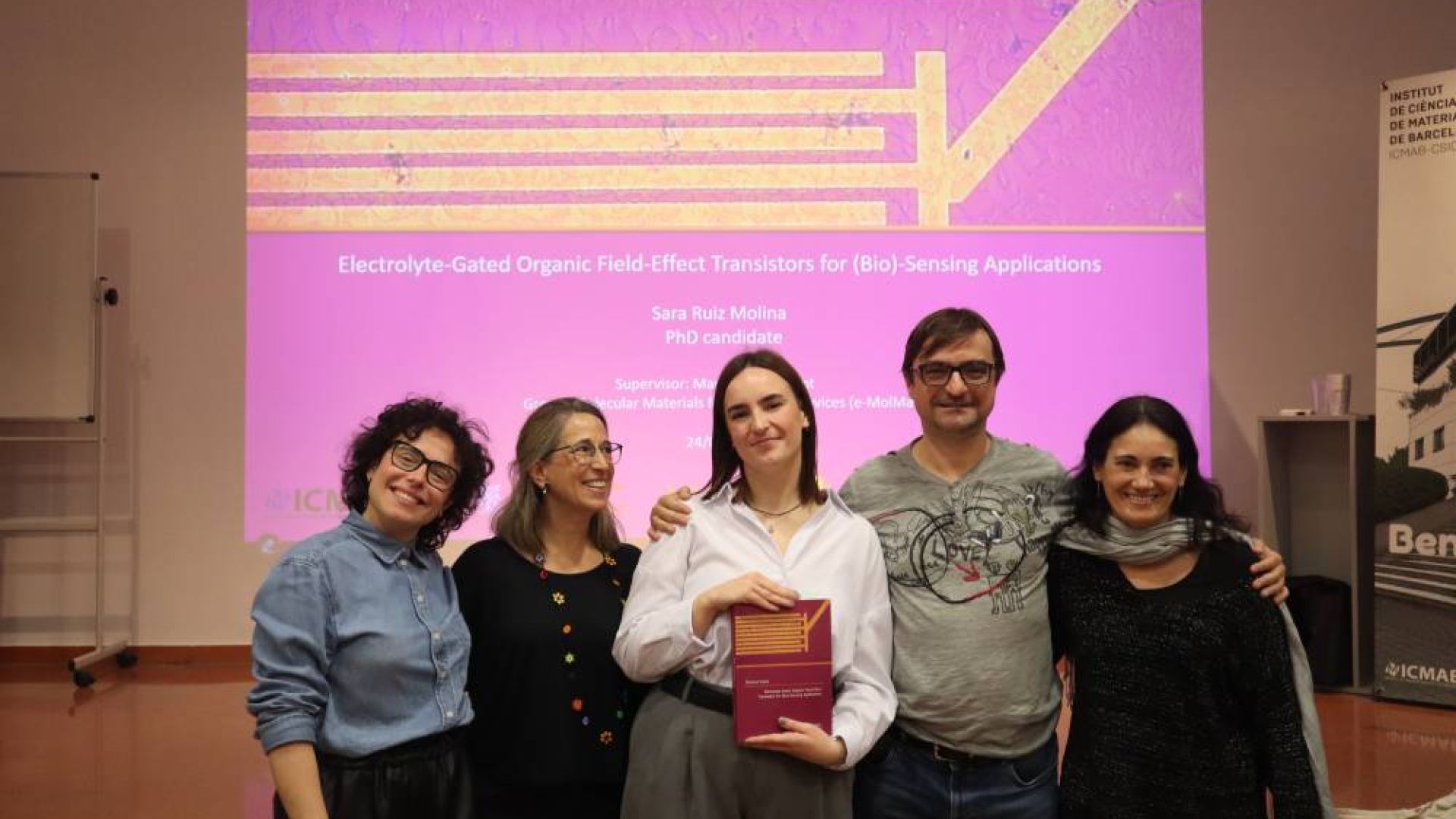
The focus of the PhD is the study of flexible EGOFETs for their possible applications in biosensors.
Can you briefly summarize the main findings or contributions of your research? You can give us some examples.
In this research, flexible EGOFETs have been used to monitor the aggregation of a peptide related to Alzheimer's disease, the behavior of these devices with deformation has also been studied, and they have also been studied as a platform for recording cellular activities.
Why do you think your research is important, and how could it impact your field or society?
This research is important because it allows the implementation of these devices, which have many advantages over conventional ones, allowing their manufacture at low cost and their application in flexible electronics fields and the possible monitoring of dynamic processes such as protein aggregation or the influence of drugs on protein aggregation
Why did you end up at ICMAB? And what do you think you will miss the most from this institute?
I ended up at ICMAB because I was awarded an FPI scholarship to do my PhD. What I will miss most is the good atmosphere among the young people who are part of the institute, it is a great family.
What’s next for you after completing your PhD? Do you have any upcoming projects or goals?
Before completing my PhD I already started teaching as a science teacher and my intention is to continue in this field.
How has completing this PhD changed you, either professionally or personally?
The PhD not only gives you tools to apply professionally, but also teaches you values such as patience, tolerance, teamwork...
What advice would you give to someone just starting their PhD journey?
Although the PhD has been a very good experience for me, it was not a vocation. So if there is someone who is starting a PhD, one piece of advice I could give is to be sure that you want to put in as much time and effort into the PhD, so that you can enjoy all your work.
Why did you become a scientist? Who were your role models who inspired you to do a PhD?
Thanks to my chemistry teacher in 2nd year of high school I decided to study chemistry, and thanks to my TFG and TFM teacher I decided to do a PhD. They have been my role models since I decided to study science.
Who or what helped you the most during your PhD? Is there anyone you would like to thank?
Professionally I want to thank my thesis advisor Marta Mas and the entire eMolMat group. Professionally I want to thank all the good friends I have made over these years and especially Xavier R. who has been a great support for me throughout this time.
Abstract
This doctoral thesis focused on the development and application of Electrolyte-Gated Organic Field-Effect Transistors (EGOFETs) and Hydrogel-Gated Organic Field-Effect Transistors (HYGOFETs) for bioelectronic purposes. Devices were fabricated by depositing small molecules of organic semiconductors (OSC) blended with an insulating polymer from solution, employing the Bar-Assisted Meniscus-Shearing technique (BAMS). The work involved designing flexible, low-power biosensors for detecting biomolecule aggregation and cellular activity, particularly amyloid peptides, which are relevant for neurodegenerative diseases like Alzheimer’s and Parkinson’s. The ability of EGOFETs to detect proteins without the need for makers highlighted their potential in systematic studies of protein aggregation and drug testing. In addition, HYGOFETs, utilizing agarose hydrogel, demonstrated improved stability in biosensing environments. The thesis also explored the potential of EGOFETs as strain sensors and their application in flexible electronics, identifying key electrical changes under mechanical stress. The research introduced innovative solutions for addressing voltage drift in EGOFETs and showed their capacity to record and stimulate cellular activity, specifically single-cell membrane potentials. Overall, the findings emphasized the promising future of EGOFETs and HYGOFETs in bioelectronic applications, enhancing the understanding of these devices while paving the way for advanced flexible biosensors.
Supervisors
- Marta Mas, ICMAB-CSIC, Spain
PhD Comitte
- President: Imma Ratera, ICMAB-CSIC, Spain
- Secretary: Francesca Leonardi, OnePlanet research Center, Netherlands
- Vocal: Javier Ramón Azcón, IBEC, Spain
