


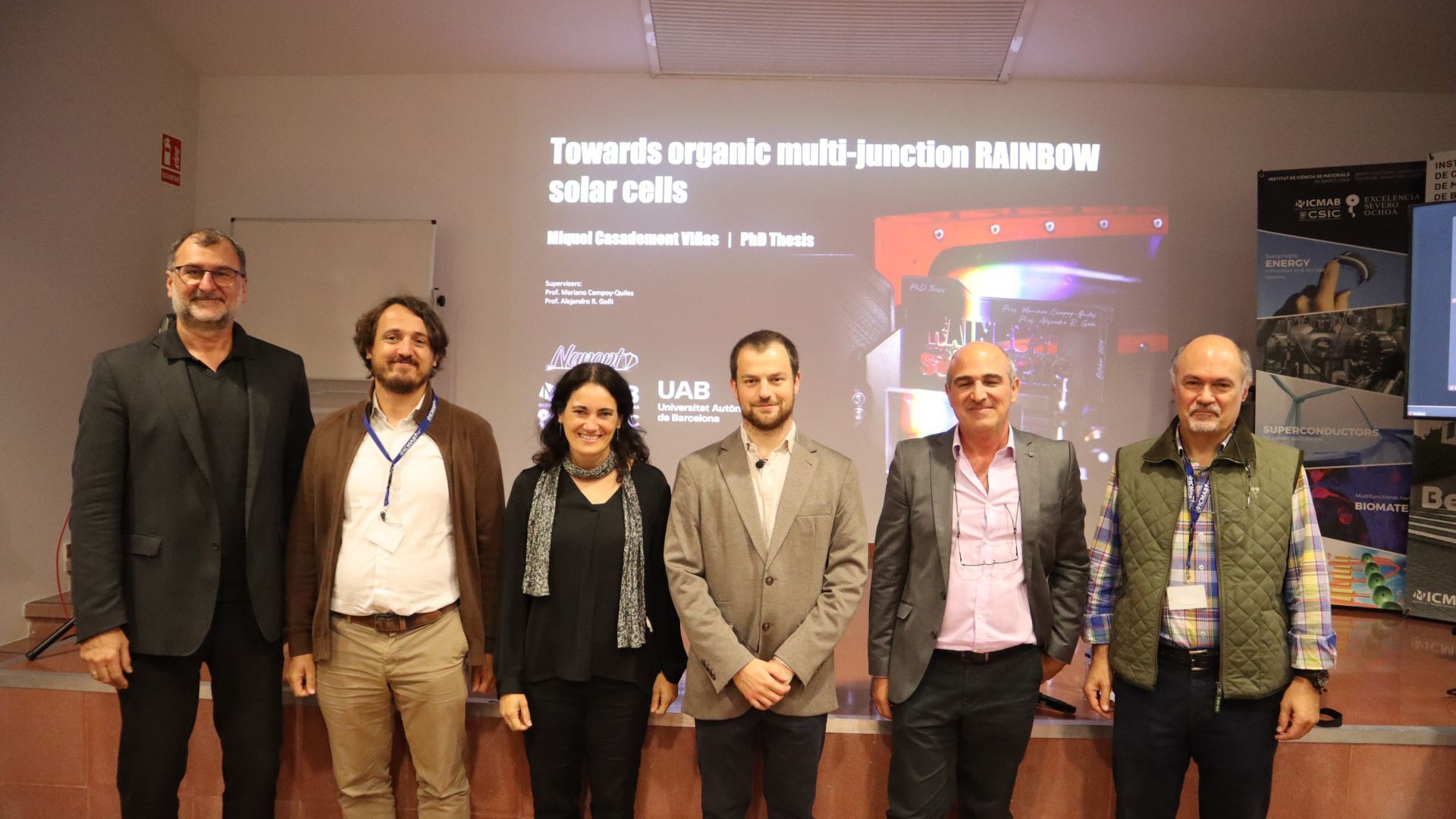
Why did you choose the ICMAB?
I think it is more accurate to say that ICMAB chose me. I'm at ICMAB since my bachelor's thesis and I could not escape from the good environment and science that I encountered since the first day.
How would you explain your research to a non-scientific audience?
The main topic of my PhD thesis is organic photovoltaics which is a technology for harvesting solar energy and convert it to electricity with a huge potential due to its large-scale production and variety of applications. My rearch has focused on a novel multi-junction geometry (named RAINBOW) to increase the efficiency of those solar cells.
What are the main applications of your research? Could you give us an example?
The application of organic photovoltaics has no limits. We can use them as light energy harvesters in any situation: solar farms, indoor light (for internet of things), integrated in buildings (facades, floor, etc...), underwater, spaceships, etc... Nevertheless, the RAINBOW geometry is more thought for applications where a high efficiency is needed such as spaceshifts of solar farms. Additionally, the research I've done resulted in materials suited for indoor and underwater applications, which is also one of the most interesting applications of organic photovoltaics from my point of view.
What will you miss the most from ICMAB?
The good research and creativity environment that I had during my PhD.
How do you think this experience will contribute to your training and to your future?
A PhD, in general, is a long trip plenty of experiences. Among them I've learned to do practical things (like 3D printing, programming, data treatment, experiment design, etc...) but also soft skills like project management, working as a team, expose results, understanding and learning skills, etc... These skills are unique from other experiences and I think this is one of the most important things after finishing a PhD.
What do you wish you had known at the beginning of your PhD?
Anything. I think a part of the PhD is learning and exploring from your own experience, so not knowing things shouldn't be a problem!
Why did you become a scientist? Which have been your role models?
I've always had curiosity to know how things work and I've always had a creative mind. I think these are key to developing a scientific career and mindset. I think my role models have been always people close to me such as my physics professor at school or my uncles.
Which is your favourite female scientist?
I especially remember Agnes Pockels from a "chemical and physical properties at interfaces" class during the nanoscience degree. I think she is the pioneer of many advances in nanotechnology that leaded to the actual understanding of properties at the nanoscale.
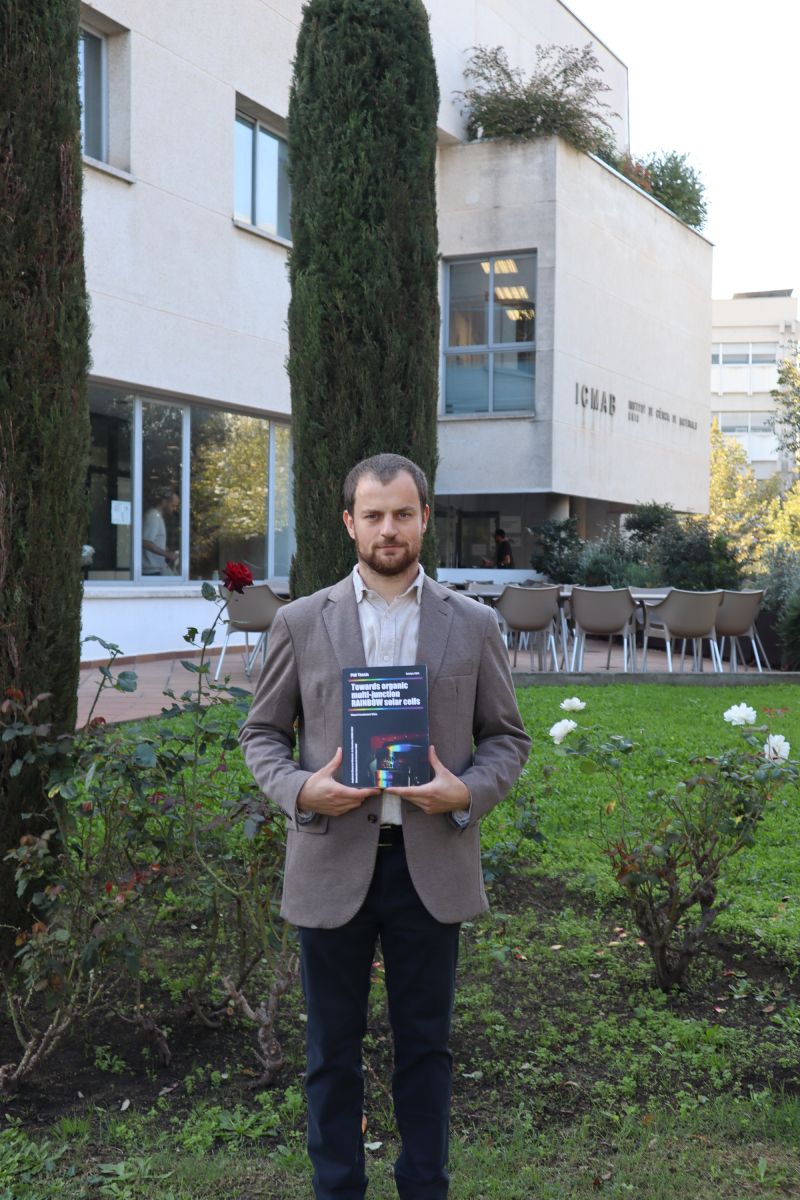
Abstract
Organic photovoltaics (OPV) is a promising green energy technology due to its lightweight, optical tunability, flexibility, and compatibility with industrial roll-to-roll fabrication. However, improvements are necessary for stability and efficiency, particularly for multi-junction OPVs based on tandem geometries. In this PhD thesis, we explore a novel multi-junction approach called RAINBOW. This geometry involves stacking sub-cells laterally instead of vertically to address processing challenges and eliminate the need for current matching. The research aimed to develop a toolkit for optimizing parameters to increase the maximum efficiency of RAINBOW and validate the RAINBOW concept. To characterize and study RAINBOW solar cells, we have developed a spectrum on demand light source (SOLS) setup and a simulation model. Proof of concept devices were fabricated to demonstrate the effectiveness of the RAINBOW concept. Additionally, through a screening of wide band-gap materials, the PTQ10:O-IDFBR blend was identified as having the potential to enhance multi-junction performance and indoor light harvesting. This finding underscores the practical implications of our research and its potential to contribute to the broader field of renewable energy.
Supervisors
Mariano Campoy
Alejandro Goñi
PhD comitee
President: Prof. Marta Mas, ICMAB, Spain
Secretary: Prof. Hernán Ruy Míguez García, Institute of Material Science of Seville (ICMS), Spain
Vocal: Prof. Christoph J. Brabec, Friedrich Alexander Universität Erlangen Nürnberg, Germany
