


Why did you choose the ICMAB?
I had the opportunity to do my master’s thesis at Nanomol Bio group from ICMAB and Nanomol Technologies SL and I enjoyed the experience of performing the work between a public institution and a company with a high scientific impact and a really nice working atmosphere. Then the chance to do an Industrial PhD between the same groups appeared and I had no doubts to repeat it.
How would you explain your research to a non-scientific audience?
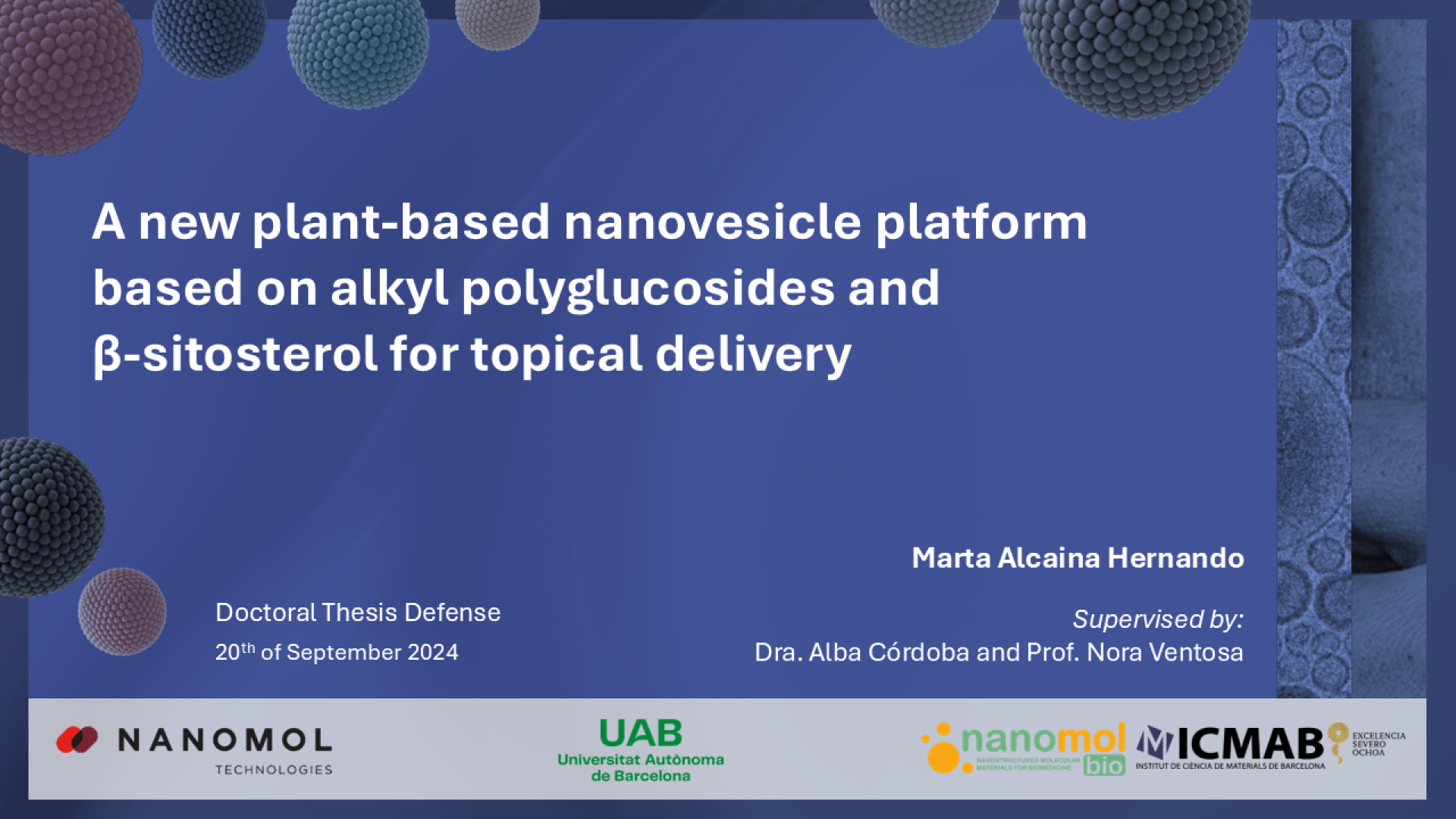
In some cases, it is difficult that the drugs and products that we apply to the skin to do a treatment arrive at their target. My research has focused on the development of novel nanovesicles, which can act as vehicles to transport the molecules to the deeper layers of the skin to perform their action. These nanovesicles are composed of plant-based and biocompatible ingredients and we have studied their role for topical delivery in the dermocosmetic market.
What are the main applications of your research? Could you give us an example?
As I have done an Industrial PhD the final applicability of the research has been one of the bases of the work. The idea is to use the novel vesicles that we have developed to increase the efficacy of cosmetic products such as vitamins or growth factors.
What will you miss the most from ICMAB?
The people, without hesitation.
How do you think this experience will contribute to your training and to your future?
All the experiences that I have lived through all these years have give me different tools for the future, from data analysis to organization and communication either oral or written.
What do you wish you had known at the beginning of your PhD?
That it is a large journey but the defense day, that could be considered one of the most important days of the PhD, would be a great day that I would enjoy, so there’s no need to be nervous about it.
Why did you become a scientist? Which have been your role models?
I think that all the small decisions that I have taken since I was on the secondary school have led me to become the person and the scientist that I am now without just one reason.
Which is your favorite female scientist?
I think I can’t choose one, there are plenty! From the most known and popular to all the women I had the opportunity to work with during all these years.
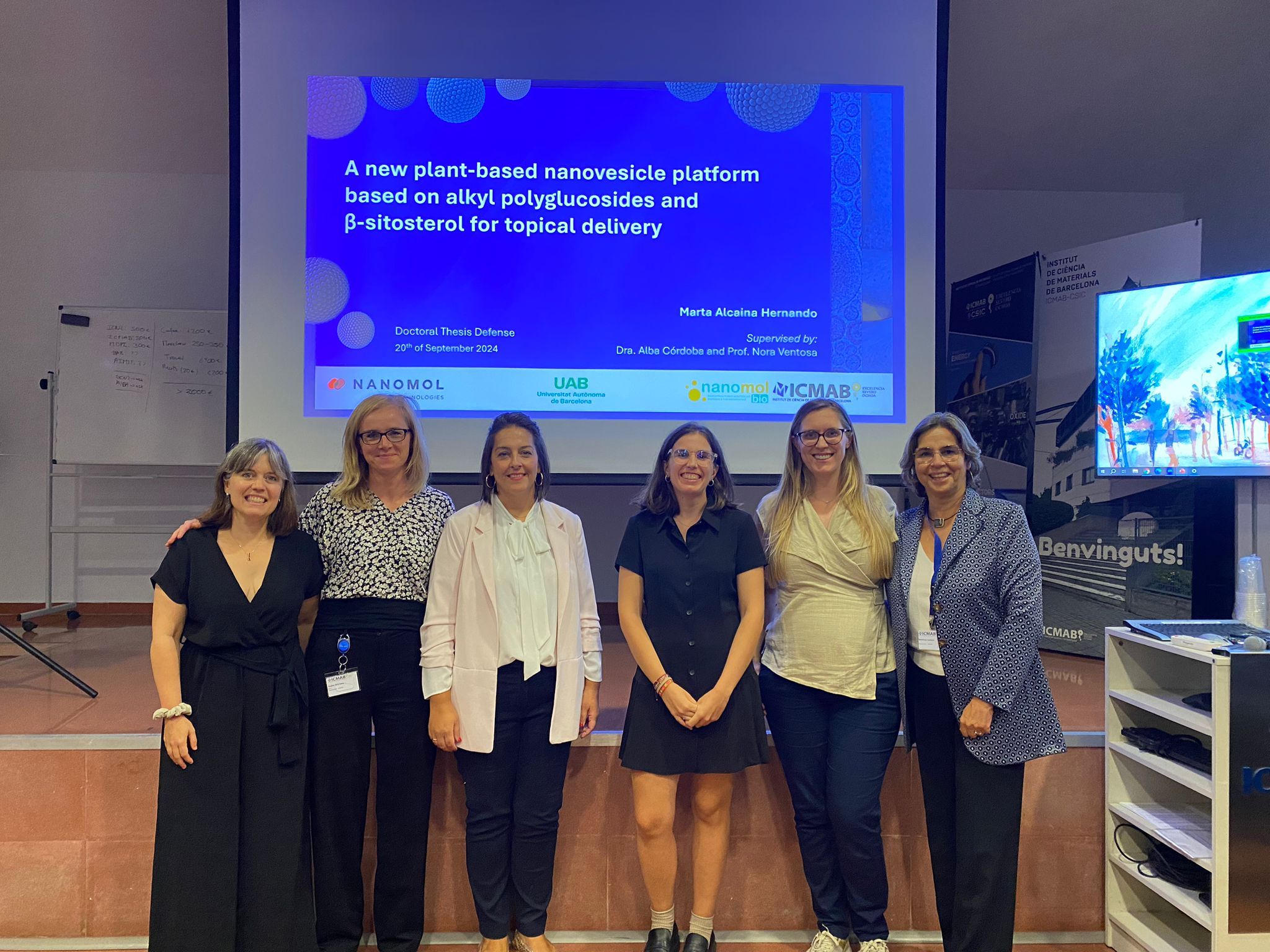
Date: Friday, 20 September 2024
Time: 11AM
Venue: Institut de Ciència de Materials de Barcelona (ICMAB, CSIC) - Sala d'Actes Carles Miravitlles
Abstract
Delivery systems have been widely used in the last decades to enhance the efficacy and safety of drugs and active molecules. Vesicles are one of the most popular drug delivery options in pharmaceutical and healthcare applications. To overcome the limitations of the first vesicular systems, such as conventional liposomes, the research has led to finding novel compositions which increase the stability and tolerability of the vesicular formulations. Nonetheless, this search is a challenging process that depends on different factors such as the components used, the interactions between them or the dispersant media.
This Industrial Thesis presents the development of new vesicular systems using plant based, biocompatible and biodegradable components as building blocks, for topical delivery in healthcare and cosmetic applications. The new delivery systems have been prepared using the DELOS process, a single-step methodology based on compressed fluids which is robust, scalable and with a low environmental impact.
The vesicles were formed by the self-assembly of β-sitosterol (Sit) and alkyl polyglucoside surfactants, mainly lauryl glucoside (LGL) and lauryl glucose carboxylate (LGC). Different systems were developed and characterized by advanced techniques such as dynamic light scattering, cryo electron microscopy and small-angle X-ray scattering.
With the objective to evaluate their role as delivery systems, several active ingredients of interest for dermocosmetic applications were formulated in the novel nanovesicles (NVs) of Sit, LGL and LGC. Small hydrophobic molecules like α-tocopherol (vitamin E), an antioxidant ingredient, and 7 dehydrocholesterol, a precursor of vitamin D, were efficiently loaded in the vesicles. Besides their physicochemical properties, the functionality of the payloads after formulation was also characterized proving that both maintained their activity once they were integrated in nanovesicles. Moreover, other types of active molecules were also tested as payloads, such as ascorbyl glucoside (vitamin C) and niacinamide (vitamin B3), both small hydrophilic molecules, and proteins such as basic fibroblast growth factor, which is a larger biomolecule.
In view of their topical application, the most promising prototypes were assessed in terms of their biological performance. First, in vitro biocompatibility assays with reconstructed human epidermis showed positive results for all the systems tested, with non-irritant effects. Second, ex vivo skin retention studies using multiphoton microscopy and NVs labelled with the fluorophore Nile red demonstrated improved skin permeability of the poorly water soluble fluorophore in comparison with the free molecule.
Finally, exploration of further applications beyond personal care and cosmetics were also evaluated in this Thesis. As a proof of concept, the vesicular systems based on Sit and LGL were tuned with components accepted for pharmaceutical usage. In particular, two derivatives of cholesterol were self-assembled with Sit and LGL to form nanovesicles: a PEG polymer moiety (cholesterol-PEG600) and an ionizable derivative with a tertiary amine (DC cholesterol), which allowed to obtain stable non-ionic or cationic systems, respectively. To complete the proof of concept, the ability to integrate different drug molecules was evaluated for NVs with DC-cholesterol. Cannabidiol, methotrexate and human growth hormone, each payload with different chemical structure and characteristics, were integrated.
Overall, the results obtained in this Thesis point to the successful development of an attractive and versatile platform, based on stable and homogeneous nanovesicles composed of plant-derived ingredients, for topical delivery in dermocosmetic, healthcare and pharmaceutical industries.
Supervisors:
Alba Córdoba Insensé
Nora Ventosa Rull
PhD comitee:
President: Dra. Patricia Gálvez Martín, Universidad de Granda
Secretary: Dra. Mariana Köber, ICMAB-CSIC, Spain
Vocal: Dra. Nuria Oliva, IQS
