


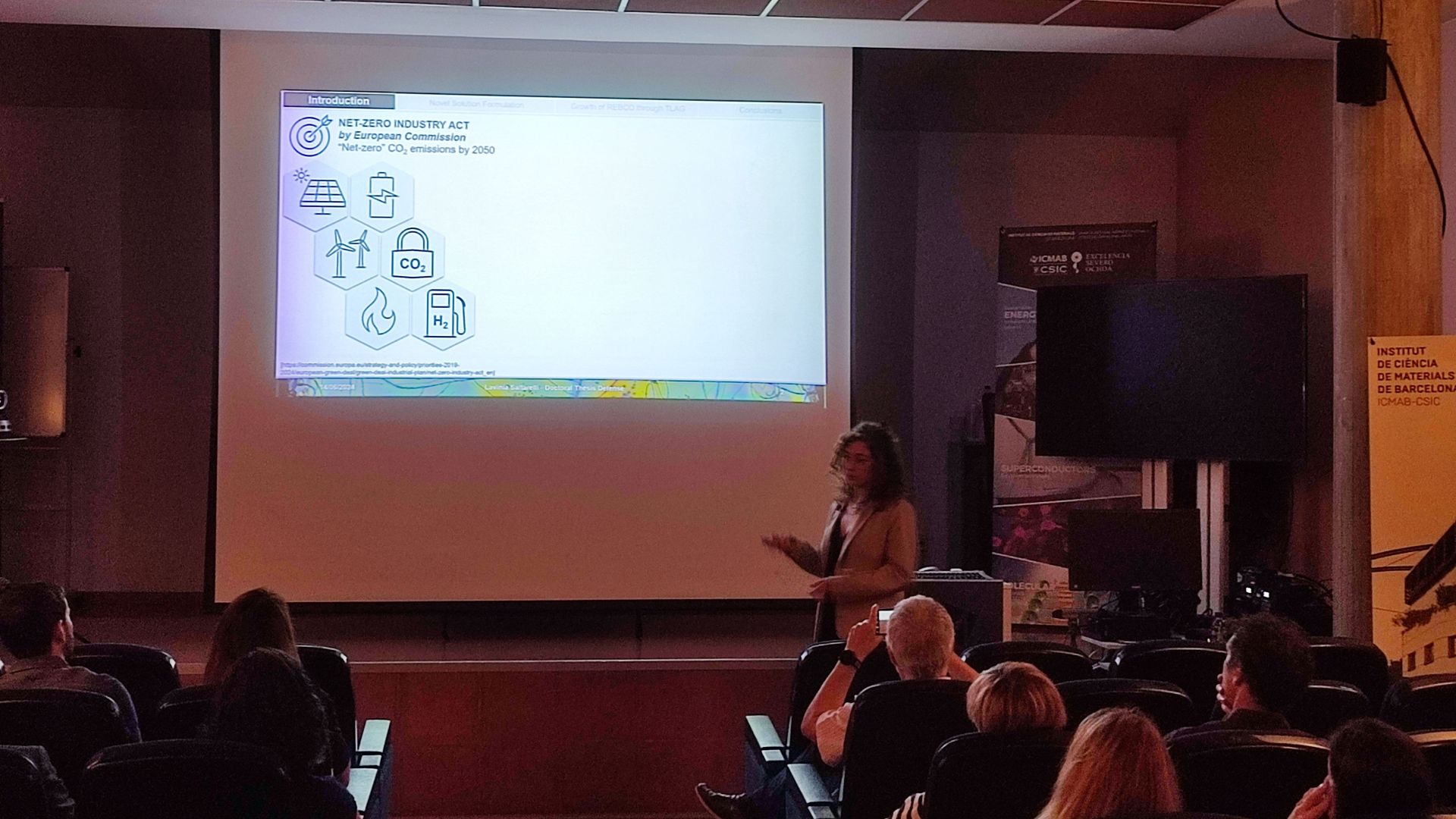
Why did you choose the ICMAB?
During my Master’s Degree studies at University of Rome “La Sapienza”, I had the opportunity of coming to Barcelona through the Erasmus programme to carry out the experimental research of the Master’s Degree thesis. Through a collaboration between Prof. Ilaria Fratoddi from Rome and Prof. Josep Ros and Prof. Jordi García-Antón, both from UAB, I spent 6 months working in the labs of the Inorganic Chemistry department. I fell in love with the city and was decided to come back. Through friends I had met at UAB, I came to know that ICMAB was an excellent research centre and a great place for a possible PhD thesis, and was lucky enough to come across an open position in the SUMAN group with Prof. Teresa Puig and Prof. Xavier Obradors.
How would you explain your research to a non-scientific audience?
The opportunities offered by superconducting materials are the cheap and efficient transport of electrical energy, given that in the superconducting state, these materials do not present any losses when carrying current, a feature common to the widely used copper cables. Despite the production of superconducting tapes (Coated Conductors) in the industrial framework is already a reality, the actual cost of these materials is too high, mainly due to the ways in which the Coated Conductors are produced. Therefore, in my research we try to reduce the production cost by developing these materials through inexpensive chemical-based methodologies, and also through an innovative method which was demonstrated to substantially enhance the production throughput (transient liquid assisted growth, TLAG).
What are the main applications of your research? Could you give us an example?
The major applications of this research include NMR devices, MRI machines, particle accelerators, fusion reactors, implementation in new-generation power grids through power cables and Fault Current Limiters (FCL), new possibilities in transportations (levitating trains and superconducting motors), and thermoelectric materials.
What will you miss the most about ICMAB?
Probably the international atmosphere and the people. I was lucky enough to be able to work alongside of amazing scientists, technicians and collaborators, many of whom I can say have become dear friends.
How do you think this experience will contribute to your training and to your future?
A PhD is not only about the results you achieve, I believe it’s the first, real independent research experience which truly shapes you as a scientist. I am sure the numerous characterization techniques I was able to learn during my PhD at ICMAB, the development of the project and especially the many collaborations we had will contribute importantly to my scientific career.
What do you wish you would have known at the beginning of your PhD?
I would have liked to know that it is a marathon and not a sprint, but at the same time the months go by very quickly. One must find a balance between work and personal life, enjoying your time off to be able to fully focus at work. It’s not as easy as it seems.
Why did you become a scientist? What have been your role models?
I have always wanted to do something meaningful but personally motivating and I love challenges. I became a scientist in an unexpected way through a radical career change during my first year of university studies, but I believe it was the best decision and which has shaped my life in a completely different, yet exciting way.
Which is your favourite female scientist?
I cannot choose only one female scientists from history, I have great respect towards all female scientists who contributed impressively to the development of science in a world which was mostly governed by men, with courage, determination and resilience.
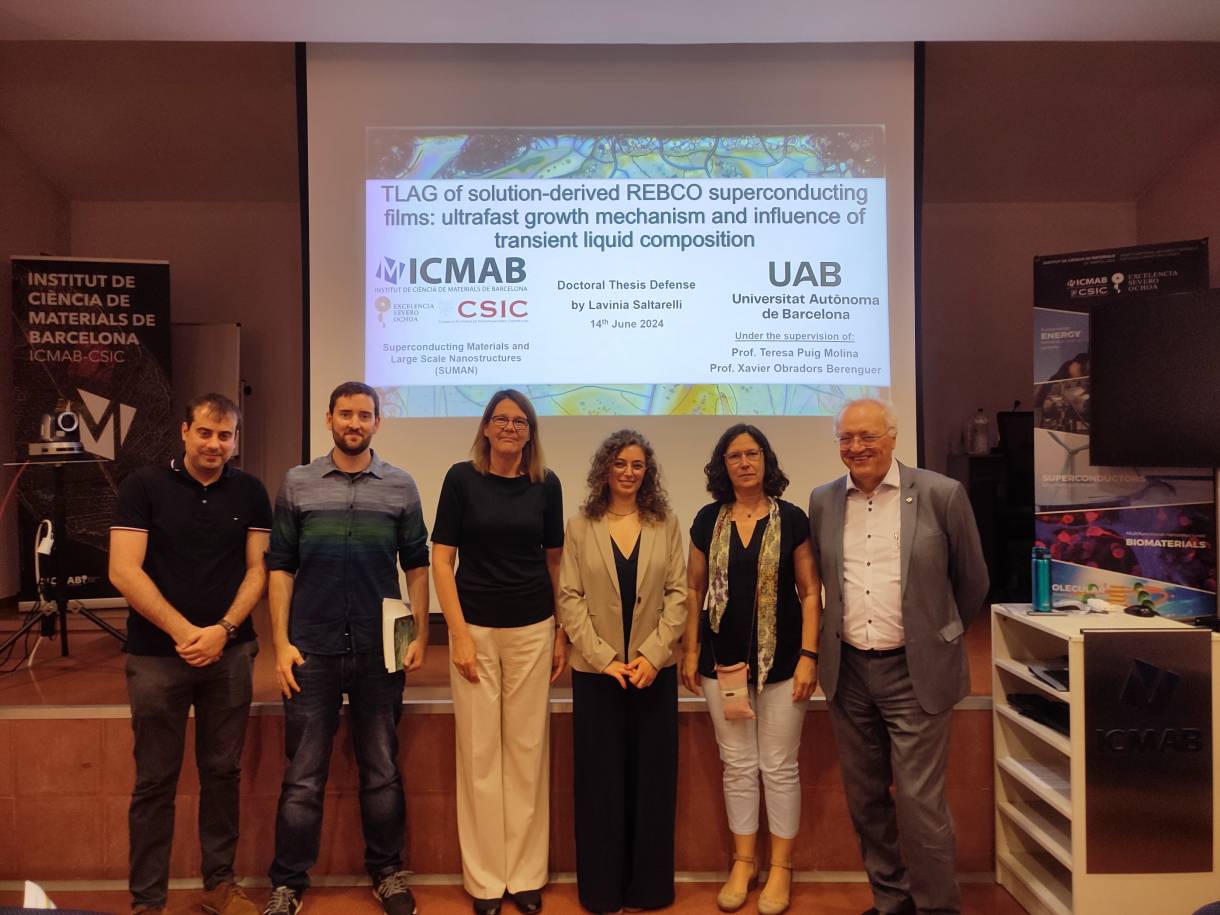
Date: Friday, 14 June 2024
Time: 11AM
Venue: Institut de Ciència de Materials de Barcelona (ICMAB, CSIC) - Sala d'Actes Carles Miravitlles
Abstract
The unparalleled feature of High Temperature Superconducting (HTS) materials of lossless electrical current conduction up to liquid nitrogen temperature and at high magnetic fields has encouraged research on REBa2Cu3O7-δ (REBCO, RE= rare earth elements) systems to unravel the opportunities towards a plethora of different applications. Nonetheless, the excessive production costs of the commercialized HTS Coated Conductors (CCs) are impeding their worldwide spread. The work conducted in this thesis sets as an objective the reduction of the high cost/performance ratio of REBCO superconductors by coupling a cost-effective chemical solution deposition-based (CSD) methodology to the innovative transient liquid assisted growth (TLAG) process. The development of novel, robust chemical solutions led to the attainment
of unprecedented chemical and microstructural homogeneity of films showing thickness of up to 2.7 mm, through implementation of two fundamental innovations. High-purity metal propionate powder precursors have been synthesized through facile and inexpensive one-pot methods. Additionally, the careful selection of an amine additive enhanced the rheological properties of the chemical precursor solution for YBCO and REBCO film fabrication. Variation of the (Ba:Cu) molar ratio of the initial chemical solution resulted in films of different transient liquid composition, enabling the in-depth analysis of the out-of-equilibrium kinetic mechanism of TLAG. Strict control of the processing parameters led to high-performance films exhibiting critical current density values up to 3 MA cm−2 and growth rates beyond 2000 nm·s−1. Advanced characterization techniques, such as in-situ synchrotron X-ray diffraction, shed light on the influence of transient liquid supersaturation, driving force towards YBCO nucleation and its successive epitaxial growth. These analyses have generated new and fundamental insights into the complex kinetic mechanism of TLAG.
Supervisors:
Teresa Puig
Xavier Obradors
PhD comitee:
President: Prof. Maarit Karppinen, Aalto University, Finland.
Secretary: Felip Sandiumenge Ortiz, ICMAB-CSIC, Spain.
Vocal: Eduardo Solano Minuesa, ALBA synchroton, Spain.
