


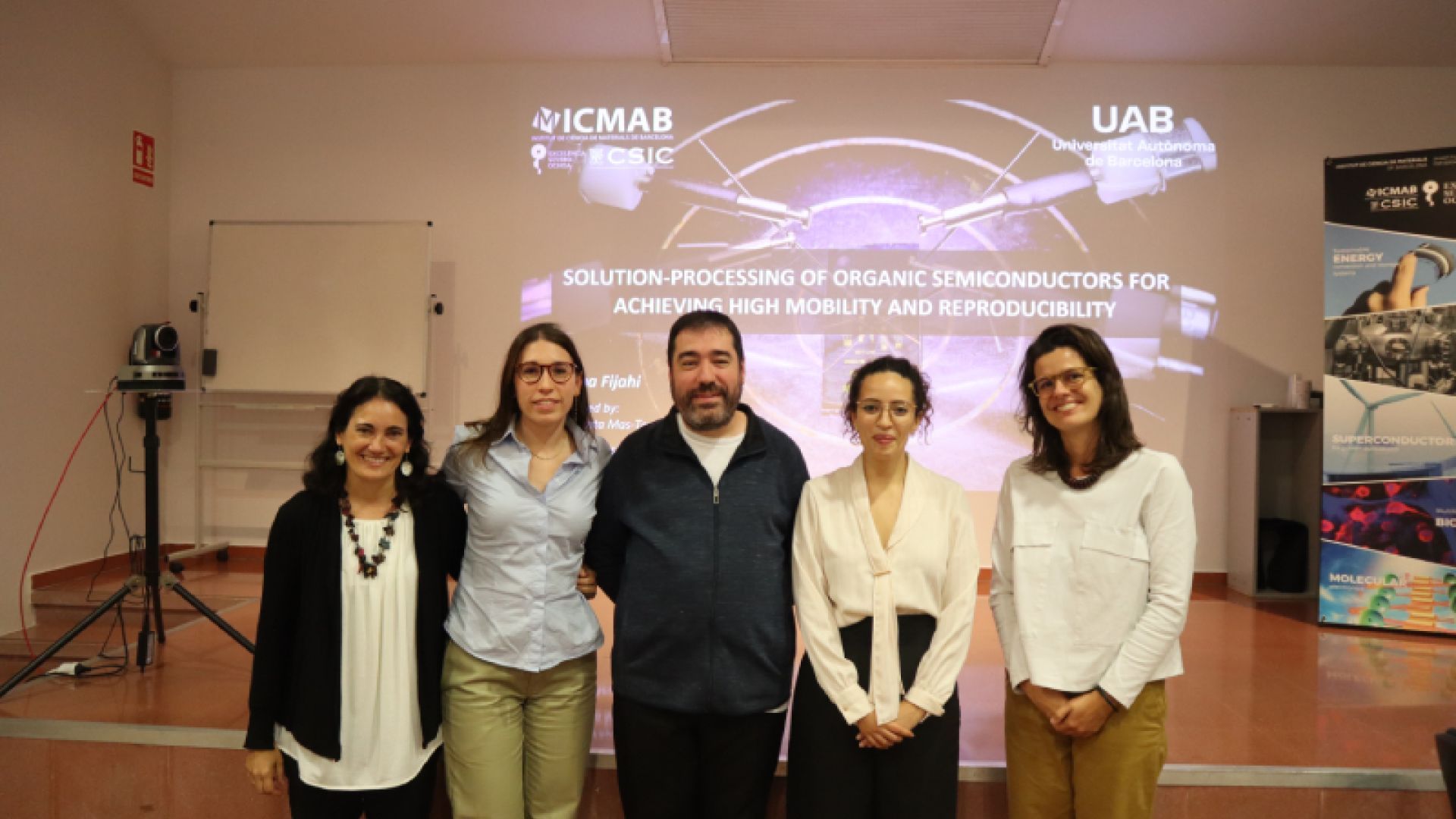
Why did you choose the ICMAB?
I chose ICMAB because it's internationally recognized for cutting-edge research in materials science, with a strong interdisciplinary approach. The opportunity to work with experts in various fields such as nanotechnology, superconductors, and functional materials was appealing. ICMAB offers access to state-of-the-art equipment and a collaborative environment, which makes it a great place to push the boundaries of scientific discovery.
How would you explain your research to a non-scientific audience?
My research focuses on creating new materials that can help us solve real-world problems. Imagine if we could make electronics smaller, faster, and more energy-efficient. The materials I study have special properties that make that possible, allowing us to develop more sustainable technologies for everything from smartphones to renewable energy. In simple terms, I work on materials that can make our future greener and more efficient.
What are the main applications of your research? Could you give us an example?
The main applications of my research, which focuses on Organic Field-Effect Transistors (OFETs), lie in flexible electronics, sensors, and low-cost, sustainable devices. Unlike traditional transistors made from silicon, OFETs use organic semiconducting materials, which are lighter, more flexible, and can be produced at a lower cost.
An example would be their use in flexible displays or wearable electronics. Imagine a smartphone or a smartwatch with a screen that can bend or roll without breaking. OFETs are key to making these kinds of flexible, foldable devices a reality. They're also ideal for biomedical sensors that can be integrated into clothing or even skin patches to monitor health conditions, thanks to their flexibility and biocompatibility.
What will you miss the most from ICMAB?
I will miss the collaborative spirit and the intellectual exchange with colleagues. The environment at ICMAB encourages sharing ideas and working together across different disciplines, which has been incredibly stimulating. I'll also miss the close-knit community and the friendships I've developed here, which have been a big part of my journey.
How do you think this experience will contribute to your training and to your future?
This experience has not only deepened my technical knowledge but also sharpened my problem-solving and critical-thinking skills. The interdisciplinary nature of my research at ICMAB has given me a broader perspective on materials science and its applications. It has also prepared me for future challenges, whether in academia or industry, by teaching me how to navigate complex research problems and collaborate with a diverse group of experts.
What do you wish you had known at the beginning of your PhD?
Many experiments don’t go as planned, and that’s okay. It’s part of learning and improving. It’s important to be persistent, patient, and adaptable. Also, maintaining a healthy work-life balance is key to staying motivated and productive in the long run.
Why did you become a scientist? Which have been your role models?
I became a scientist because I’ve always been curious about how things work, and I love the idea of discovering something new that could have a positive impact on the world. My role models include Marie Curie, for her groundbreaking work in physics and chemistry, and more recently, figures like Ada Yonath, who revolutionized our understanding of ribosomes, or Angela Belcher, known for her work in biotechnology and materials science. They all have shown that perseverance and passion can lead to incredible breakthroughs.
Which is your favorite female scientist?
My favorite female scientist is Marie Curie. Not only was she the first woman to win a Nobel Prize, but she also won it in two different fields: physics and chemistry. Her groundbreaking research on radioactivity has had an immense impact on science and medicine, and her determination in a male-dominated field was incredibly inspiring.
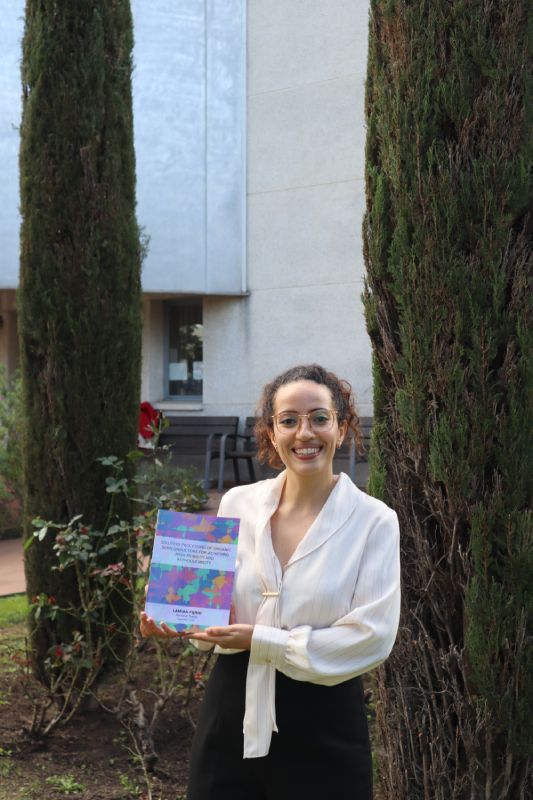
Abstract
This thesis explores various facets of organic field-effect transistors (OFETs), focusing on their fabrication, electrical characterization, and applications in organic electronics. It highlights the growing interest in organic electronics for their potential in low-cost and large-area applications, emphasizing the advantages of organic semiconductors (OSCs) deposited using solution-based techniques compatible with roll-to-roll processes. The importance of OSC film morphology and structure for device performance is also underscored, with OFETs recognized as promising platforms for studying OSC transport properties.The thesis primarily focuses on the fabrication of OFETs using the bar-assisted meniscus shearing (BAMS) technique for depositing OSCs. This cost-effective, scalable printing method can produce large-area crystalline films. One key study involves the use of charge transfer complexes of a benzothienobenzothiophene derivative as the active layer in OFETs, while another examines the processing of dinaphtho[2,3-b:2′,3′-f]thieno[3,2-b]thiophene (DNTT) derivatives. The OSCs are blended with polystyrene to improve solution processability, reduce charge traps, and enhance device mobility. Further research investigates the morphology and structure of thin films of the asymmetric OSC 2-decyl-7-phenyl[1]benzothieno[3,2-b][1]benzothiophene, created through both evaporated and solution-based methods. By adjusting coating parameters, solution formulations, and post-annealing treatments, the controlled formation of kinetic or thermodynamic polymorphs is achieved, leading to improved OFET performance.
Supervisor
Marta Mas Torrent
PhD comitee
President: Dr. Jaume Garcia Amorós, UB
Secretary: Dr. Carme Martínez-Domingo, ICMAB
Vocal: Dr. Claudia Delgado Simao, EURECAT
