


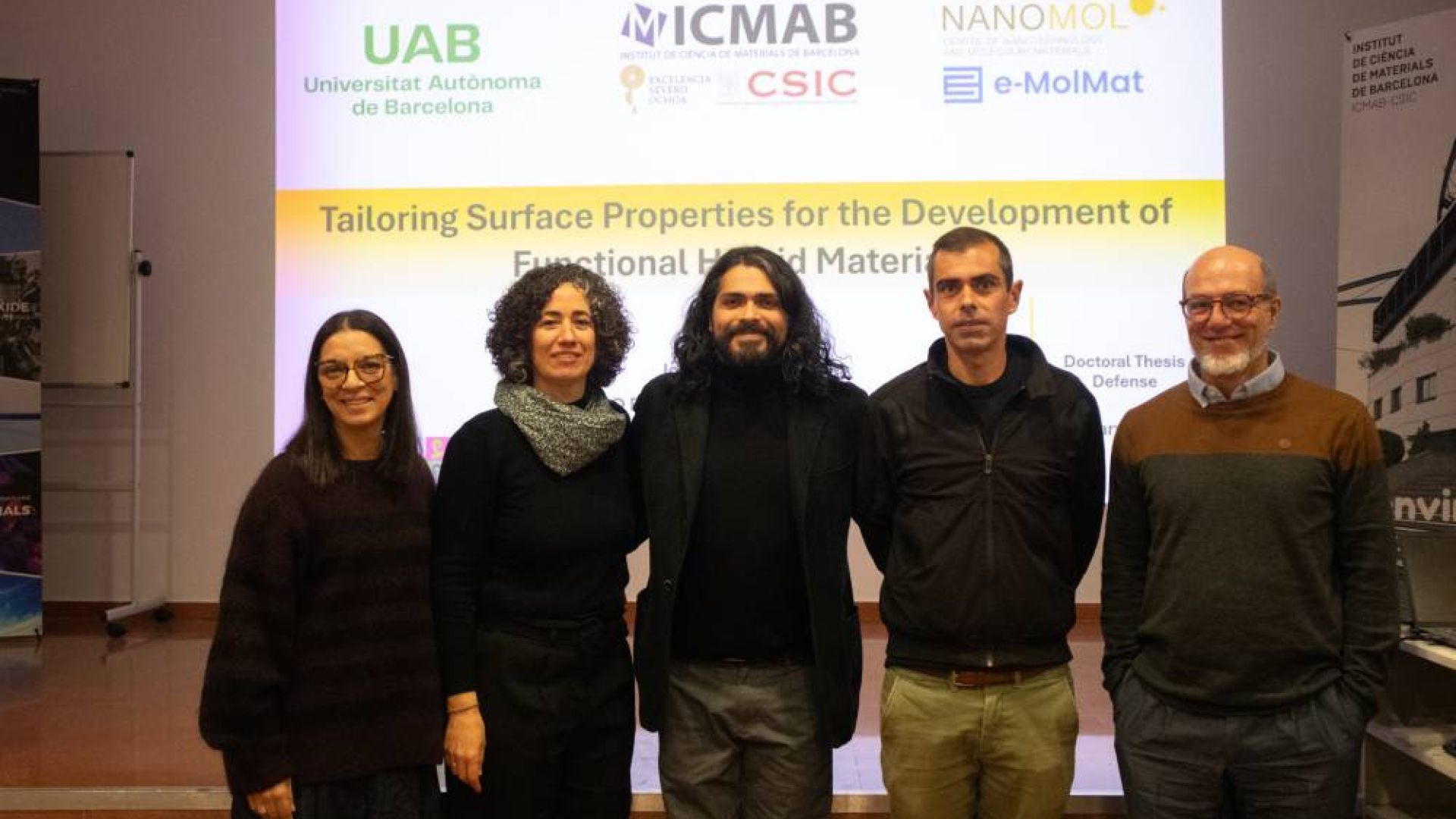
What was the focus of your PhD research? Can you explain it to a non-scientific audience?
My research focused on creating new, advanced materials by working with extremely small particles (nanoparticles). I used materials like gold and an interesting liquid metal alloy called Eutectic Gallium Indium (EGaIn) to produce these tiny particles. By the modification of their surface, I improved their ability to carry out specific chemical reactions, which is useful for wastewater treatment, among others. In simple words, I worked on designing innovative materials that could help to improve and opens up new possibilities for future technologies.
Can you briefly summarize the main findings or contributions of your research? You can give us some examples.
With the aim of developing new hybrid functional materials, the preparation of Au nanoparticle films modified with redox-active molecules at the liquid-liquid interface and their application for the removal of organic pollutants in water (dyes) by electrocatalysis has been effective. Also, the preparation, stabilization, and functionalization of EGaIn nanoparticles with redox-active molecules in water with small ligands opens an exploration into the development of this type of materials by greener approaches.
Why do you think your research is important, and how could it impact your field or society?
I focused the impact of my research in society as, first, I worked on creating hybrid materials that act as efficient platforms for cleaning water by breaking down harmful, long-lasting pollutants. These materials help address the serious issue of industries releasing toxic compounds into the environment, which can harm both people and ecosystems over time. Second, the design of greener methods to produce advanced materials directly in water, avoiding the need for toxic and hazardous solvents. This approach not only makes the process safer but also reduces waste, contributing to a more sustainable way of creating new materials.
What was one of the most challenging aspects of your PhD journey, and how did you overcome it?
There were many challenges during the PhD, but the first was starting from scratch as a biochemist, in a completely different field, in this case organic electronics and hybrid nanomaterials, which had a huge impact on me, where I learned a lot during my training and development as a researcher. Then I would say starting a PhD in a completely different topic, with a pandemic in between, also added more challenges to the process.
Why did you end up at ICMAB? And what do you think you will miss the most from this institute?
When I was planning to do a PhD, I found the ICMAB website, where I checked out the group of Prof. Jaume Veciana (Nanomol Department), and I was very interested in his research, so I contacted him. After some time, I had the chance to come to ICMAB for a meeting and I was introduced to Dr. Núria Crivillers, where I finally decided to apply for the DOCFAM fellowship. What I will miss most about the Institute is the warm working environment and my colleagues.
What’s next for you after completing your PhD? Do you have any upcoming projects or goals?
There are a lot of opportunities now, whether it's going into R&D in a private company or staying in academia and doing a postdoc abroad, I'm open to all options at the moment.
How has completing this PhD changed you, either professionally or personally?
A PhD definitely gives you many fundamental tools to continue and grow professionally, where many skills are enhanced by these years of research. Personally, these PhD years have allowed me to listen and be more aware of myself and what my body and mind need in order to create a balance between my personal and academic life.
What advice would you give to someone just starting their PhD journey?
My advice would be that persistence is everything. It is also important to see that a negative result can be an opportunity and to make sure that what you are doing is reproducible. Even for people who have a background other than your PhD topic, it is not a limitation but an opportunity to test your knowledge and skills. Finally, they should not neglect their mental health, because without it, is very difficult to follow this path.
Why did you become a scientist? Which have been your role models that inspired you to pursue a PhD?
I became a scientist thanks to the English writer Aldous Huxley, many of his texts and visions encouraged me to understand biochemistry, and I stayed in science thanks to the motivation of my professors at the Universidad Austral de Chile, where I felt in love with research, which eventually led to the exploration of different fields as materials science and nanotechnology.
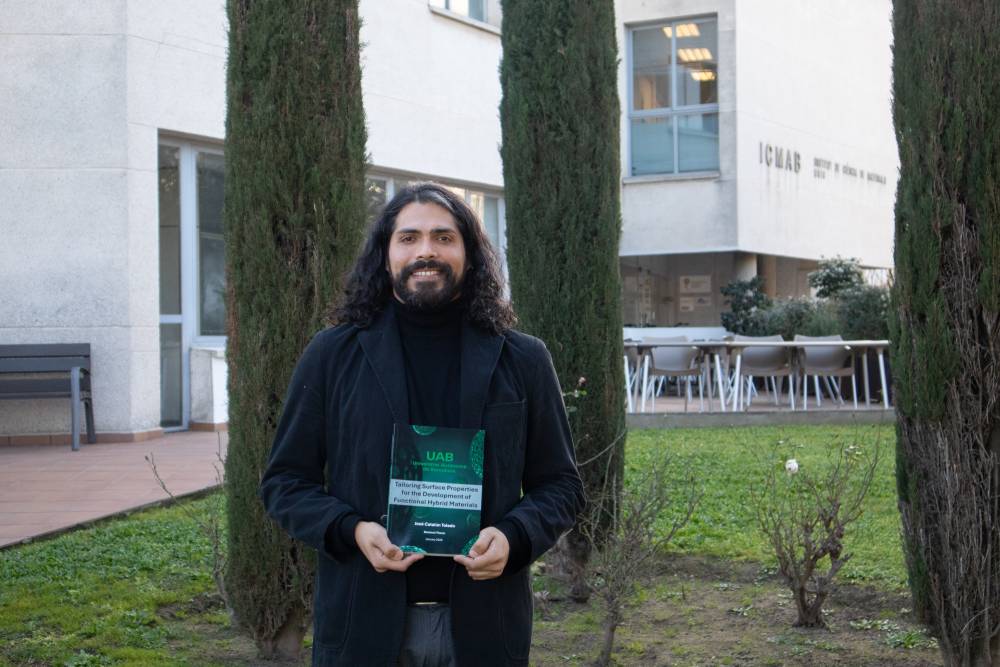
Abstract
This research focuses on hybrid materials by functionalizing inorganic surfaces with organic switchable molecular ligands to develop responsive nanomaterials for molecular electronics and catalysis. Electrochemically responsive self-assembled monolayers (SAMs) featuring stilbene and ferrocene units were integrated into Au/SAM/EGaIn molecular junctions, demonstrating light-triggered conductivity switching. Functionalized gold nanoparticles and catalytic composite films were synthesized using alkyne derivatives, showing enhanced dye degradation. EGaIn liquid metal was explored as soft top-contact electrodes and nanoparticles, stabilized via phosphonic acid derivatives, achieving enhanced redox properties. Nanographene-based SAMs were investigated as molecular wires and others with tunable chiroptical properties, making them suitable for spintronics. This work highlights the potential of tailored organic-inorganic interfaces in advancing hybrid nanomaterials with unique, adaptable properties.
Supervisors
- Núria Crivillers, ICMAB-CSIC, Spain
PhD Comitte
- President: Neus Bastús, ICN2, Spain
- Secretary: Javier Lodeiro, Universidad Nova Lisboa, Portugal
- Vocal: Ignacio Moreno Villoslada, Universidad Austral de Chile, Chile
