


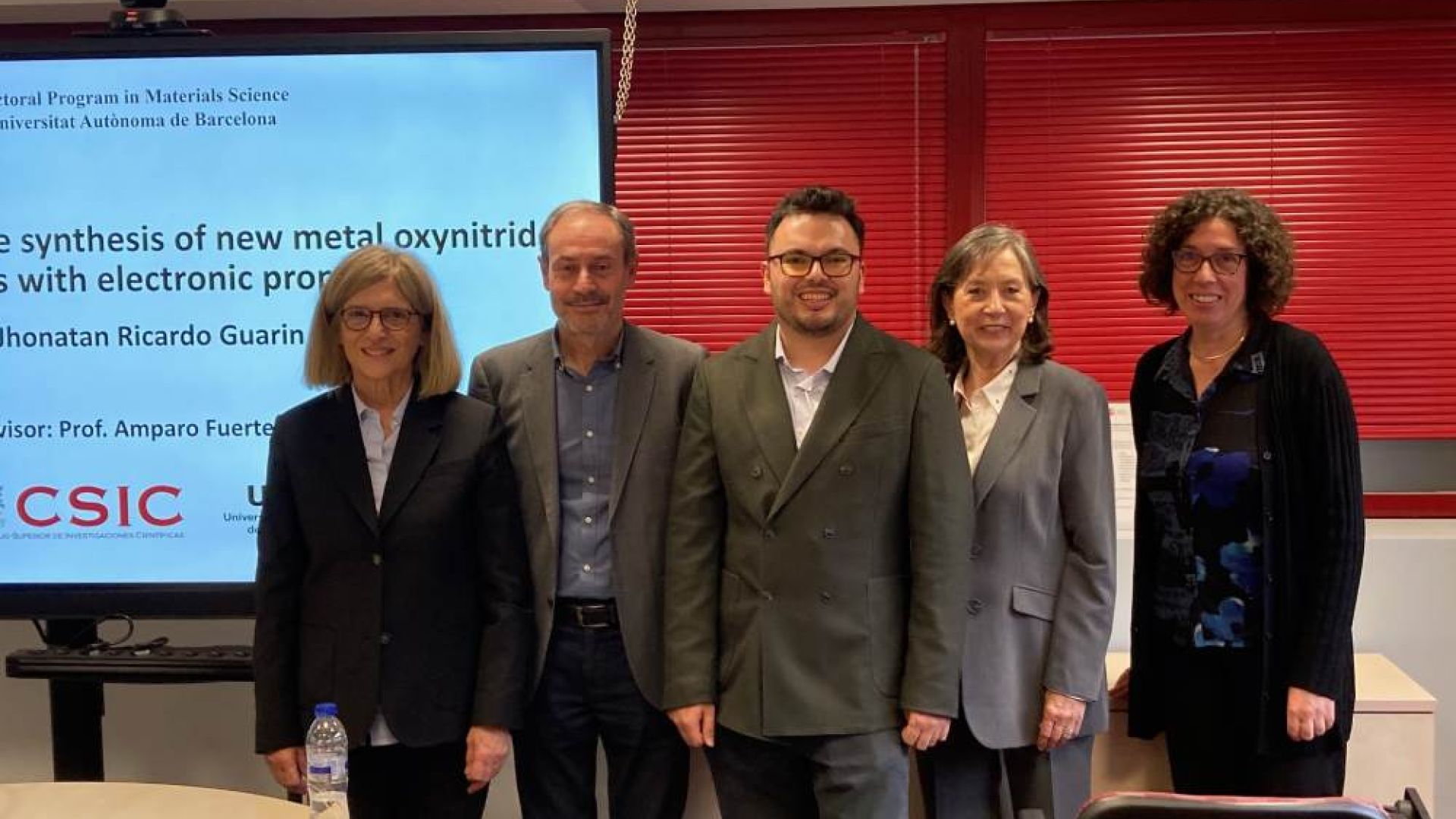
What was the focus of your PhD research? Can you explain it to a non-scientific audience?
This thesis was focused on the developing of new high temperature synthetic approaches of metal oxynitrides with electronic properties. The majority of compounds in nature are oxides, and there are only few examples of nitrides or oxynitrides like sinoite (Si2N2O) that have been found in meteorites. The number of oxynitrides synthesized in the laboratory is also very small compared to the hundreds of oxidic compounds. In this thesis we obtained several new rare earth oxynitrides with electrical, magnetic and optical properties.
Can you briefly summarize the main findings or contributions of your research? You can give us some examples.
The main contributions of my thesis are a new method of synthesis of LaTaON2 at high temperature, the synthesis of the first triple oxynitride perovskite with formula Eu3Ta3O3.66N5.34, the first Ruddlesden Popper n = 1 phases of rare earth cations and tantalum R2TaO4-xNx for R = La, Ce, Nd, Eu , and the new oxynitridosilicate NdSrSiO3N as a host to produce europium luminescent materials.
Why do you think your research is important, and how could it impact your field or society?
The new solids prepared in this thesis have allowed to broaden the world of materials area. Their different applications as for example in the field of luminescence are important to prepare materials at a lower cost and better luminescence capacity, the new oxynitrides could also be used as photocatalysts in water splitting processes to produce hydrogen as an energy source.
What was one of the most challenging aspects of your PhD journey, and how did you overcome it?
The waiting time for approval of the synchrotron X-ray and neutron diffraction measurements. Fortunately during all these years we prepared about 10 proposals that were approved.
Why did you end up at ICMAB? And what do you think you will miss the most from this institute?
I ended up at ICMAB because I was looking for scholarships to do a PhD and I read Amparo Fuertes Miquel' project and as I liked it I decided to contact her, after some interviews I was selected to do the PhD. From the institute I will miss many things especially the good atmosphere and the teamwork that exists in the solid state chemistry group.
What’s next for you after completing your PhD? Do you have any upcoming projects or goals?
If I have the opportunity, I hope to apply for a postdoc and return to research.
How has completing this PhD changed you, either professionally or personally?
Doing my PhD has shown me that it is worth dreaming and that with discipline and effort anything is possible.
What advice would you give to someone just starting their PhD journey?
Don't give up at the first attempt, doing research is sometimes not easy, but over time you will gain the experience that will enable you to deal with the problems that arise in your research.
Why did you become a scientist? Which have been your role models that inspired you to pursue a PhD?
At school I liked subjects related to mathematics, chemistry, physics, mechanics or electricity. Finally I studied chemistry and I had the opportunity to do my TFG for two years with a teacher who had done her PhD in Seville on materials, so I also wanted to come to Europe and learn more about techniques such as synchrotron X-ray and neutron diffraction since in my home country we don't have access to them.
Who or what helped you the most during your PhD journey, and is there anyone you'd like to thank?
I would like to thank a large number of people, such as friends, family and experts in the subject with whom we collaborated, but I would especially like to thank my director Dr. Amparo Fuertes Miquel who gave me the opportunity to work in her research group, thanks to her help, experience and scientific rigour in the area of oxynitrides, we were able to obtain the results that allowed me to finalise this thesis.
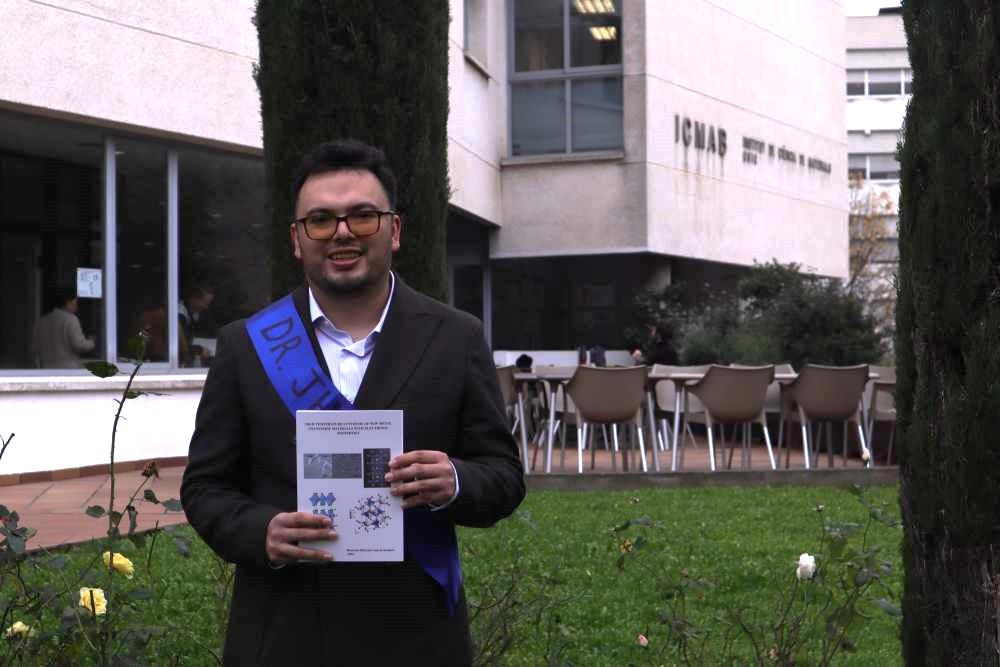
Abstract
In this work we have developed a new synthetic approach of perovskite oxynitrides of tantalum and rare earth metals at temperatures between 1200 and 1700 oC in N2 or N2/H2 (95%/5% V/V) atmospheres, controlling the anion content by the starting stoichiometric ratios of metal nitrides, oxides and oxynitride reactants. New oxynitridosilicates of rare earth and alkaline earth cations have been also prepared by a similar method, as host structures to produce luminescent materials.
We have prepared the pseudocubic perovskite LaTaON2 using solid state reactions at 1500 oC under N2 that produce samples with high crystallinity, sintering degree and a high dielectric permittivity. We report the synthesis of the perovskite EuTaO2.37N0.63 and the new ferromagnetic triple perovskite Eu3Ta3O3.66N5.34 at 1200°C using N2 or N2/H2 gas and mixtures of EuN, Ta3N5 or TaON and Eu2O3 as reactants. The crystal structure of Eu3Ta3O3.66N5.34 exhibits two different A sites that are occupied by Eu3+ and Eu2+ with partial order along the c axis. We have found the new family layered perovskites with n=1 Ruddlesden-Popper type structure R2TaO4-xNx for R = La, Ce, Nd, Eu and x=2.69, 2.81, 2,54, 1.20 respectively, that were obtained under N2 at temperatures between 1200°C and 1700°C. They are the first examples of rare earth transition metal oxynitrides with n=1 Ruddlesden-Popper structure, and show different crystal structures and magnetic properties.
Finally, the synthesis of the new oxynitridosilicates NdEuSiO3N and NdSrSiO3N with ß-K2SO4 structure is reported. Upon excitation at 405 nm, NdEuSiO3N and NdSrSiO3N:Eu, with band gaps 2.37 eV and 3.72 eV respectively, exhibit orange red luminescence with broad emission bands centered between 605 and 639 nm
Supervisor
Amparo Fuertes Miquel
PhD comittee
President: Xermán de la Fuente Leis, Instituto de Nanociencia y Materiales de Aragón (CSIC), Spain
Secretary: Rosa Palacín Peiró, Institut de Ciència de Materials de Barcelona (CSIC), Spain
Vocal: Lourdes Mestres Vila, Facultad de Química, Universitat de Barcelona, Spain
