


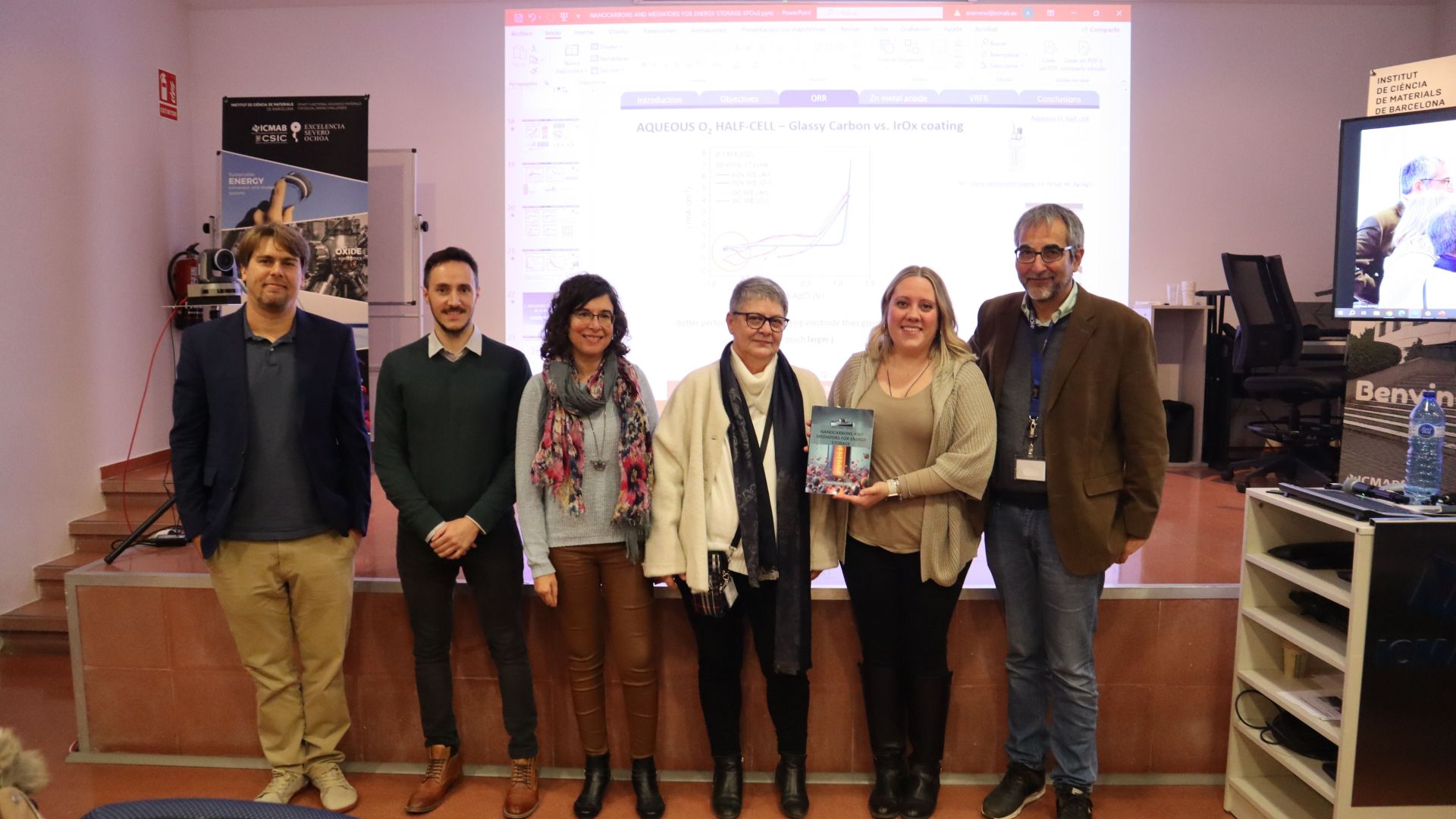
My PhD research focused on improving energy storage systems, specifically batteries, to support the transition from fossil fuels to renewable energy sources. Since renewable energy sources like solar and wind are intermittent, we need efficient ways to store the energy they generate. My work concentrated on two types of batteries: Zinc-Oxygen batteries and Vanadium Redox Flow batteries, as alternatives to the commonly used Lithium-ion batteries. These alternatives aim to address safety concerns and the reliance on critical raw materials like lithium. I explored the use of nanoparticles in the electrolytes of these batteries to enhance their performance.
Can you briefly summarize the main findings or contributions of your research? You can give us some examples.
The main findings of my research involved the development and evaluation of Zinc-Oxygen and Vanadium Redox Flow batteries electrolytes. The major contribution was the discovery that adding conducting nanoparticles to the electrolyte, even at low concentrations, can significantly enhance the battery's performance when combined with a redox couple. This synergy, that we called it mediated percolation, allows for improved kinetics and cyclability without requiring high amounts of conducting nanoparticles.
Why do you think your research is important, and how could it impact your field or society?
My research is important because it addresses the critical need for reliable, efficient and sustainable energy storage solutions. By developing safer and more efficient battery technologies, we can facilitate the widespread adoption of renewable energy sources, reducing our reliance on fossil fuels and mitigating climate change. The use of nanoparticles in electrolytes offers a promising approach to improving battery performance, which can lead to better energy storage systems for various applications, from consumer electronics to grid-scale energy storage.
What was one of the most challenging aspects of your PhD journey, and how did you overcome it?
One of the most challenging aspects of my PhD journey was fighting against the frustration of not getting results immediately. In university labs, you often work with well-established practices and protocols, but during your own research, it's a different story. Experiments can fail, and sometimes you find unexpected results or nothing at all. This can be very demotivating.
However, I learned to overcome this frustration by focusing on my long-term goals and discussing my challenges with my colleagues and professionals. It's important to remember that research is a process that involves setbacks and surprises. Sometimes, you find something valuable through serendipity, and other times, you have to iterate multiple times to get the desired results.
Talking about my frustrations with my lab mates and supervisors was incredibly helpful. They provided valuable advice, shared their own experiences, and helped me stay motivated. It's crucial to maintain a supportive network and to be open about your challenges. By doing so, you can gain new perspectives, stay focused on your goals, and ultimately overcome the frustrations that come with the research process.
Why did you end up at ICMAB? And what do you think you will miss the most from this institute?
During my Bachelor, I had the opportunity to participate in an Erasmus program at the University of Strathclyde in Glasgow, where I was involved in research on energy storage, although it was a different type of batteries.
Upon returning, a colleague of mine who was working at ICMAB informed me about a position related to battery research. Given my interest in the topic and my familiarity with the campus (as I studied my BSc in Chemistry at the Universitat Autònoma de Barcelona – UAB – placed in the same campus as ICMAB), I applied immediately. What I will miss the most from my PhD times are my lab colleagues and the collaborative and supportive environment.
What’s next for you after completing your PhD? Do you have any upcoming projects or goals?
After completing my PhD, I realized that I really enjoy performing research management. As a result, I’m now working as a research manager at ICMAB. In this role, I apply the skills and knowledge I gained during my PhD to manage and coordinate research projects. So, I’ve already achieved my goal of working as a research manager.
How has completing this PhD changed you, either professionally or personally?
Completing my PhD has significantly enhanced my professional skills, particularly in research, problem-solving, and communication. It has also taught me resilience, perseverance, and the ability to manage complex projects. Personally, it has made me more confident and capable, with a deeper understanding of the importance of sustainable energy solutions and the role I can play in advancing this field. Additionally, my experience has prepared me well for my current role as a research manager.
What advice would you give to someone just starting their PhD journey?
My advice would be to set clear goals, stay organized, and seek feedback regularly. It's important to maintain a healthy work-life balance and to be open to learning from setbacks. Staying patient will also help you navigate the challenges of the PhD journey.
I would also like to highlight the importance of taking advantage of the resources available at ICMAB. The mentorship program now available, for instance, is really interesting and something I would have greatly benefited from during my own PhD. Having a mentor who can guide you on issues beyond the scientific day-to-day of your PhD can be incredibly valuable. So, please take advantage of having a mentor at ICMAB; it can make a significant difference in your PhD experience.
Remember that your research has the potential to make a significant impact, so stay motivated and focused on your goals. And don't hesitate to reach out to your colleagues and supervisors for support when you need it.
Why did you become a scientist? Which have been your role models that inspired you to pursue a PhD?
I became a scientist not only because of my passion for understanding how our world works but also because of my Chemistry and Physics teachers during high school. They were incredibly passionate and passed on their love for science to their students. From that moment, I knew I wanted to pursue a degree in Chemistry. Their inspiration and my own curiosity drove me to continue in the field and eventually pursue a PhD. Moltes gràcies Àngels i Itziar!
Who or what helped you the most during your PhD journey, and is there anyone you'd like to thank?
My lab mates and colleagues really helped me throughout my PhD journey. When experiments were not working or I obtained undesired results, my colleagues (now friends) were always there to support me. We had a very cohesive group, and their support was invaluable. I would also like to thank the entire ICMAB community for their guidance and resources.
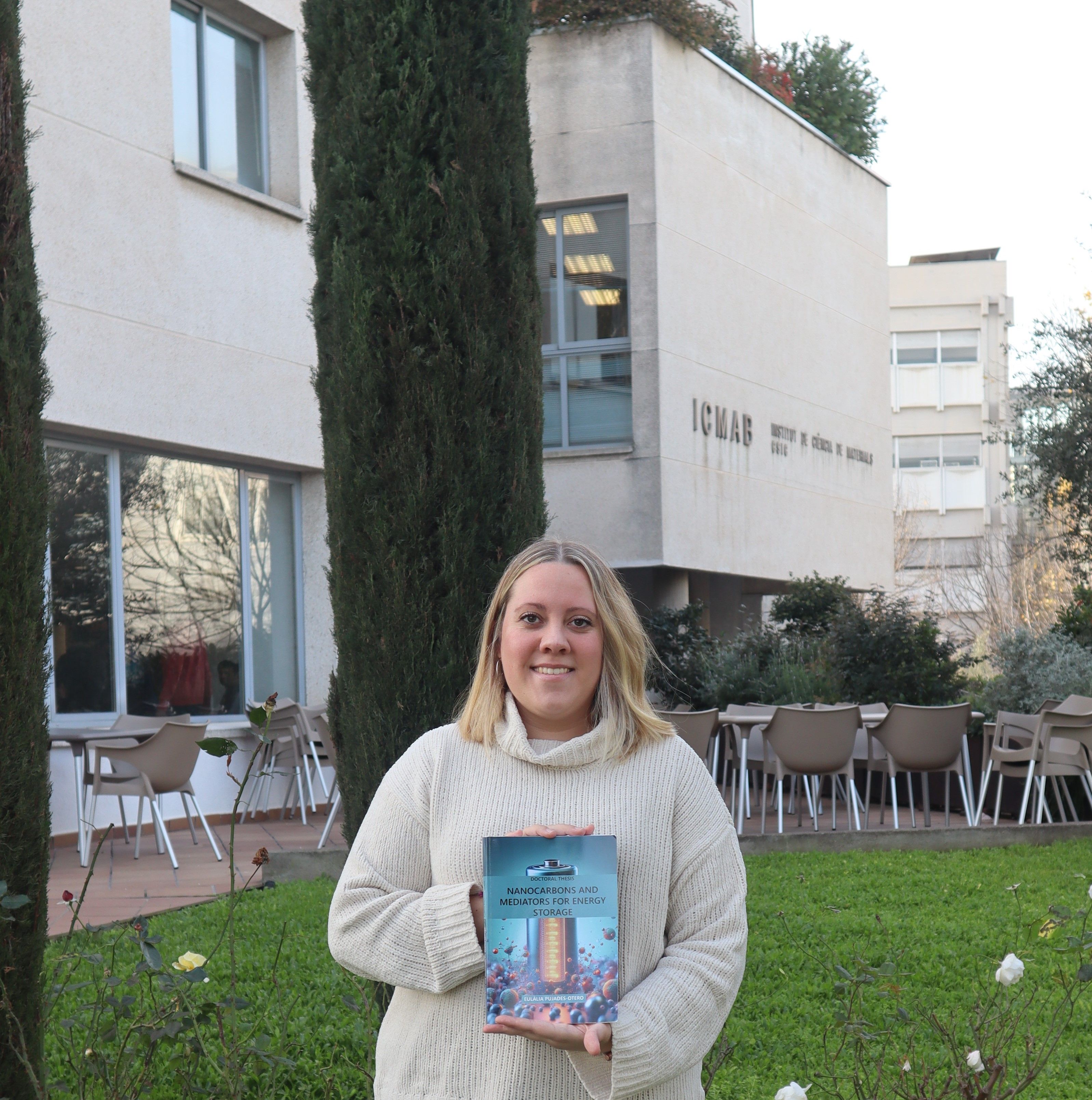
Abstract
Renewable energy sources are important for switching from harmful energy systems to eco-friendly options because of environmental problems caused by industrialization and the growing demand for fossil fuels. Energy Storage Systems (ESS) are crucial for the development of renewable energy sources, which are inconsistent and depend on time and weather. The growth of electric vehicles also requires new ESS that can store and provide high energy and power. Electrochemical energy storage is especially important for this transition.
This thesis focuses on the enhancement of ESS through the addition of nanocarbons and multiredox nanosized oxides as dispersed conducting agents in zinc-air batteries and vanadium redox flow batteries (VRFBs). Nanocarbons are expected to increase the total active surface area, improve electrical conductivity, and build percolation networks for electrons. Multiredox nanosized oxides, such as polyoxometalate clusters and iridium oxohydroxide, act as redox mediators and catalysts for the oxygen reactions, enhancing the efficiency and reversibility of the battery cycling.
Various characterization techniques to understand the structure, composition, and electrochemical properties of the nanomaterials have been employed within the thesis. Electrochemical measurements are conducted to evaluate the performance of the modified electrolytes and anodes in VRFBs and zinc-air batteries.
For Zn-air batteries, the research highlights the significant enhancements in current densities and reductions in overpotentials for oxygen redox reactions achieved by incorporating nanocarbons as dispersed conducting agents and redox particles as mediators. The discovery of a bipolar effect on the conducting particles facilitated additional charge transfer mechanisms, leading to superior electrochemical performance. Although initial attempts to use a single electrolyte for both Zn and O2 half-cells were unsuccessful due to pH incompatibilities and Zn passivation, the use of carbon-based suspensions showed promise in improving cycling stability through protective coatings on Zn anodes.
In the domain of VRFB, the incorporation of Super P nanoparticles was found to form percolation networks that decreased charge transfer resistance and overpotentials while increasing current density. The complete redox flow cell study underscored the necessity of optimizing cell geometry to prevent clogging and improve electrolyte flow, highlighting the potential of small amounts of carbon black as a cost-effective alternative to traditional high-cost collectors.
The results are expected to contribute to the development of more efficient and sustainable energy storage systems, enhancing the transition to renewable energy sources and reducing environmental impacts.
Supervisors
- Nieves Casañ-Pastor
- Dino Tonti
PhD Comitte
- President: Ashley Philip Black Serra, ICMAB-CSIC, Spain
- Secretary: Eva Maria Pellicer Vilà, UAB, Spain
- Vocal: Leandro Nicolás Bengoa, ICN2, Spain
