


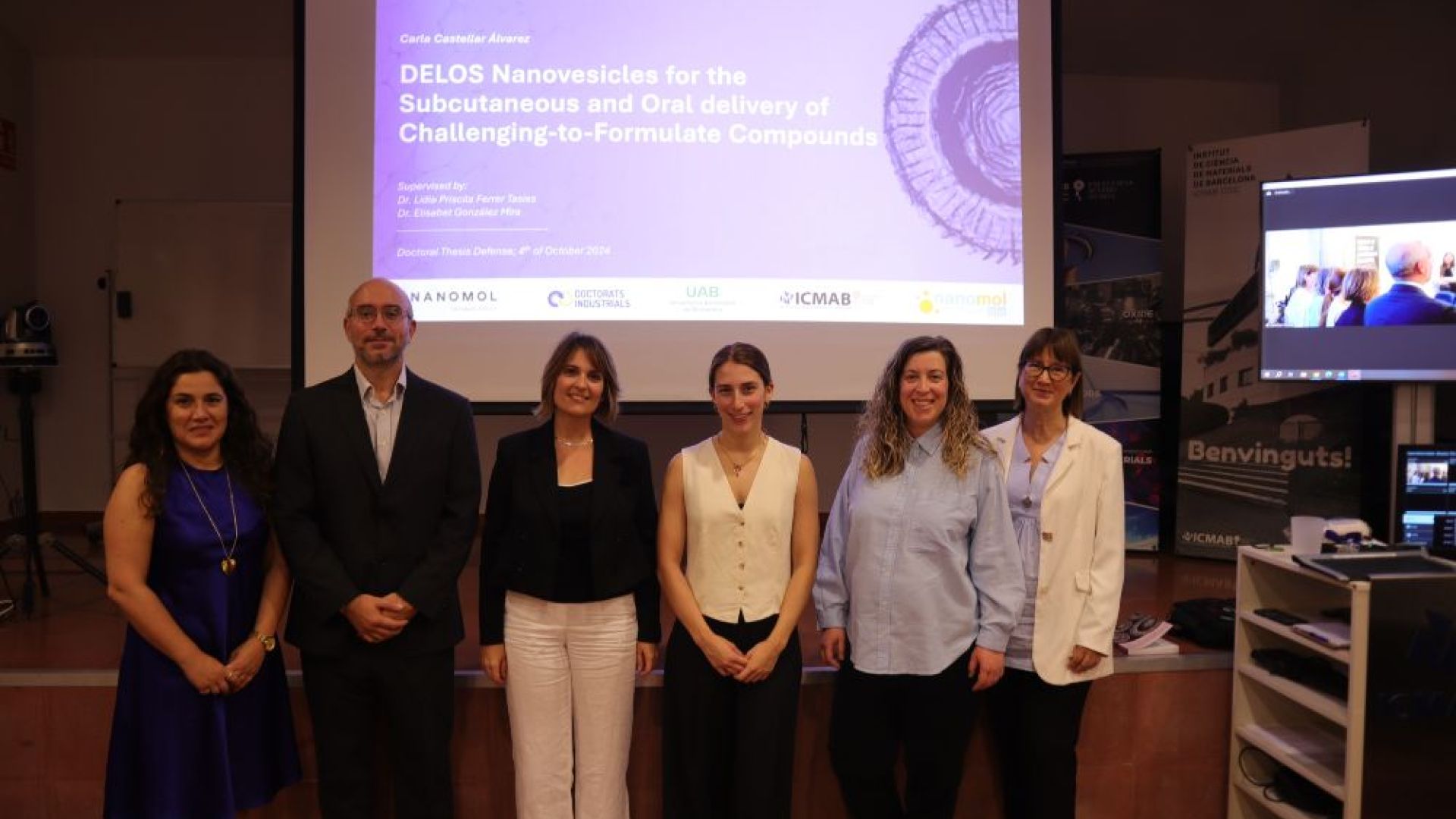
Why did you choose ICMAB?
My relationship with both Nanomol Technologies S.L. and ICMAB goes back several years. I joined Nanomol Technologies S.L. in 2017 and had the opportunity to combine my work there with a master’s research project at ICMAB that same year. My time at ICMAB was highly rewarding; I learned a great deal and thoroughly enjoyed the experience at such a cutting-edge research center. This positive experience made the idea of pursuing an industrial Ph.D. in collaboration with both Nanomol Technologies S.L. and ICMAB especially appealing to me.
How would you explain your research to a non-scientific audience?
At Nanomol Technologies, we develop drug delivery systems called DELOS nanovesicles, which are carriers that transport active medicinal ingredients directly to their specific sites of action in the body. They are designed to ensure that the right amount of medicine goes to the right place, sometimes even at the right time. My thesis focused on optimizing these nanovesicles for two new administration routes that had never been studied before with our systems: the subcutaneous and oral routes.
What are the main applications of your research? Could you give us an example?
DELOS nanovesicles could increase the effectiveness and reduce the side effects of certain medications, helping patients stick to their treatments. They could also make it possible to use new types of medicines that need an appropriate carrier, allowing us to treat conditions that were previously untreatable.
Optimizing these nanovesicles for oral and subcutaneous routes expands their versatility. Patients generally prefer oral administration; it is more familiar and convenient. The subcutaneous route, on the other hand, allows for subcutaneous depots that can release medicine gradually over time, reducing the frequency of doses, side effects, and overall improving patient compliance. The findings in my thesis contribute to the development of more effective, patient-friendly medicines.
What will you miss the most from ICMAB?
Since I will continue working at Nanomol Technologies, I expect to maintain a close connection with ICMAB, which I’m very grateful for. Otherwise, I would truly miss the people I worked with, who have become good friends and a significant part of my experience there.
How do you think this experience will contribute to your training and future?
Completing a Ph.D. not only makes you an expert in your research area but also enhances other important skills, like communication, critical thinking, and managing resources effectively. These skills are valuable for any future professional endeavors.
What do you wish you had known at the beginning of your Ph.D.?
That a negative result is still a meaningful result. In science, it is essential to stay flexible because things do not always go as planned. But that is okay; negative results still contribute to scientific progress.
Why did you become a scientist? Who have been your role models?
I have always been drawn to creativity, and in high school, I struggled to choose between an artistic and scientific path. Ultimately, I chose science because I believe creativity is a vital part of research too, and working in R&D lets me combine my love for creativity with my passion for science. My teachers served as role models, inspiring me to pursue this career.
Who is your favorite female scientist?
It’s hard to pick just one. Many remarkable women have advanced science in incredible ways. I had the privilege of being supervised by two brilliant female scientists, Dr. Elisabeth González and Dr. Lidia Ferrer, whose critical thinking and commitment to scientific rigor were truly inspiring to me.
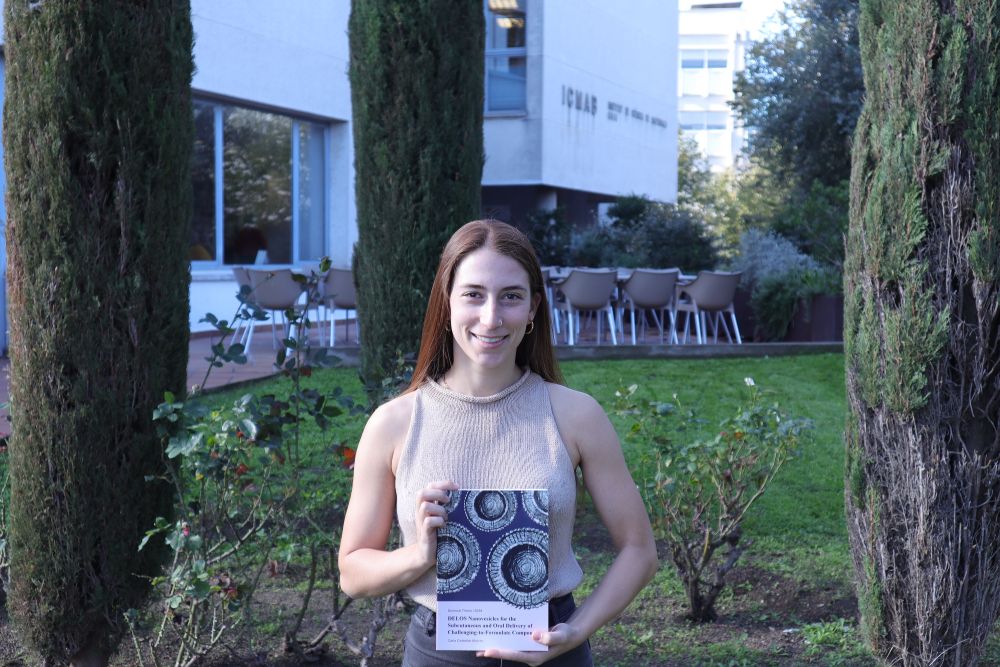
Thesis Abstract
The ongoing shift from traditional orally bioavailable small molecules to novel drug modalities requires more sophisticated and innovative drug delivery strategies. These advanced strategies aim to improve the solubility and stability of challenging-to-formulate drugs while ensuring selective delivery with predictable rates and mechanisms to specific organs, tissues, or cells.
In this context, DELOS nanovesicles, also known as Quatsomes, offer a promising solution to address the complexities associated with novel, challenging-to-formulate drugs. DELOS nanovesicles are a unique class of nanocarriers composed of sterols and ionic surfactants. They are produced using the DELOS technology (Depressurization of an Expanded Liquid Organic Solution), an eco-efficient, scalable, one-step method based on compressed CO2 for producing colloidal systems.
DELOS nanovesicles have shown potential to deliver a variety of drug modalities, ranging from small molecules to biologics, via intravenous and topical administration routes. However, their application for other administration routes remains unexplored, limiting their versatility.
This thesis aims to investigate the potential of DELOS nanovesicles as drug delivery systems specifically formulated for subcutaneous and oral administration routes.
In pursuit of this goal, a systematic design of experiments was conducted to refine DELOS nanovesicles composition, using exclusively excipients listed in the United States Food and Drug Administration (FDA) Inactive Ingredients Database, to pursue the development of a biocompatible and regulatory-oriented formulation for the intended administration routes.
Considering the subcutaneous route, a hybrid in situ-forming subcutaneous depot was developed based on the optimized DELOS nanovesicles and a thermoreversible hydrogel. Different concentrations of the thermoreversible Poloxamer 407 were tested in combination with the DELOS nanovesicles. Through rheological characterization of the obtained hydrogels, the 17% w/w Poloxamer 407 was identified as optimal for subcutaneous administration, being injectable at 22 °C and forming a cohesive in situ depot at 37 °C. In vitro tests showed a consistent release pattern of the DELOS-NV over an 8-hour period, following zero-order kinetics. Additionally, a highly hydrophobic compound, as challenging-to-formulate “beyond the Rule of Five” (bRo5) molecule, was entrapped into the DELOS-NV based thermoreversible hydrogel. This compound was successfully loaded into the DELOS nanovesicles with high entrapment efficiency, and the nanoconjugates demonstrated long-term stability under storage conditions (5 ± 3 °C) and at 40 ± 3 °C. When integrated into the 17% w/w Poloxamer 407 hydrogel, a 10-hour zero-order in vitro release profile of the nanoconjugate was achieved, highlighting the potential of the developed hybrid system for extended subcutaneous drug delivery.
To explore the feasibility of using the DELOS nanovesicles for the oral administration route, the impact of these nanovesicles on the intestinal epithelium was assessed using Caco-2 in vitro models. A nanoconjugate containing a model protein (bovine serum albumin) was prepared, and isothermal titration microcalorimetry characterization confirmed strong hydrophobic binding of the protein to the DELOS nanovesicles, suggesting no premature release of the protein before or during in vitro permeation assays. Besides, two additional model molecules, a small molecule (lucifer yellow) and another protein (insulin), were evaluated by loading them into the DELOS nanovesicles. Permeation assays in Caco-2 monolayers demonstrated that DELOS-NV significantly enhanced the permeation of lucifer yellow, while both proteins (bovine serum albumin and insulin) did not permeate the Caco-2 barrier. These results suggest that DELOS-NV have potential for either systemic or local delivery in the gastrointestinal tract, depending on the integrated molecule.
To further harness their potential for gastrointestinal applications, DELOS-NV were developed into a biosensor incorporating an oligonucleotide as a sensing biomolecule, capable of detecting miR21, a microRNA overexpressed in colorectal cancers. The biosensor exhibited very high sensitivity and specificity, highlighting the potential of DELOS-NV for dual purposes in therapy and diagnosis.
Supervisors
- Lidia Priscila Ferrer Tasies
- Elisabet González Mira
PhD comittee
- President: Dr. Maria José Garcia, UB
- Secretary: Dr. Ana Catarina da Silva, Universidad Fernando Pessoa
- Vocal: Dr. Adolfo Lopez, Medincel
