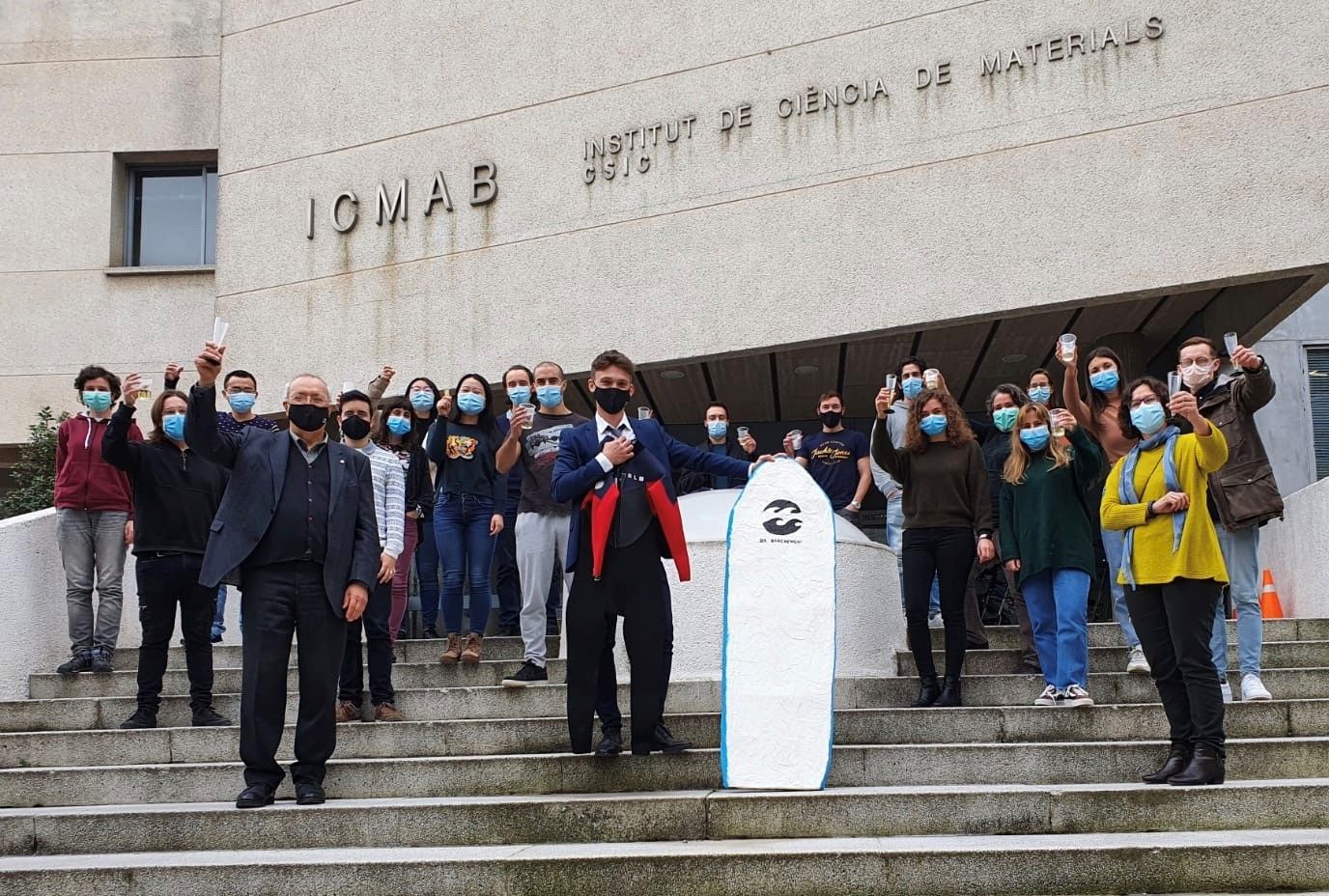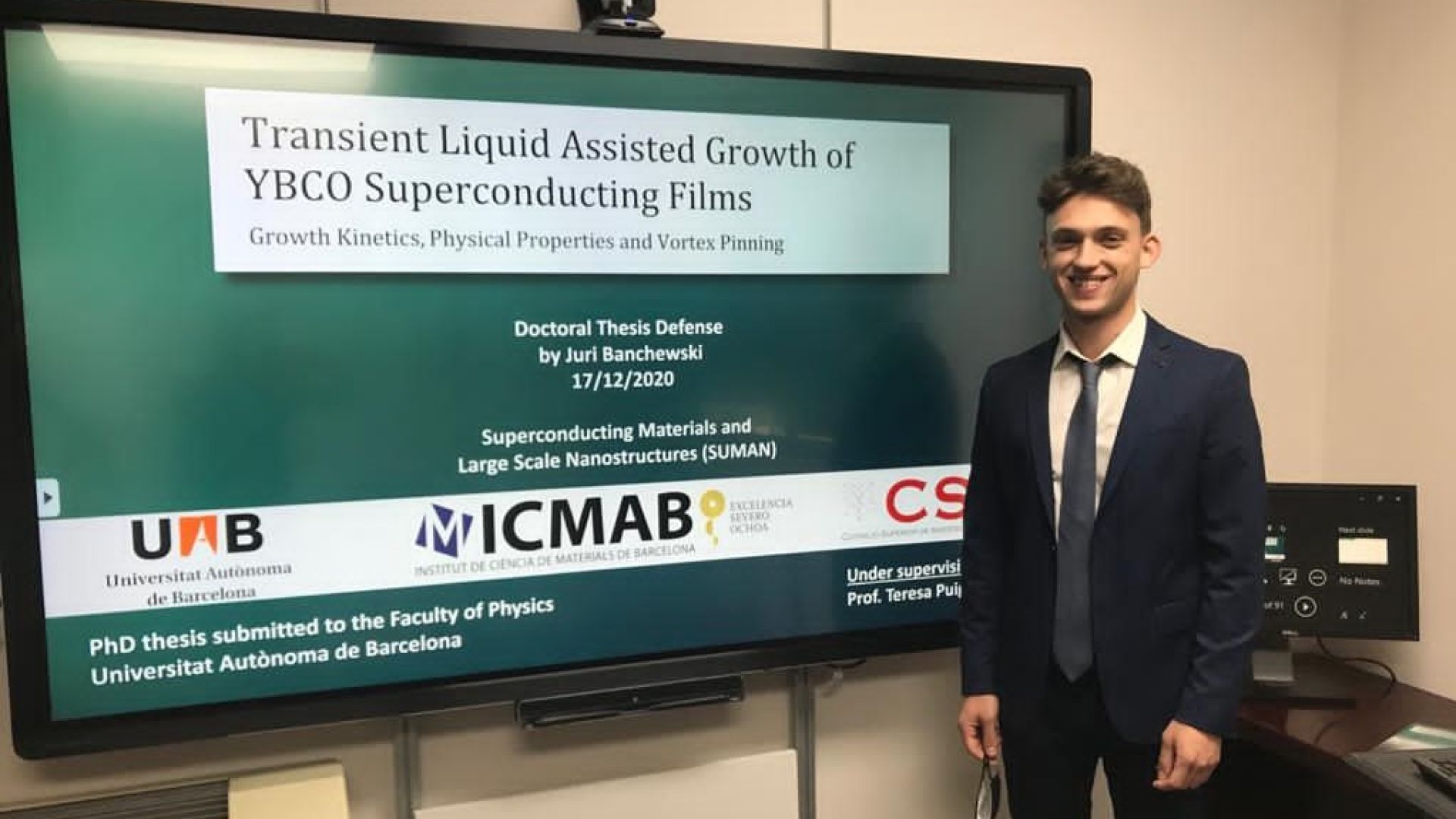
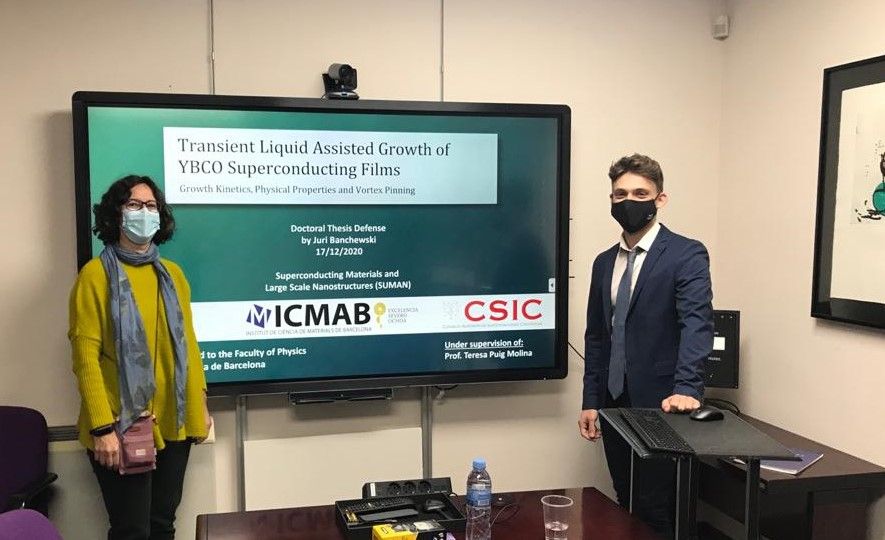
His PhD Thesis was supervised by SUMAN group leader, researcher Prof. Teresa Puig, and was in the framework of the Physics PhD Programme of the Universitat Autònoma de Barcelona (UAB). The PhD Committee was formed by Prof. Bernhard Holzapfel, Karlsruhe Institute of Technology (KIT), Germany (President), Dr. Joffre Gutierrez, ICMAB-CSIC (Secretary) and Prof. Salvador Ferrer Fabregas, Alba Synchrotron (Vocal).
Juri, why did you choose the ICMAB for your PhD?
How would you explain your research to a non-scientific audience?
High temperature superconductors (HTS) have the potential to be part of the next technological revolution. These materials can conduct electrical current without loss of energy (other than, for instance, the old-school light bulbs). The technological implications of that are immense. HTS materials could yield a new generation of light, energy-efficient electrical motors, transform our energy grids and give rise to compact fusion reactors, potentially the only energy source that can scale with our growing consumption and provide energy on demand.
Why don’t we see these applications everywhere yet? HTS materials require careful growth on metallic tapes on lengths of hundreds of meters making the conductor too expensive for commercial use. In this project, we are developing a novel method to grow the HTS material in a cost-effective way, opening a door to its marketability.
What are the main applications of your research? Could you give us an example?
I worked on developing a novel, liquid-based growth approach to crystallize epitaxial YBa2Cu3O7-d (YBCO) films. The growth method will affect the field of YBCO wire production and its concepts could be applied to any other complex material system which allows transient liquid phase formation. As an example, once the YBCO is grown on flexible metallic tape, at a low cost, it will become the enabling technology for compact fusion reactors (SPARC), light rotating machines (EcoSwing) and transmission cables (AmpaCity project)
From the lessons learnt here, which one do you value the most?
What will you miss the most from ICMAB?
Being surrounded by interesting people from various research fields. Also the awesome coffee in the ICMAB cafeteria. You will know it once you’ve tried!
How do you think this experience will contribute to your training and to your future?
It widened my experimental toolset, expertise in coding and communication skills. I think that the balance makes the difference and that this is not taught at many research facilities.
What are your plans once you finish your PhD?
If the PhD thesis doesn’t turn into a best-selling book, I will look for a job in R&D, data research or other applied fields.
What do you wish you had known at the beginning of your PhD, that now you can recommend to the ones who are starting?
Why did you become a scientist? Which have been your role models?
I had an early interest for how nature works and, luckily, it was conserved throughout all these years. My early role model was especially a physics teacher from high school, Herr Wilhelmi, who could make a whole class of teenagers wet their eyes just by talking about the universe.
Which is your favourite female scientist?
Lise Meitner. She is my favourite female scientist because she was nominated various times for the Nobel prize in physics, her close colleague and friend Otto Hahn received it (though based partially on her discoveries) and this didn't discourage her on proceeding in research. She achieved so much and came so far regardless of all the hurdles.
Describe in 3 keywords…
* Your research: Fun, Multidisciplinary, Challenging
* Barcelona: Vibrant, Open-minded, Versatile
* Your experience at ICMAB: Warm, Memorable, One-of-a-kind
Any other comments you would like to say:
ICMAB people, thank you for all and see you soon!