Why did you choose the ICMAB?
I chose the Institute of Materials Science of Barcelona (ICMAB) because my PI was based there, and the Institute is known as a center of research excellence. In addition, ICMAB's facilities and collaborative research environment were ideal for advancing my scientific career and contributing to innovative research.
How would you explain your research to a non-scientific audience?
Photonic metasurfaces are specially designed structures that can control how light interacts with materials in unique ways. By carefully arranging tiny components in ordered configurations, we can create surfaces that change how light behaves making possible to proper engineer the optical responses.
Recently, researchers have started focusing on creating devices that can interact with their chemical environment. This shift requires new manufacturing techniques beyond traditional methods. One promising approach is using tiny metal particles, known as plasmonic colloids, to build these surfaces, which allows for precise control over their shape, structure, composition, and surface properties. In my thesis, I optimized two methods for creating these advanced metasurfaces: one involves organizing pre-synthetized nanoscale metal particles using soft stamps, and the other involves growing the particles directly onto surfaces in specific patterns. My work demonstrates that these colloidal plasmonic metasurfaces can enhance optical phenomena by modifying the interaction with fluorescent media, even to the point of achieving a laser emission.
What are the main applications of your research? Could you give us an example?
The results achieved suggested that our colloidal-based plasmonic metasurfaces fabricated with bottom-up approaches offer a high versatility in terms of materials combination and configurations to produce open and accessible device with great potential for various applications such as photonics, to enhance the emission of gain media and produce nanoscale light sources, biosensing, to lower the detection limit of an analyte and produce sensors with high performances, and photovoltaics, to reduce the thickness of the device while increasing the energy harvesting of the active media. For example, in photocatalysis (processes in which light energy is used to drive chemical reactions such as water splitting and CO2 reduction), these systems offer great flexibility in combining different metals to form alloys that compose the building blocks, and in engineering the metasurface to modify the electronic band structure of the underlying materials and tune the band gaps to match the energy of the incident light. This maximizes the absorption cross-section of the molecules involved and increases the number of hot carriers, facilitating the chemical reaction and improving overall catalytic activity.
What will you miss the most from ICMAB?
For sure I will miss all the colleagues with whom I shared work projects and cheered the stress of long working days.
How do you think this experience will contribute to your training and to your future?
This experience has significantly deepened my understanding of the research world and the various aspects involved in academia. It has highlighted the importance of the meticulous process of writing and managing research projects, which requires a high level of responsibility and organization. It has also underlined the value of open discussion and sharing of results with other researchers within the scientific community. These interactions not only give rise to a collaborative environment, but also contribute to the collective advancement of knowledge. I believe that this open exchange of ideas and findings is crucial for both personal and professional growth, as it encourages continuous learning, critical thinking and the development of effective communication skills.
What do you wish you had known at the beginning of your PhD?
Probably one is never ready to interface properly with a PhD path. However, I would say that at the beginning of my PhD I wish I had known how challenging it can be to get results in most of the cases and move a project forward when many attempts fail, and that this is all part of the learning and development journey of the research work.
Why did you become a scientist? Which have been your role models?
I became a scientist because I always have been fascinated by the world of science in general, and my interests range from life sciences to nanoscience. Throughout my life, I have been motivated by different role models, including renowned scientists whose groundbreaking work has shaped their fields, as well as mentors and educators who have encouraged me to pursue the scientific path.
Which is your favourite female scientist?
One of my favorite women scientists is Rita Levi-Montalcini, an Italian neurobiologist who made groundbreaking contributions to our understanding of nerve growth factors, leading to her being awarded with Nobel Prize in 1986. Her success came in the early 1900s, a time when being a woman in science was particularly challenging. Despite facing significant gender bias and political obstacles, including anti-Semitic laws that barred her from academic positions, she persevered with incredible resilience and dedication. Her legacy includes not only her scientific achievements, but also her pioneering role as women in science, demonstrating that passion and perseverance can overcome even the most difficult barriers.
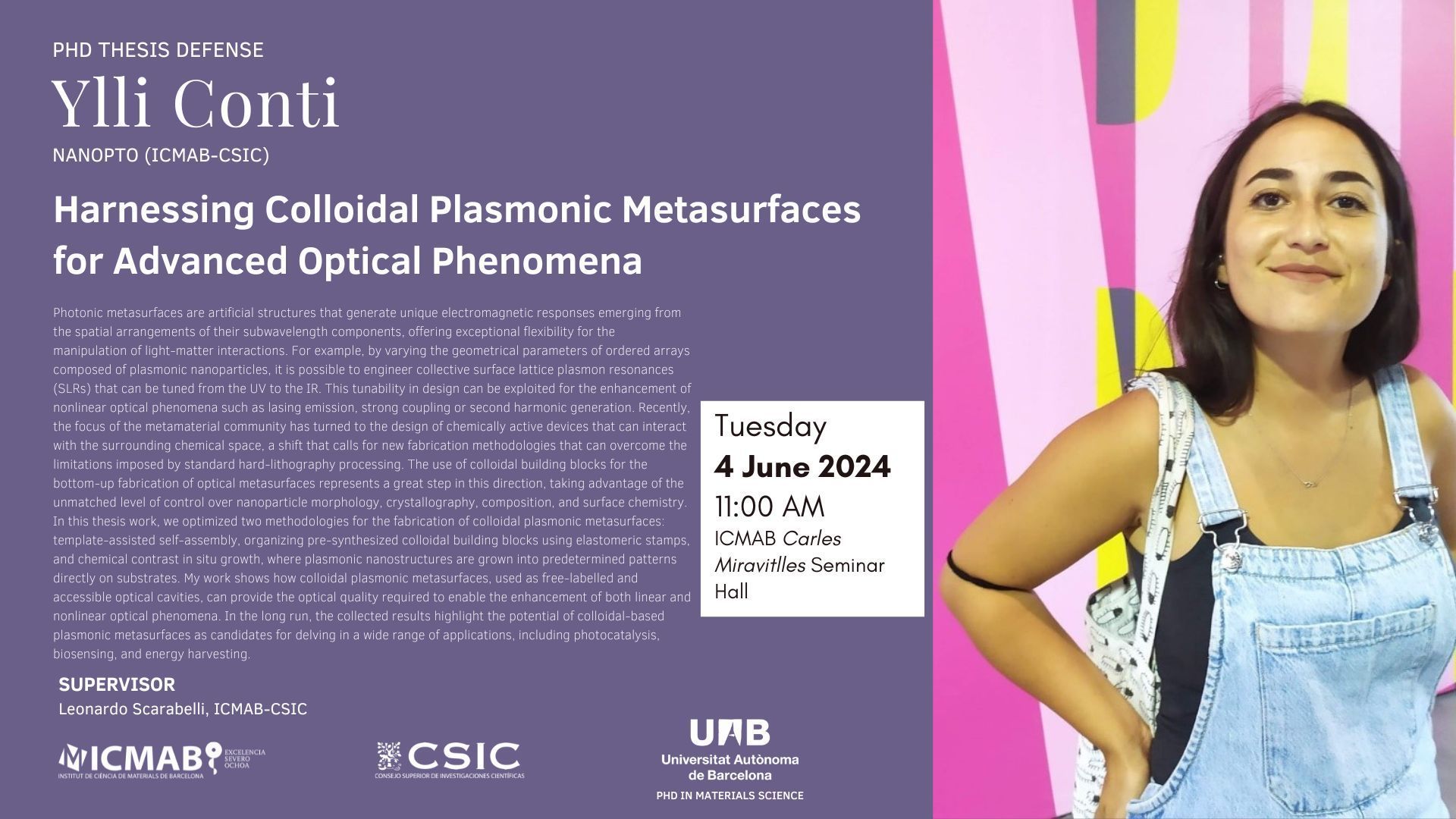
Harnessing Colloidal Plasmonic Metasurfaces for Advanced Optical Phenomena
Date: Tuesday, 4 June 2024
Time: 11AM
Venue: Institut de Ciència de Materials de Barcelona (ICMAB, CSIC) - Sala d'Actes Carles Miravitlles
Abstract:
Photonic metasurfaces are artificial structures that generate unique electromagnetic responses emerging from the spatial arrangements of their subwavelength components, offering exceptional flexibility for the manipulation of light-matter interactions. For example, by varying the geometrical parameters of ordered arrays composed of plasmonic nanoparticles, it is possible to engineer collective surface lattice plasmon resonances (SLRs) that can be tuned from the UV to the IR. This tunability in design can be exploited for the enhancement of nonlinear optical phenomena such as lasing emission, strong coupling or second harmonic generation. Recently, the focus of the metamaterial community has turned to the design of chemically active devices that can interact with the surrounding chemical space, a shift that calls for new fabrication methodologies that can overcome the limitations imposed by standard hard-lithography processing. The use of colloidal building blocks for the bottom-up fabrication of optical metasurfaces represents a great step in this direction, taking advantage of the unmatched level of control over nanoparticle morphology, crystallography, composition, and surface chemistry.
In this thesis work, we optimized two methodologies for the fabrication of colloidal plasmonic metasurfaces: template-assisted self-assembly, organizing pre-synthesized colloidal building blocks using elastomeric stamps, and chemical contrast in situ growth, where plasmonic nanostructures are grown into predetermined patterns directly on substrates. My work shows how colloidal plasmonic metasurfaces, used as free-labelled and accessible optical cavities, can provide the optical quality required to enable the enhancement of both linear and nonlinear optical phenomena. In the long run, the collected results highlight the potential of colloidal-based plasmonic metasurfaces as candidates for delving in a wide range of applications, including photocatalysis, biosensing, and energy harvesting.
Supervisor:
Leonardo Scarabelli
PhD comitee:
President: Prof. Lucia Curri, CNR-IPCF Bari Division, Università degli Studi di Bari Aldo Moro, Italy.
Secretary: Prof. Alejandro Rodolfo Goñi, Institut de Ciència de Materials de Barcelona (ICMAB-CSIC), Spain.
Vocal: Prof. Yuri Antonio Diaz Fernandez, InLAB, Università degli studi di Pavia, Italy.