


Margherita Hack
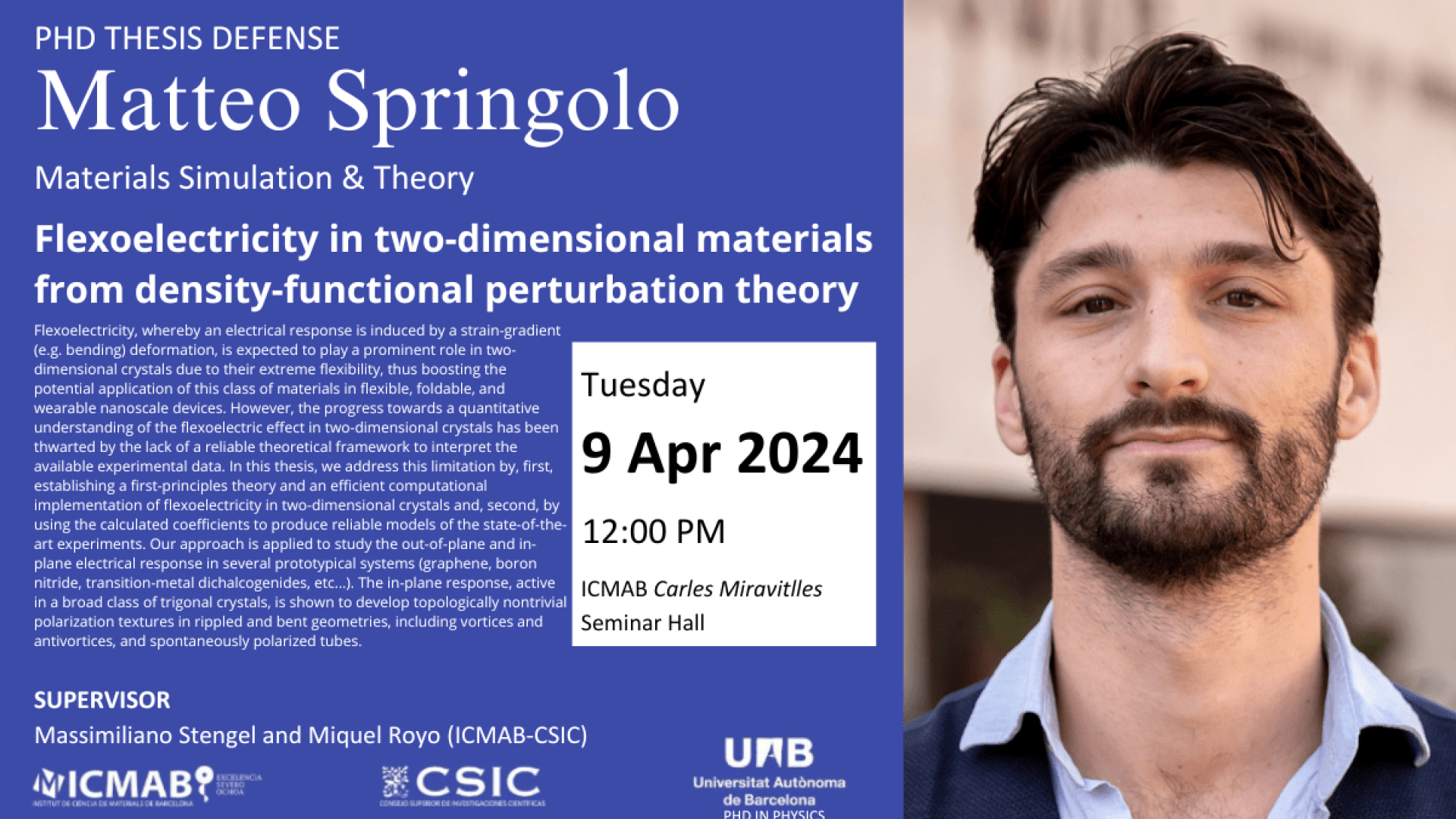
THESIS TITLE: Flexoelectricity in two-dimensional materials from density-functional perturbation theory
Matteo Springolo, Materials Simulation & Theory (MTS)
Date: Tuesday, 9 Apr 2024
Time: 12:00 PM
Venue: Institut de Ciència de Materials de Barcelona (ICMAB, CSIC) - Sala d'Actes Carles Miravitlles
Abstract:
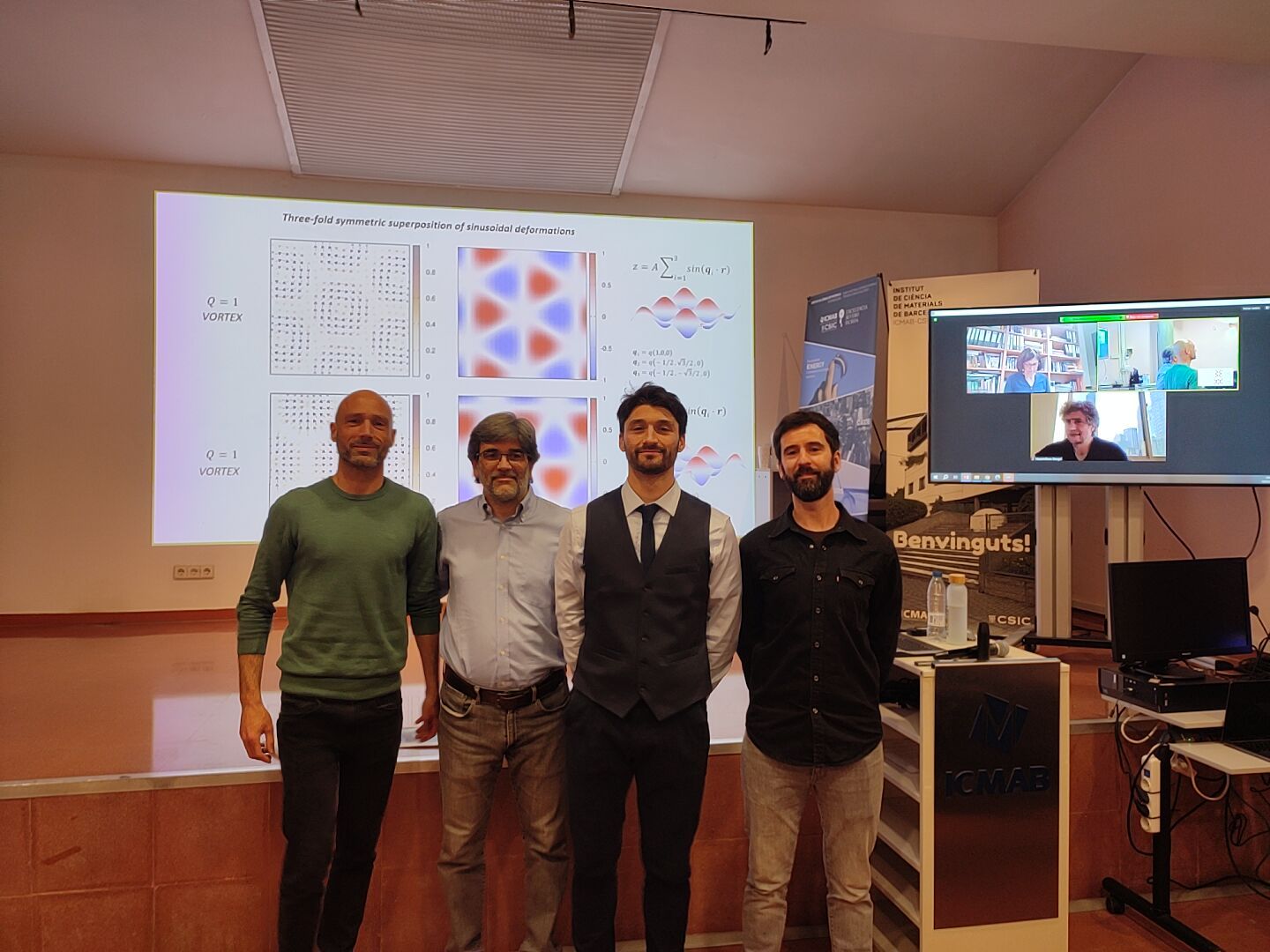
Flexoelectricity, whereby an electrical response is induced by a strain-gradient (e.g. bending) deformation, is expected to play a prominent role in two-dimensional crystals due to their extreme flexibility, thus boosting the potential application of this class of materials in flexible, foldable, and wearable nanoscale devices. However, the progress towards a quantitative understanding of the flexoelectric effect in two-dimensional crystals has been thwarted by the lack of a reliable theoretical framework to interpret the available experimental data. In this thesis, we address this limitation by, first, establishing a first-principles theory and an efficient computational implementation of flexoelectricity in two-dimensional crystals and, second, by using the calculated coefficients to produce reliable models of the state-of-the-art experiments. Our approach is applied to study the out-of-plane and in-plane electrical response in several prototypical systems (graphene, boron nitride, transition-metal dichalcogenides, etc...). The in-plane response, active in a broad class of trigonal crystals, is shown to develop topologically nontrivial polarization textures in rippled and bent geometries, including vortices and antivortices, and spontaneously polarized tubes.
Supervisors:
Massimiliano Stengel
Miquel Royo
PhD Committee:
President: Riccardo Rurali, ICMAB, Spain
Secretary: Claudio Cazorla, UPC, Spain
Vocal: Roser Valentí, Goethe University, Germany
