


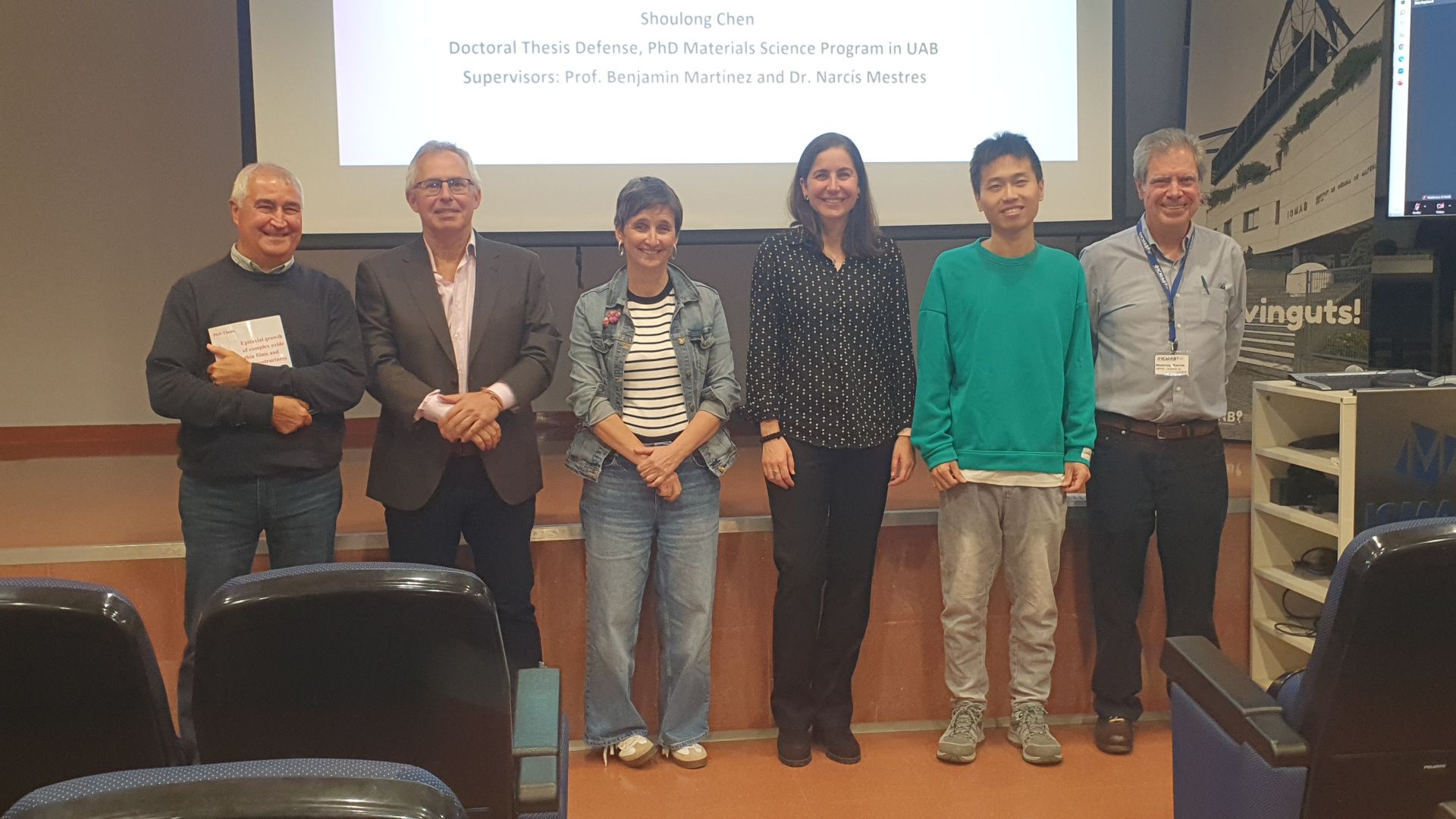
What was the focus of your PhD research? Can you explain it to a non-scientific audience?
My PhD focused on studying how spin currents travel through oxide materials. I worked on designing and understanding thin-film heterostructures to improve spin-based device performance.
Can you briefly summarize the main findings or contributions of your research? You can give us some examples.
I demonstrated how the atomic structure and crystal orientation of materials like NiO and LSMO affect the efficiency of spin transport. These findings help guide the design of low-power spintronic devices.
Why do you think your research is important, and how could it impact your field or society?
It contributes to developing energy-efficient electronics that use spins instead of electric charge, potentially reducing power consumption in future computing technologies.
What was one of the most challenging aspects of your PhD journey, and how did you overcome it?
Maintaining sample quality during complex thin-film growth was tough. I overcame it through persistence, optimization, and learning from failed experiments.
Why did you end up at ICMAB? And what do you think you will miss the most from this institute?
I joined ICMAB because of its strong expertise in functional oxides and excellent research facilities. I’ll miss the collaborative environment and the supportive people here.
What’s next for you after completing your PhD? Do you have any upcoming projects or goals?
After finishing my PhD, I’d like to take some time to recharge and carefully plan my future path.
How has completing this PhD changed you, either professionally or personally?
It has made me more patient, resilient, and confident in solving complex problems—both in research and in life.
What advice would you give to someone just starting their PhD journey?
Be curious, stay consistent, and don’t be afraid of failure—it’s part of the process.
Why did you become a scientist? Which have been your role models that inspired you to pursue a PhD?
I’ve always been fascinated by how materials behave at the atomic level. My mentors and the excitement of discovery inspired me to pursue a PhD.
Who or what helped you the most during your PhD journey, and is there anyone you'd like to thank?
I’m deeply grateful to my supervisors, colleagues, and family for their constant guidance, collaboration, and emotional support throughout this journey.
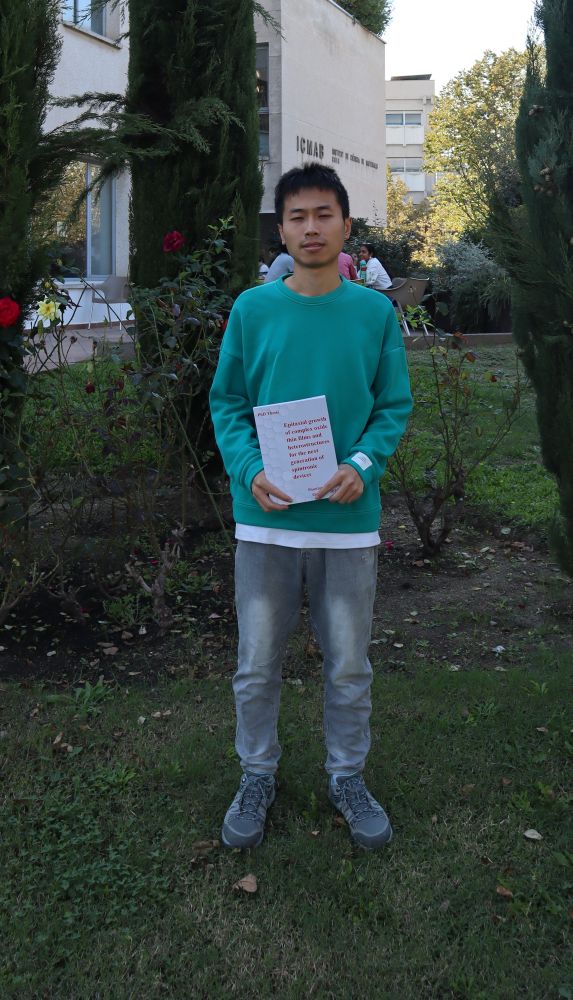
Shoulong Chen at ICMAB garden on the day of his thesis | ICMAB-CSIC
Abstract
My doctoral research focuses on spin transport in complex oxide heterostructures, particularly La₂/₃Sr₁/₃MnO₃/NiO/Pt trilayers grown on SrTiO₃ substrates. I systematically investigated the structural quality, interfacial coupling, and orientation-dependent spin transparency of epitaxial and polycrystalline NiO thin films. Spin pumping combined with inverse spin Hall effect detection revealed thickness- and temperature-dependent spin conduction, highlighting the crucial role of crystalline orientation in spin diffusion.
These experiments also clarified how interfacial conditions govern spin transparency across ferromagnet/antiferromagnet/normal-metal junctions. The findings provide fundamental insights into antiferromagnetic spin transport and interfacial engineering, offering design guidelines for efficient spintronic devices based on oxide heterostructures.
Supervisors
- Benjamín Martínez, ICMAB-CSIC, Spain
- Narcís Mestres, ICMAB-CSIC, Spain
PhD Committee
- President: Francisco Javier Palomares Simón, ICMM, Spain
- Secretary: Anna Palau, ICMAB-CSIC, Spain
- Vocal: Regina Galceran Vercher, UB, Spain
Read more
ICMAB - Shoulong Chen will defend his PhD thesis on 10 October 2025 at ICMAB
