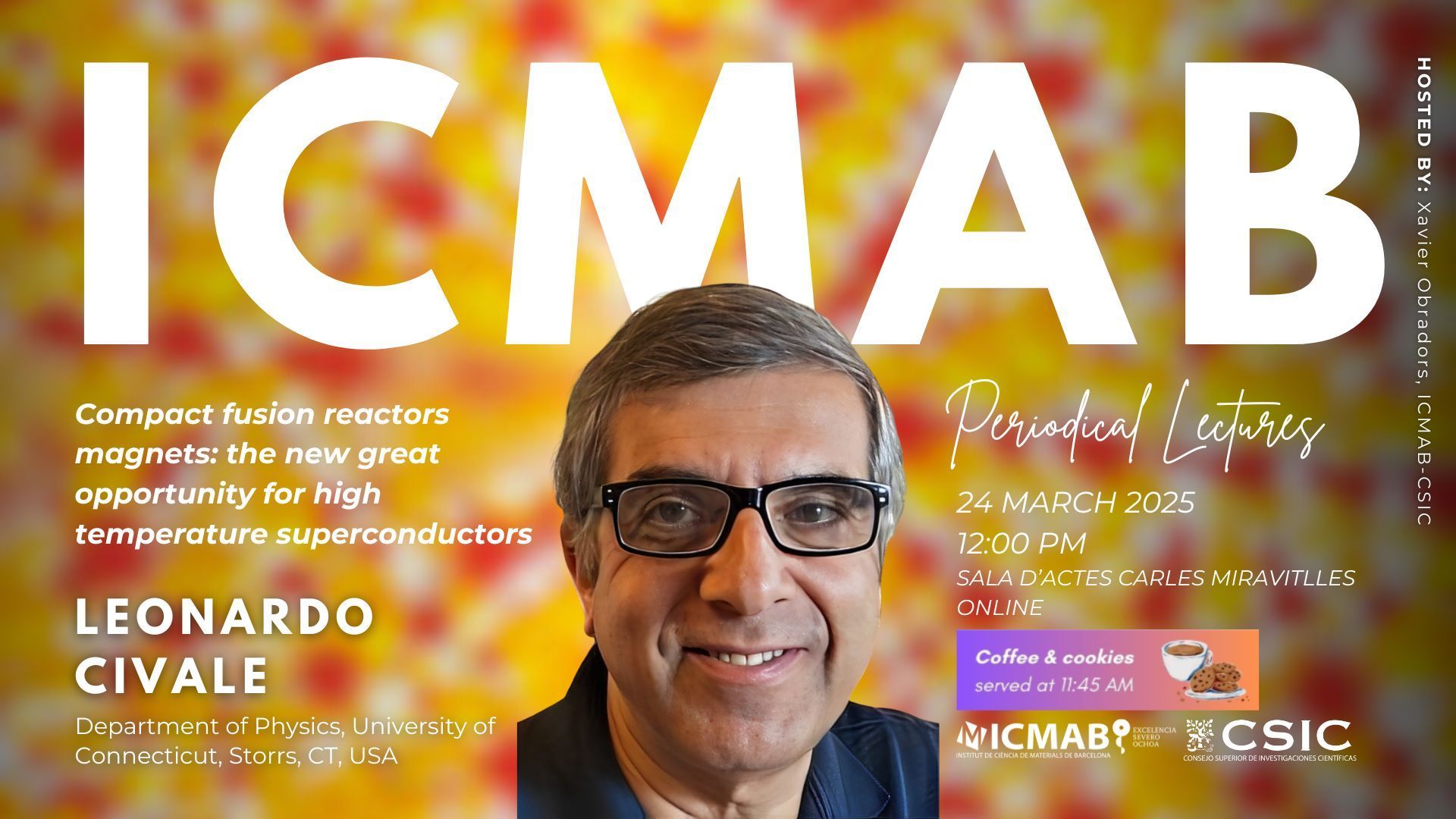
Compact fusion reactors magnets: the new great opportunity for high temperature superconductors
Leonardo Civale, Department of Physics, University of Connecticut, Storrs, CT, USA
Monday 24 March 2025, 12.00 PM*
ICMAB - Sala d'Actes Carles Miravitlles and ONLINE (Register here)
*Coffee and cookies by 11:45 AM
Abstract
We are approaching 40 years since the discovery of the cuprate high temperature superconductors (HTS), a remarkable scientific breakthrough that immediately generated the expectation that widespread revolutionary technological applications were just around the corner. Over time, it became clear that the enormous initial enthusiasm was excessive. Although several applications have been successfully developed, the huge markets failed to materialize, mainly due to factors not directly related to the properties of the HTS, which in fact continued to be strongly improved until today. The main technological milestone was the development, around the beginning of the century, of Coated Conductors (CC), based on HTS ReBa2Cu3O7 films grown on metal substrate tapes.
In this talk, I will focus on a new and potentially huge market opportunity that has recently appeared, namely the use of CC to fabricate the magnets for compact nuclear fusion reactors. The combination of requirements is ideally suited for them: operation at high magnetic fields (the power gain scales as B3) and high temperatures to simplify the cryogenics, and large critical current density (Jc). There is consensus that the properties of present CC are already good enough for this application, and as of today there are no credible competitors. There is, however, a caveat: the CC magnets must endure the radiation generated during the decades-long lifespan of the reactor. Obviously, the irradiation damage will eventually deteriorate the HTS films to the point that they will not be able to sustain the required Jc, but it must be kept in mind that some degree of material disorder (defects) is needed to produce vortex pinning, otherwise Jc would be zero.
Irradiation effects in cuprate HTS have been extensively investigated since their discovery. In the 1990’s, studies with a variety of irradiation particles over broad energy ranges contributed significantly to the understanding of vortex physics and pinning mechanisms in HTS, and in particular showed that Jc in clean YBa2Cu3O7 single crystals (with weak pre-irradiation pinning) could be increased by orders of magnitude. As the purpose was to enhance Jc, the physics underlying its decrease at high fluences was almost unexplored. The interpretation of irradiation results in CC is far more complex, because the pre-irradiation Jc’s are already very high due to the presence of large densities of strong pinning centers, including artificial pinning centers nanoengineered by incorporation of second phases. The interaction between irradiation-induced and pre-existing defects cannot be ignored, so the effects depend on the CC fabrication method and processing. Frequently, irradiation initially produces modest Jc increases at high fields, but deterioration from the start at low fields. An additional complication is that nobody knows exactly the details of the radiation that the magnets will receive, because that will depend on the reactor design. We need a focused effort to investigate irradiation effects in CC under conditions relevant to fusion reactors, particularly “in-operando” (at cryogenic temperatures while the magnet is on) and in the high fluence side of the Jc vs. fluence curve.
Short bio
Leonardo Civale is a Fellow of the American Physical Society. He has nearly 40 years of research experience in materials science and condensed matter physics, mostly on superconductivity, both on applied and basic science aspects. He completed undergraduate studies in Physics at the Univ. of Buenos Aires, Argentina (1983), and received his Ph.D. in Physics at the Instituto Balseiro, Bariloche, Argentina (1989). He was a postdoc at the IBM T. J. Watson Research Center (1989-1992) and spent short periods as visiting scientist at ORNL (1992) and several institutions in Europe (1993). He returned to Bariloche as professor (1993-2001), and in 1998 he became Head of the Low Temperature Group. In 2002 he joined Los Alamos National Laboratory (LANL) as Physics Team Leader of the Superconductivity Technology Center, whose goal was to develop Coated Conductors (CC), which are wires of High Temperature Superconductors (HTS), through a National Program of the DOE Office of Electricity. There, he worked in close collaboration with USA CC manufacturers (SuperPower, AMSC).
In 2020 he became Leader of the MPA-Quantum Group, until he retired in Dec. 2022. Leonardo’s research on critical current density (Jc) and vortex pinning in HTS has significantly contributed to shaping the topic. The study where he first showed that columnar defects created by heavy ion irradiation produced large Jc enhancements in YBa2Cu3O7 (L. Civale et al., PRL 67, 648 [1991]) has ~1550 citations. At LANL, he showed that BZO inclusions in CC produced strong Jc increases. Their publication (J.L. MacManus-Driscoll et al., Nat. Mat. 3, 439 [2004], ~1300 citations) triggered a flurry of research, with full conference sessions dedicated to second phases additions in HTS. His team performed the first study of a CC in pulsed magnetic field (M. Miura et al., Appl. Phys. Lett. 96, 072506 [2010]), (fields up to 65T), and the first study of Jc in pulsed field (M. Leroux et al., Phys. Rev. Appl. 11, 054005 [2019]). He has ~ 250 publications, > 14000 citations and h-index 56 (Google Scholar). Leonardo is now an Affiliate to the University of Connecticut at Storrs, CT, USA, and his main present research interests include the use of CC for fusion reactors and space applications.
Hosted by Xavier Obradors, from the Superconducting Materials and Functional Nanoengineered Structures group
>> If you want to meet the speaker, please contact the host, Xavier Obradors, at This email address is being protected from spambots. You need JavaScript enabled to view it..