


A new paper has been published in The Journal of Materials Chemistry C:
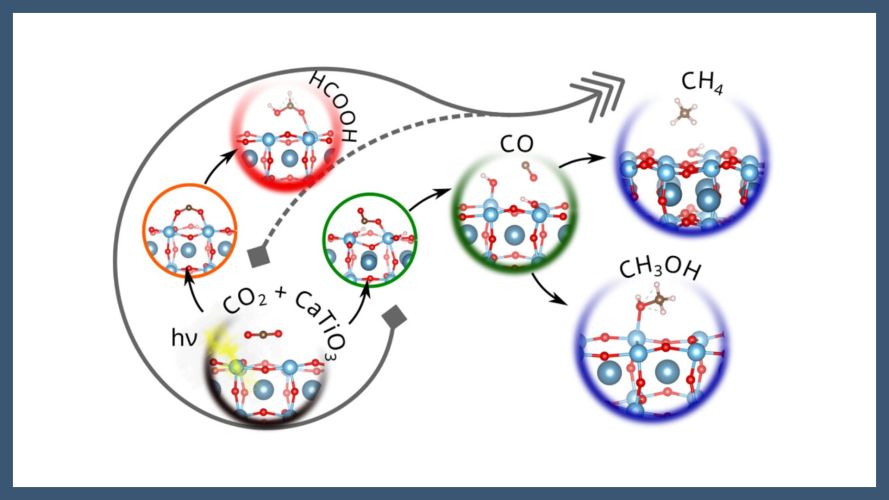
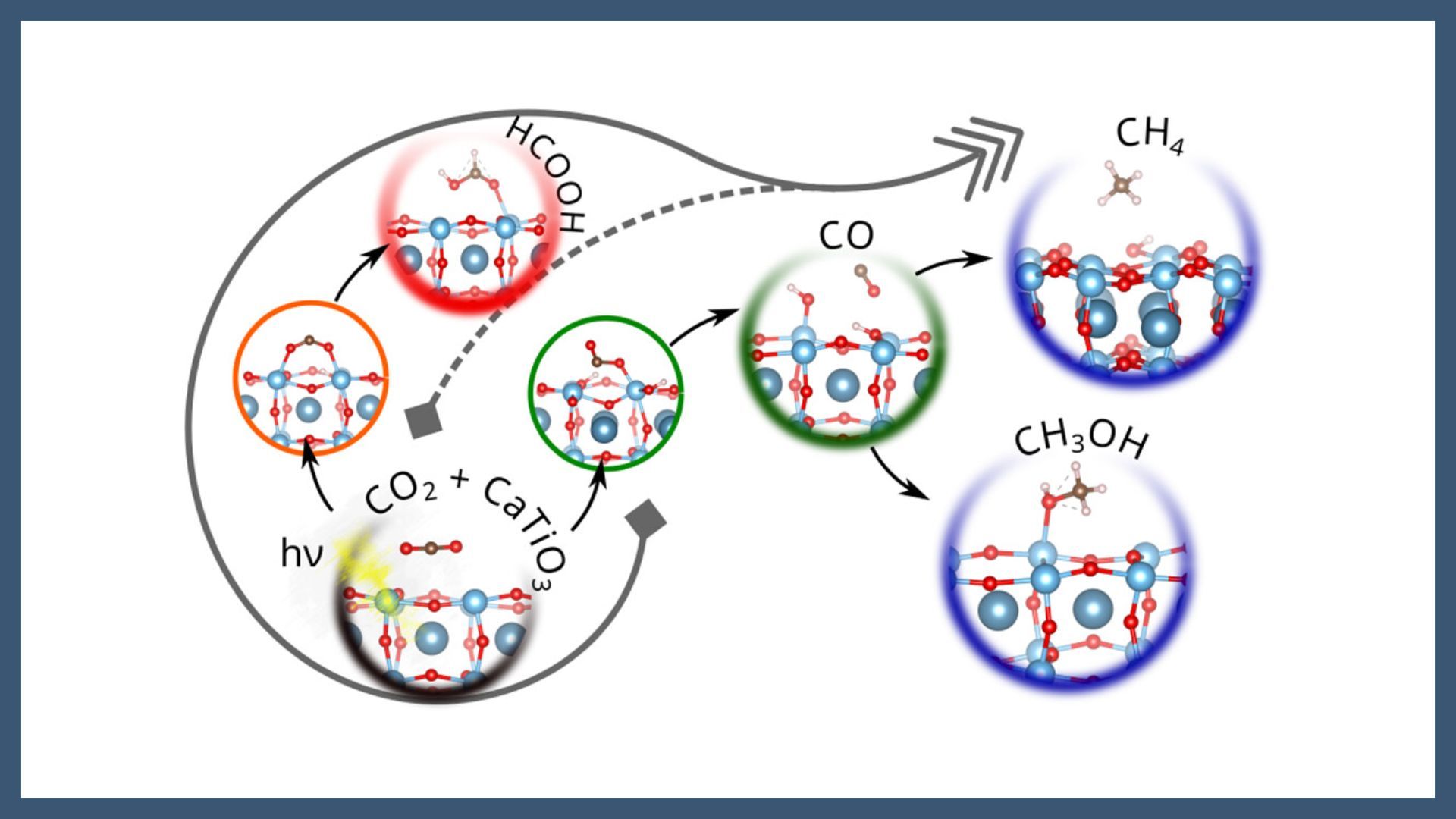
Photoreduction is an important approach aimed at reducing the CO2 atmospheric content, which is responsible for global warming. The development of an efficient photocatalyst can strongly improve the efficiency and selectivity of the byproducts of such a process. Recently, CaTiO3 has been used as an alternative semiconductor catalyst due to its attractive properties. In this study, we present first-principles electronic structure calculations to investigate the general reaction mechanism that leads to the main value-added HCOOH, CO, CH3OH, and CH4 byproducts, focusing on the reactions of the adsorption, activation, and reduction reactions of molecules on the TiO2-terminated CaTiO3 (100). Our results show that CO2 can be activated by charge transfer of excess electrons, leading to a CO2·– anion that can give the formate (HCOO–) intermediate by first reduction. However, the second hydrogenation leading to HCOOH is impeded by the prohibitive energy barrier; in particular, activated CO2 can also easily undergo decomposition, which facilitates CO production. Afterward, we discuss the possible reaction mechanisms of CO photoreduction toward CH3OH and CH4 value-added products, taking into account the experimental evidence that only CO and CH4 have been detected. The reaction pathway generally follows the most energetically convenient routes characterized by activated intermediates. Although CH3OH could finally be produced, its strong adsorption and promoted decomposition to CH3O + H on the surface could explain why it has not been detected, compared to the more volatile CH4 molecule, ascribed by its nonpolar nature.
M4NRG Clean Energy
CO2 Adsorption and Photocatalytic Reduction Mechanisms on TiO2-Terminated CaTiO3(100): A Density Functional Theory Study
Tau, Onofrio; Giorgi, Giacomo; Rurali, Riccardo
DOI: 10.1021/acs.jpcc.5c04650

