


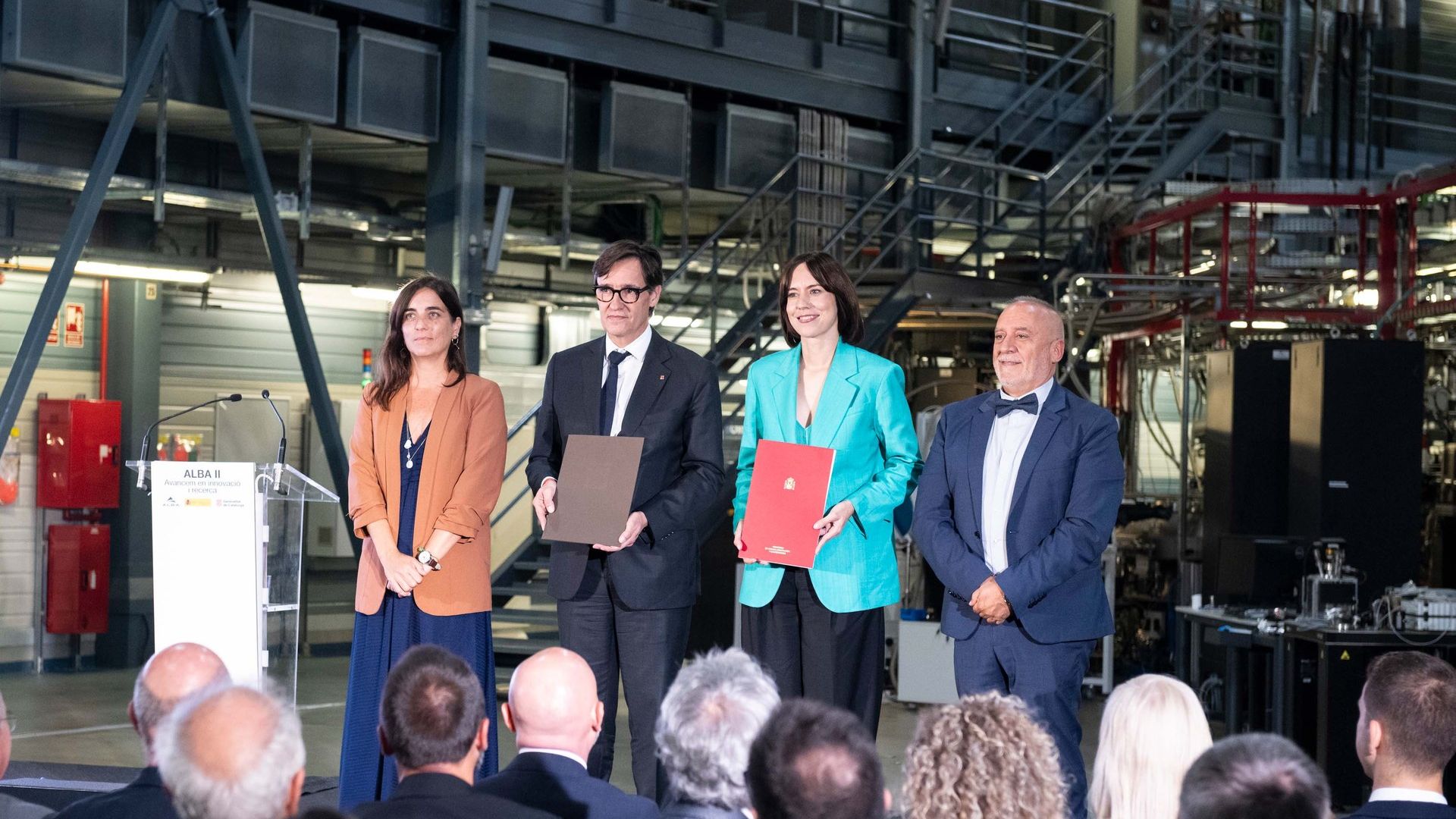
The budget approved by the Spanish Government and the Generalitat de Catalunya for the next 14 years is €926.2 million, funded 50 % by each government, and includes investments, operations and personnel. €170 million (18%) are devoted entirely to the ALBA II upgrade project. This new investment takes advantage of almost all of the previous investment in ALBA and increases its economic and societal return. The cost-benefit analysis has shown that each euro invested in ALBA II generates an annual social return of 1.5 euros.
The event, which took place on Tuesday, 9 September 2025, was presided by the President of the Generalitat de Catalunya, Salvador Illa; the Minister of Science, Innovation and Universities, Diana Morant; and the Catalan Minister for Research and Universities, Núria Montserrat; among others.
Before signing the agreement, the delegation made a tour around ALBA. The director, Caterina Biscari, guided the group through the upcoming changes under the ALBA II project, highlighting its impact on the resolution, speed, and detection capabilities of synchrotron light-based experiments.
The visit included a visit to 3Sbar beamline, the 14th beamline currently under construction and the first one to be developed as part of ALBA II. 3Sbar will focus on chemical and catalytic studies with applications in environmental and sustainable technologies.
The visit ended in BOREAS, a beamline dedicated to the study of magnetic properties of advanced materials. There, attendees had the opportunity to speak with researchers from Johannes Kepler University (Austria), who are currently using the facility for spintronics-based material analysis.
ALBA II: a new era for science
Currently ALBA is a 3rd generation synchrotron facility. It has thirteen beamlines and one microscopy platform that allow us to visualize the structure and properties of matter. Its advanced technology, detectors and data infrastructures are used every year by more than 3,500 researchers in fields as wide as the biomedicine, nanotechnology, chemistry, material physics or energy.
With ALBA II, the ALBA Synchrotron will become a fourth generation facility, aligned with the technological advances of the world's leading synchrotrons. This evolution represents a significant technological leap, which will dramatically reduce the size of the beam, increasing its accuracy and analytical capacity. The facility will go a step further, pushing the boundaries of what synchrotron science can achieve.
This technological transformation is essential to ensure that ALBA will keep at the forefront of European and global research in the coming years, consolidating its role in research and innovation. The investment will upgrade the accelerator and build new beamlines, that will make possible more precise and faster studies, expanding the range of scientific and industrial applications. Two of these new beamlines will be extra long (200-250 m) and their experimental stations will be located outside the current building. One will be dedicated to life sciences and the other to the study of advanced materials.
The ALBA II upgrade project will also renovate existing beamlines, including the relocation of one of them, expanding the data infrastructure and new buildings and additional laboratories.
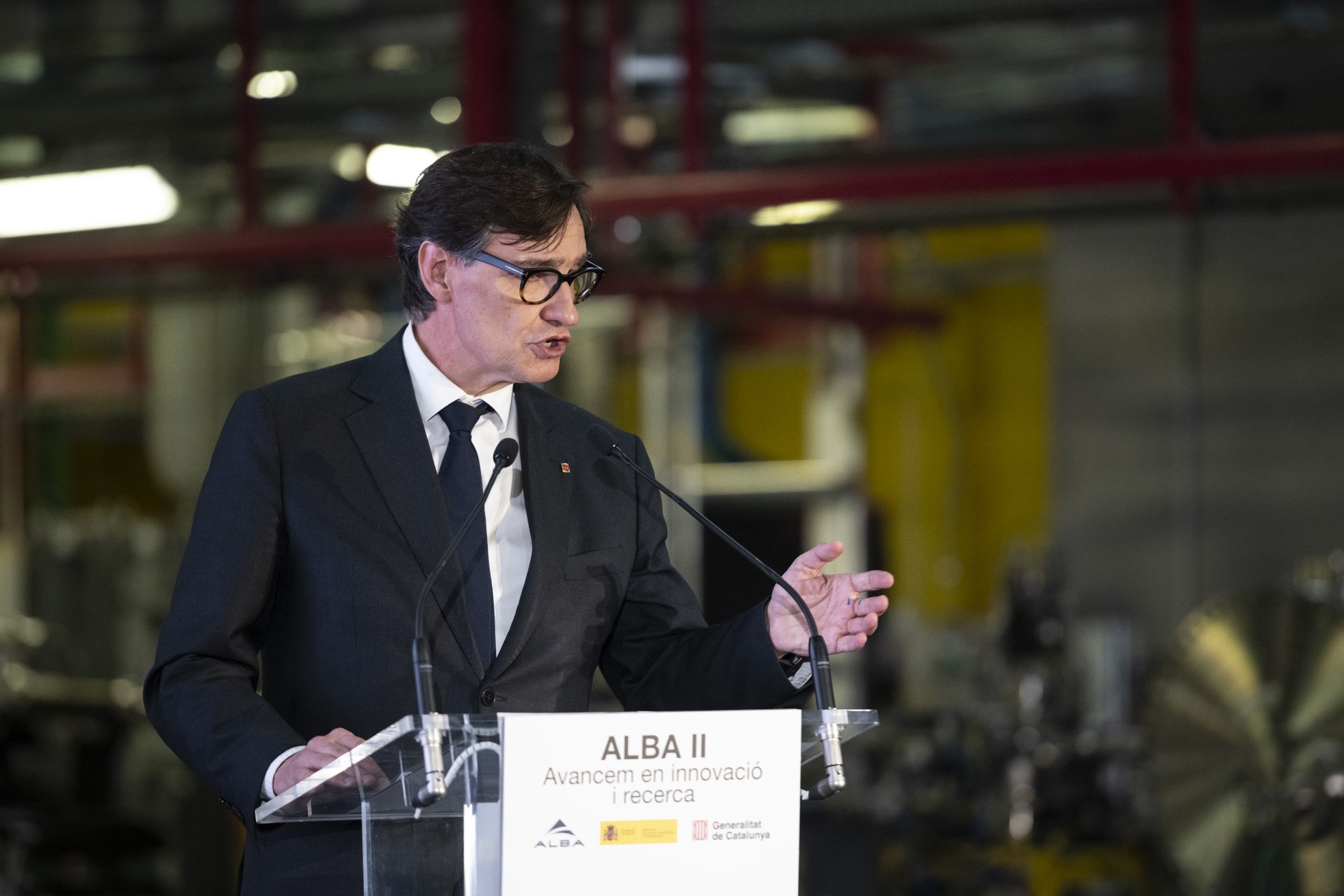 Salvador Illa highlighted that this agreement is an example of the country's project: stable, ambitious, collaborative and putting the economy, innovation and knowledge at the service of citizens. ALBA
ICMAB participation at ALBA II
ICMAB has been collaborating with ALBA Synchrotron since its very beginnings: among the first user experiments at ALBA in 2012 were members of ICMAB’s SUMAN group, who participated in experiments at the BOREAS beamline. Over the years, more than 20 % of ALBA’s publications in certain years have involved ICMAB researchers, proving a long-standing, fruitful partnership.
Following this path, ICMAB has also been actively involved in the creation of ALBA II and will continue to collaborate in its development — for example, through the design of the new CoDI beamline, with the participation of ICMAB researcher Carlos Frontera, and through joint ongoing projects InCAEM and JEMCA, and collaborations within the CSIC PTI TransEner, which has enabled the Energy Transition Joint Lab CSIC-ALBA.
CoDI beamline: Coherent Diffraction Imaging
ICMAB researcher Carlos Frontera is part of the team which has developed the development of a scientific case (a list of research areas or topics in which the construction of the proposed beamline should have a considerable impact). One of the applications of the beamline is in thin oxide films. Frontera's proposal was twofold: first, to point out to the people involved the possibility of using the beamline for diffraction on thin films and the potential advantages of using coherent diffraction in this field; and second, to gather information from nearby research groups (mainly, in ICMAB and ICN2) in order to build a scientific case representative of the community working in this area.
The beamline is called CoDI (Coherent Diffraction Imaging). Coherent diffraction requires X-ray beams with very high coherence, which means the wave reaching the sample must have very well-defined wavefronts. The degree of coherence required can only be achieved in diffraction beamlines where the source and the sample are separated by a large distance. For this reason, the beamline is designed to be 250 meters long, with a 20-meter gap between the sample and the detectors. The need to build them in third-generation synchrotrons stems from the fact that these facilities make it much easier to harness the radiation generated at the source, and they naturally provide greater coherence—essential for this technique.
In addition to diffraction, using ptychography and holo-tomography, the beamline should be possible to reconstruct images of nanoparticles and nanodevices with a resolution on the order of 10 nm (in a non-destructive manner), including strain and composition maps.
According to Frontera: "The beamline represents an enormous technological challenge. The techniques that will be implemented are very advanced, the data generation is extraordinary (500 TB/day), and its processing is highly complex. The techniques it will support should help address very important current technological challenges in the aforementioned fields, as well as serve as an incentive for new researchers to train in the technique of coherent diffraction. ALBA has always shown a constant spirit of improvement and innovation throughout its history. ALBA II takes this ambition even further. CoDI is fully aligned with this vision".
InCAEM: In Situ Correlative Facility for Advanced Energy Materials
InCAEM, In Situ Correlative Facility for Advanced Energy Materials, is a new facility, now in construction at the ALBA Synchrotron premises, open to all the scientific community for studying advanced materials. It is funded by the Ministry of Science and Innovation and the Generalitat de Catalunya through the Planes Complementarios programme, which includes NextGenerationEU funds. It is coordinated by the ALBA Synchrotron with the involvement of the following partners: the Catalan Institute of Nanoscience and Nanotechnology (ICN2), the Institute for Materials Science of Barcelona (ICMAB-CSIC), the Institute for High Energy Physics (IFAE) - Scientific Information Port (PIC, UAB).
JEMCA: Joint Electron Microscopy Center
The Joint Electron Microscopy Center at ALBA (JEMCA) was created thanks to the collaboration of different research entities to launch a new centre within the ALBA Synchrotron building offering electron microscope services to the scientific community. In specific, eight different partners will be using this centre: the Institute for Molecular Biology of Barcelona (IBMB-CSIC), the Catalan Institute for Nanoscienc and Nanotechnology (ICN2), the Institute for Biomedical Research (IRB Barcelona), the Centre for Genome Regulation (CRG), the Institute for Materials Science of Barcelona (ICMAB-CSIC), the Spanish National Research Council (CSIC), the Universitat Autònoma de Barcelona (UAB), and the ALBA Synchrotron. The project definition phase also included the fundamental support of the Barcelona Institute of Science and Technology (BIST).
This is the only facility in all of Spain that allows working with tools that are complementary to the synchrotron light source with the aim of gathering more information in the field of structural biology and materials science.
Energy Transition Joint Lab
Within the CSIC PTI TransEner, we can mention the collaboration between ALBA and the ICMAB Research Groups SUMAN (Superconducting Materials) and SSC (Solid State Chemistry) in the creation of the Energy Transition Joint Lab CSIC-ALBA.
The new laboratory focuses on developing greener energy solutions in two main areas: advanced batteries and superconducting tapes. In the battery area, researchers can assemble and test cells under operando conditions using synchrotron-based techniques to optimize performance. In parallel, the superconducting area enables high-throughput growth of superconducting tapes using ICMAB-CSIC’s TLAG method, with in situ experiments at ALBA Synchrotron to improve efficiency, reduce costs, and foster industrial collaborations.
Read more
- Agreement to secure the funding for the ALBA Synchrotron upgrade - ALBA Synchrotron
- A Fourth Generation Synchrotron will place Catalonia and Spain at the Forefront of Research - ICN2
- ICMAB - The InCAEM project is presented to the Catalan scientific community
- ICMAB - New electron microscope centre to advance in research into structural biology and new materials
- ICMAB - Test bench at ALBA Synchrotron for green energy applications within the CSIC PTI+ TransEner
