


![Water-soluble dendrimer probe with magnetic and fluorescent properties for MRI/FI [ACS Publications]](/templates/yootheme/cache/72/non-linear-organiddendrimers-nffa-72a26873.png)
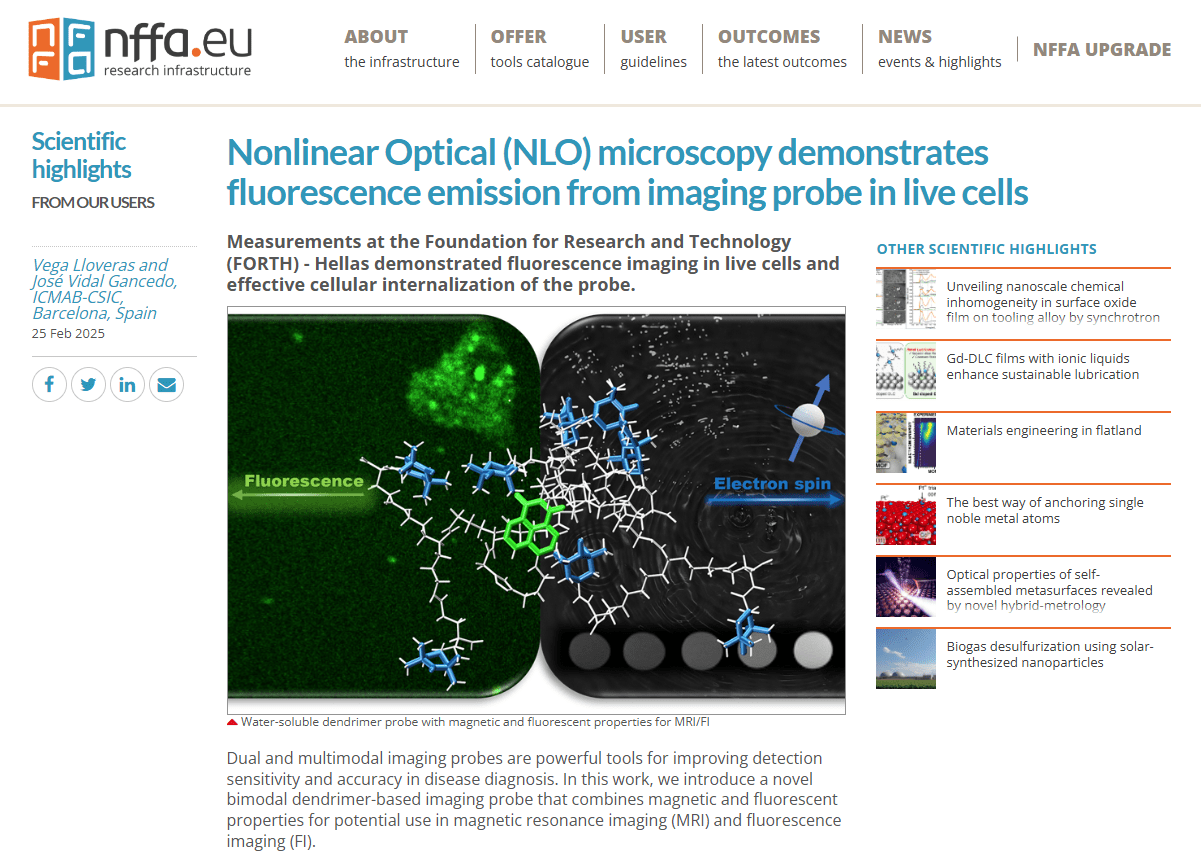
ICMAB researchers, in collaboration with researchers from the Universidad de Málaga and Foundation for Research and Technology (FORTH), have successfully demonstrated the fluorescence emission of a novel bimodal dendrimer-based imaging probe in live cells, marking a significant advancement in biomedical imaging.
This water-soluble dendrimer-based probe, designed for both magnetic resonance imaging (MRI) and fluorescence imaging (FI), utilizes organic radicals instead of conventional metal-based contrast agents (such as gadolinium (Gd3+)-chelates), reducing potential toxicity. Its efficient cellular internalization and fluorescence properties were confirmed using nonlinear optical (NLO) microscopy, offering promising applications for improved disease diagnosis.
The study, carried out with the participation of ICMAB researchers Yufei Wu, Vega Lloveras and José Vidal Gancedo from the Nanomol-Bio group, highlights the potential of organic radical-based probes in biomedical research. Their work emphasizes the importance of alternative, metal-free contrast agents that can enhance imaging techniques while ensuring biocompatibility. The research provides new insights into the structure-function relationships of these probes, combining experimental results with molecular dynamics simulations.
These experiments were conducted at the Foundation for Research and Technology (FORTH) - Hellas, in Greece, using advanced facilities provided by the NFFA-Europe project. The access to cutting-edge microscopy techniques and research infrastructure was instrumental in achieving these results. The researchers express their gratitude to NFFA-Europe for supporting this study and facilitating international scientific collaboration.
>> Read the full article on the NFFA-Europe website: Nonlinear Optical (NLO) microscopy demonstrates fluorescence emission from imaging probe in live cells
 Article in the NFFA-Europe website
The findings of this study have been published in ACS Applied Materials & Interfaces, a renowned journal covering interdisciplinary research in materials science and engineering. The article details the design, synthesis, and characterization of the bimodal dendrimer-based imaging probe, along with its successful application in live-cell imaging. This publication underscores the significance of organic radical-based probes as promising alternatives for biomedical imaging and highlights the collaborative efforts that made this research possible.
Reference article:
Water-Soluble Bimodal Magnetic-Fluorescent Radical Dendrimers as Potential MRI-FI Imaging Probes
Yufei Wu, Vega Lloveras,* Anjara Morgado, Ezequiel Perez-Inestrosa, Eleftheria Babaliari, Sotiris Psilodimitrakopoulos, Yolanda Vida, and José Vidal-Gancedo*.
ACS Applied Materials & Interfaces 2024 16 (47), 65295-65306
DOI: 10.1021/acsami.4c13578
About NFFA-Europe
NFFA-Europe is a pan-European research infrastructure that integrates nanofoundries with advanced characterization and fine analysis facilities, offering researchers access to a comprehensive suite of tools and techniques for cutting-edge nanoscience research.
By participating in NFFA-Europe, the Institute of Materials Science of Barcelona (ICMAB) enhances its research capabilities by accessing a broad array of state-of-the-art facilities and collaborating with leading institutions across Europe. This collaboration facilitates the development of innovative nanomaterials and devices, strengthens ICMAB's position in the global scientific community, and contributes to the advancement of nanoscience and nanotechnology.
If you have any doubts about the project, please contact our Strategic Projects Unit - Head of Unit Laura Cabana (